CDL Road Test in 2026: Turns, Lane Changes, and Safe Driving Skills
Learn what the CDL on-road skills test evaluates, how to practice turns, intersections, lane changes, speed and space management, and what can cause an automatic failure.
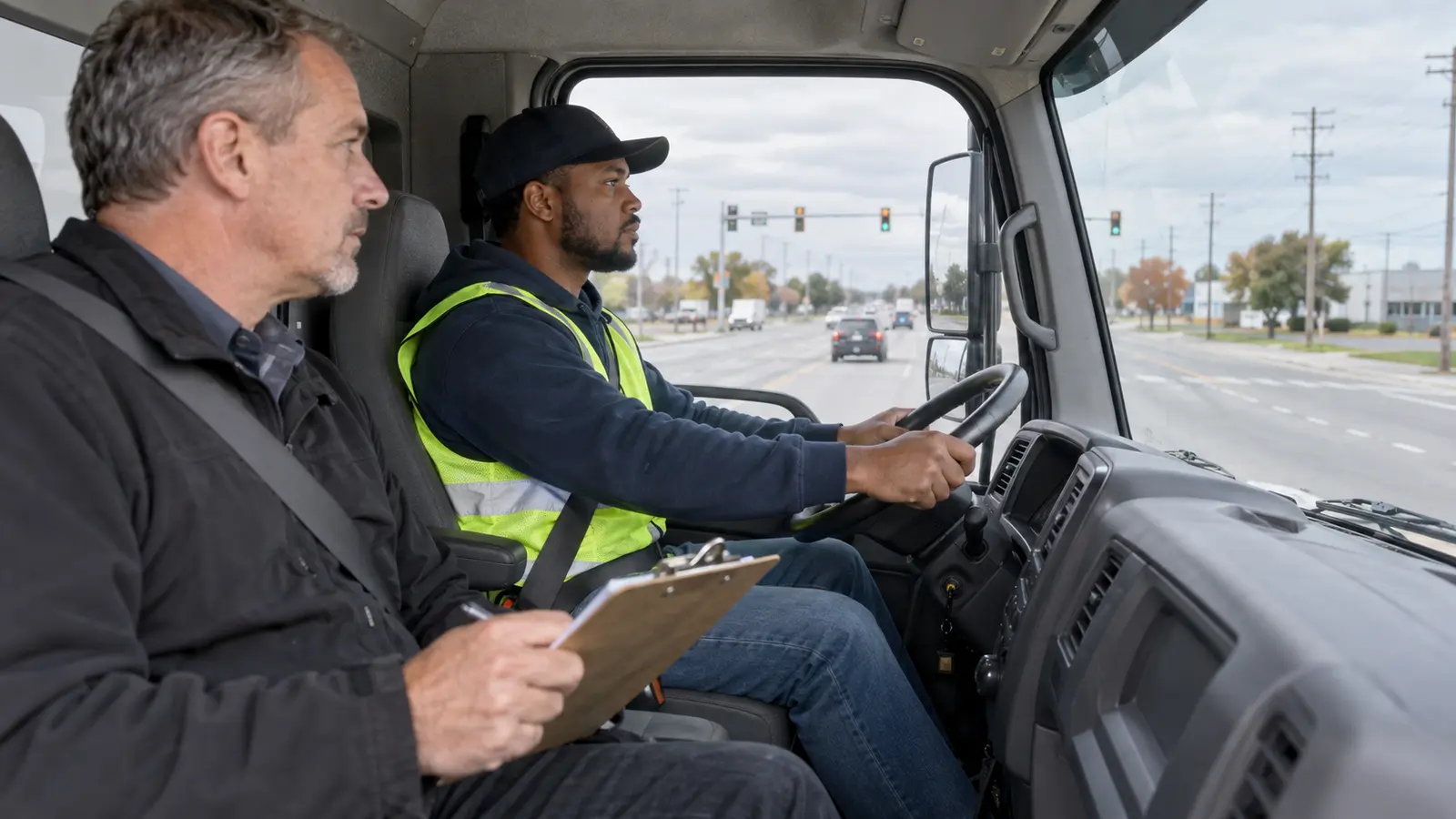
The on-road test is the final segment of the CDL skills test, but it is not simply a drive around the block. The examiner is watching whether you consistently control a commercial motor vehicle, identify changing hazards, communicate with other road users, and make safe decisions without coaching.
Federal rules define the skills every applicant must demonstrate, while the State testing agency selects the route and follows standardized examiner instructions. Your exact streets, traffic, grades, and maneuvers can vary. Prepare for the driving habits being evaluated rather than trying to memorize one rumored test route.
The road test is the third skills-test segment
Under 49 CFR §383.133, the skills test must be completed in order: vehicle inspection, basic vehicle control, then on-road skills. If you fail a segment, you cannot continue to the next one that day. Passed segment scores remain valid only during the initial issuance of that commercial learner's permit; if the CLP is renewed, federal rules require all three segments to be taken again.
Before the State may administer a Class A or Class B skills test to a driver covered by ELDT, required theory and behind-the-wheel completion must be available through the Training Provider Registry. Confirm the record, the CLP holding period, appointment rules, and required documents before test day.
What federal rules require you to demonstrate
Section 383.113 identifies eight core on-road abilities: proper visual search, appropriate signaling, speed adjustment, safe gap selection, correct turning position, safe following distance, adjustment to weather, and observation of the road and other vehicles before changing speed or direction. Testing must include on-street conditions, even if some skills are also evaluated off street.
Think of these abilities as a connected system. A lane change is not just moving the wheel; it begins with seeing the traffic situation, checking mirrors, choosing a usable gap, signaling, controlling speed, moving smoothly, and rechecking the vehicle's position. Examiners look for repeatable safe behavior across the route.
Build a visible search routine
Commercial vehicles have large blind areas and need more planning distance. Scan far enough ahead to notice signals, traffic queues, changing speed limits, work zones, pedestrians, clearance signs, railroad crossings, and vehicles that may enter your path. Move your attention between the road ahead, side areas, and mirrors instead of staring at one point.
Make mirror checks clear but natural. Check before changing speed or direction, before and during turns, after completing a turn, and regularly while traveling straight. Do not exaggerate head movement so much that you lose the forward view. Your practice instructor should be able to identify where you are looking and why.
Approach intersections early and under control
Read the intersection before reaching it. Identify the traffic control, lane assignment, crosswalk, pedestrians, overhead clearance, turning traffic, and available stopping distance. Reduce speed smoothly and select the proper gear before the maneuver. Stop behind the legal line or crosswalk and avoid creeping into a space that blocks pedestrians or cross traffic.
When the way is open, continue scanning through the intersection. Do not enter unless the truck can clear it without becoming trapped in cross traffic. On an uncontrolled approach, reduce speed enough to evaluate hazards. A green signal gives permission to proceed, not permission to stop observing.
Make left and right turns without creating a new hazard
Set up in the correct lane, signal early enough to communicate, and control speed before steering. Watch the front corner, rear wheels, mirrors, curb, signs, poles, pedestrians, cyclists, and vehicles that may attempt to pass on the turning side. Account for off-tracking, but do not swing unnecessarily into another lane.
For a right turn, keep the rear of the vehicle from climbing the curb while protecting the right side from traffic entering the gap. For a left turn, remain in the proper approach lane and finish in the correct available lane under State rules. If space is tight, slow down and use deliberate steering rather than rushing to hide an imperfect setup.
Treat every lane change as a complete procedure
Change lanes only when it is necessary or the examiner directs you and it is legal to do so. First assess traffic ahead and behind, check the appropriate mirrors and blind area, signal, choose a gap large enough for the entire vehicle, and adjust speed without forcing another driver to brake. Move gradually and maintain control of the trailer or rear body.
After crossing the lane line, center the vehicle, cancel the signal, and confirm the new space around you. Never follow an instruction into an unsafe or prohibited move. If the requested lane change cannot be made safely, continue controlling the vehicle and tell the examiner you are waiting for a safe opportunity.
Manage speed, following distance, and gears together
Driving at the posted maximum is not always safe. Federal standards require speed to reflect roadway design, weather, visibility, traffic, vehicle condition, cargo, and driver conditions. Enter curves and ramps at a controllable speed, create extra space when sight distance or traction is reduced, and avoid abrupt braking that transfers weight sharply.
Maintain enough following distance to see developing hazards and stop smoothly. With a manual transmission, choose a gear that matches speed and conditions, complete necessary shifting without coasting, and keep the vehicle under power and control. In any transmission, avoid unnecessary acceleration toward a red light or stopped queue.
Know what can end the test
Section 383.135 requires an automatic failure when an applicant disobeys traffic laws, causes a crash, or commits another automatic-failure offense identified in the approved driver and examiner manuals. Dangerous action, examiner intervention, striking an object, running a signal, or losing control should never be treated as a small point deduction.
States use standardized scoring and instructions, but applicants generally do not receive the confidential examiner script or a promise that one specific number of minor mistakes is acceptable. Use the current manual from your licensing State and ask the testing agency about its retest policy. Train to eliminate unsafe patterns instead of trying to calculate how many errors you can afford.
Use a representative vehicle and understand restrictions
The test vehicle must represent the CDL group being sought, and federal rules use its GVWR or GCWR rather than its current scale weight for that determination. It must be properly registered, insured, safe, and permitted by the State testing agency. Practice in that vehicle or one with similar dimensions, mirrors, controls, brakes, and handling.
Equipment choice affects the resulting license. Testing in an automatic can create an E manual-transmission restriction; testing without air brakes can create L; air-over-hydraulic brakes can create Z. A Class A test with a non-fifth-wheel connection can create O. Verify the vehicle before paying a rental fee or arriving at the test site.
Practice with feedback, not just mileage
Build sessions around measurable behaviors. Have a qualified instructor record missed mirror checks, late signals, poor lane position, wide or tight turns, excessive approach speed, rough stops, weak gap selection, and missed signs. Repeat the same skill in different traffic and roadway conditions until the safe sequence is automatic.
Practice listening to short directions while continuing to drive safely. Federal rules prohibit interpreters during the skills test, and the applicant must understand and respond to the examiner's verbal instructions in English. If a direction is unclear, ask for it to be repeated; do not guess, make an abrupt move, or let the question distract you from traffic.
A practical test-day checklist
Bring the CLP, medical documentation when required, appointment confirmation, and every document your State lists. Arrive early enough to inspect the vehicle, adjust the seat and mirrors, fasten the belt, locate controls, and settle into a consistent routine. Confirm that lights, signals, brakes, windows, mirrors, tires, plates, registration, and proof of insurance meet local test requirements.
During the drive, keep making safe decisions after a minor mistake. One rough shift or imperfect turn does not justify rushing the next maneuver. Listen, scan, signal, position, control speed, and leave space. When the route ends, secure the vehicle exactly as instructed and review the result calmly so any retest preparation is specific.
Prepare for safe operation beyond the test route
The road test measures minimum licensing skills in a short sample. A first job may add unfamiliar trailers, delivery sites, mountain grades, dense traffic, night driving, weather, passengers, or company procedures. Keep practicing after licensure with supervision and equipment-specific training rather than treating the test as the finish line.
If you are pursuing your first Class A or Class B CDL, complete the applicable CDL Compass online ELDT theory course and coordinate hands-on instruction with a registered provider. Use your State's current CDL manual for local procedures, then prepare the inspection, control, and on-road segments as one connected safety system.