CDL Basic Control Skills Test in 2026: Backing Maneuvers and Test-Day Preparation
Learn what the CDL basic control skills test measures, why state exercises differ, and how to practice backing, boundaries, and vehicle control for test day.
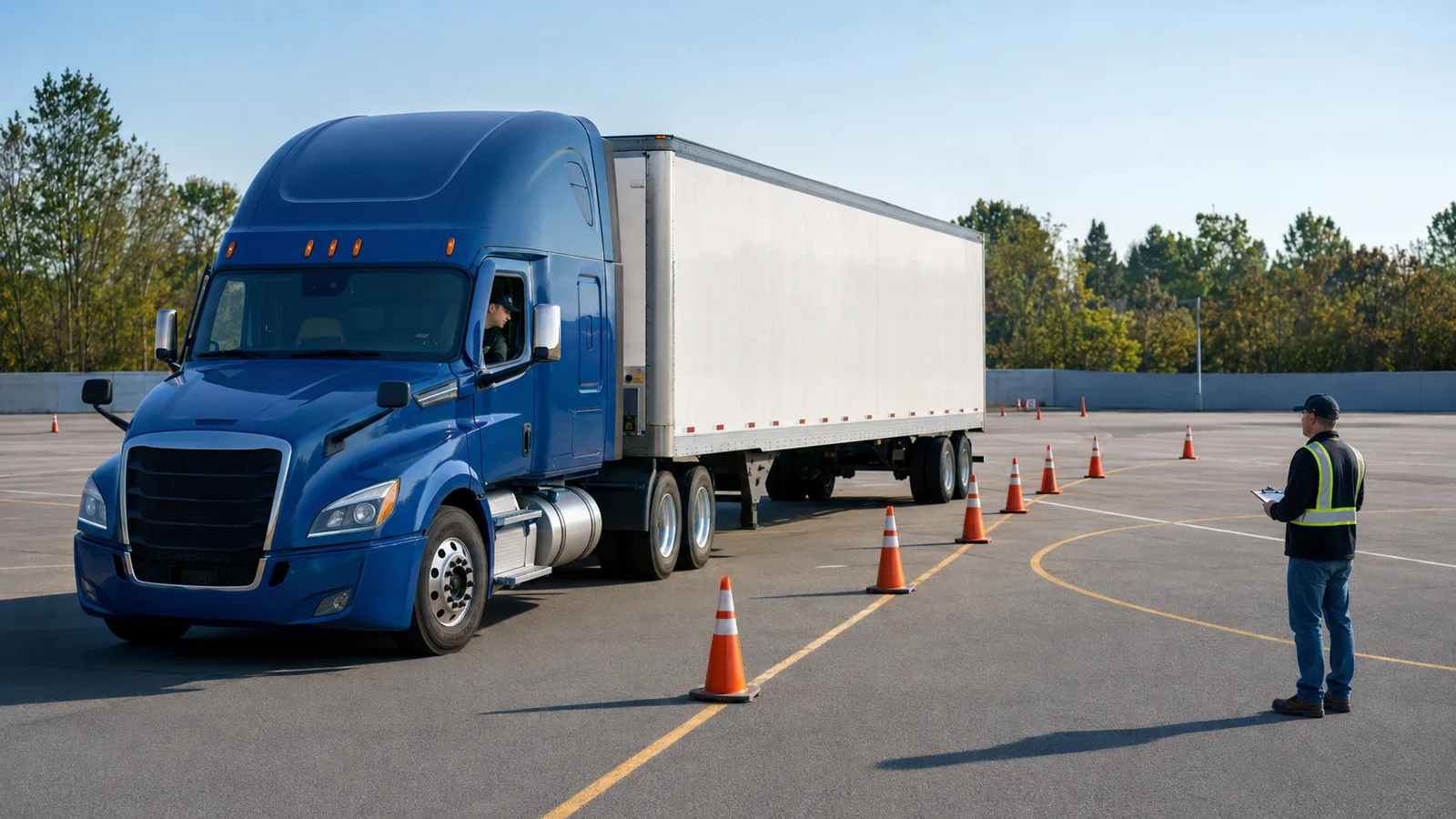
The CDL basic control skills test measures whether you can move a commercial vehicle accurately at low speed while maintaining control and checking the space around it. It is one of three parts of the CDL skills test, along with the vehicle inspection test and the on-road test. For many applicants, the backing exercises create the most anxiety because small steering inputs produce delayed, sometimes unfamiliar movement at the rear of the vehicle.
Good preparation is not about memorizing a viral diagram or another student’s steering count. Learn your state’s test model, understand the test vehicle, and build a repeatable process for observation, setup, correction, and stopping. This guide explains the federal baseline and a practical way to train for the 2026 test.
What federal rules require
Under 49 CFR 383.113, every CDL applicant must demonstrate basic control skills in a vehicle representative of the class the driver operates or expects to operate. The federal list includes starting and shutting down the engine, moving and accelerating smoothly forward and backward, stopping smoothly, backing in a straight line while checking path and clearance, positioning for left and right turns, selecting the appropriate gear, and backing along a curved path.
FMCSA also states that applicants must pass all three parts of the skills test: Vehicle Inspection, Basic Controls, and Road Test. A covered first-time Class A or Class B applicant must hold the commercial learner’s permit for at least 14 days and complete applicable Entry-Level Driver Training before becoming eligible for the skills test. A state may require a longer permit period, extra training, different appointment procedures, or additional documents.
Why the exact exercises may differ by state
Federal regulations define the skills, but states administer CDL testing. FMCSA explains that state tests must meet federal minimum standards and that applicants should use the current CDL manual issued by the testing state. States may use an approved model test, including a modernized vehicle inspection and basic control skills format, or another compliant format.
Depending on the state and test model, exercises may be described as straight-line backing, forward stop, forward offset tracking, reverse offset backing, alley docking, parallel parking, or another curved-path maneuver. Limits on pull-ups and looks, boundary rules, scoring, order, and timing can also vary. Do not assume an out-of-state video describes your test.
Download the newest state manual and read its basic control skills chapter. Confirm the model in use, exercises for your vehicle class, and current test-site instructions when scheduling. Compare any school or third-party handout with the state’s official material.
Understand what the examiner is evaluating
The test is not a race. The examiner is looking for controlled movement, accurate final position, effective observation, and compliance with boundaries and instructions. State scoring can include encroachments, excessive pull-ups, improper final position, or too many looks. Losing control, ignoring an instruction, or creating a collision risk can be more serious than an ordinary point deduction.
Listen to the full instructions before moving and ask a permitted question if the setup is unclear. Know the boundaries, stopping point, and what portion of the vehicle is scored. Use a speed slow enough to recognize an error, stop safely, and make a deliberate correction before it grows.
Build a repeatable backing process
Begin with the setup specified by your state and trainer. Straighten and center the vehicle, select the correct gear, release the brakes smoothly, and scan both mirrors before moving. Keep steering inputs small. With a combination vehicle, wait to see how the trailer responds; changing direction too quickly can create a correction cycle.
Alternate mirror checks instead of staring at the target side. Track the rear, the opposite side swinging toward a boundary, and the tractor-trailer relationship. For curved backing, learn how an input begins the angle, following the trailer controls it, and countersteering reduces it. Reference points help only when connected to your seat position, mirrors, wheelbase, trailer length, and layout.
Use pull-ups as planned corrections. Stop before crossing a boundary, move forward enough to improve the angle, then resume with a clear target. If your state permits getting out and looking, follow its procedure: secure the vehicle, use required points of contact, check the path and clearances, and avoid boundary markers. Practice-yard customs do not override official rules.
Practice quality matters more than repetitions
Ten careful repetitions with feedback beat fifty hurried attempts that reinforce a mistake. Ask an instructor to identify when the maneuver first fails, not merely the cone you hit. The cause may be a poor setup, late mirror recognition, excessive steering, or a wrong-direction correction.
Make practice gradually resemble the test. Learn with coaching, then explain what you see in the mirrors, and finally follow only examiner-style instructions. Record the setup, first error, correction, final position, and boundaries after each attempt. Stop when fatigue produces careless inputs.
Whenever possible, train in the test vehicle or one with similar dimensions, transmission, mirrors, steering response, and coupling. Class B trucks and buses respond differently from Class A combinations, and tractor-trailers vary in wheelbase, fifth-wheel position, trailer length, and sight lines.
Prepare the vehicle and avoid unwanted restrictions
The test vehicle must represent the CDL class and type of vehicle you want to operate. FMCSA warns that testing in equipment without certain features can place restrictions on the CDL. For example, an automatic-transmission test vehicle can lead to an E restriction, a vehicle without a full air-brake system can lead to an L or Z restriction, and some Class A connection types can create an O restriction. Passenger-vehicle testing can also affect the class of passenger vehicle authorized.
Before test day, confirm with the school, employer, rental provider, or licensing agency exactly which vehicle will be supplied and which restrictions may result. Check that required registration, insurance, inspection documents, plates, safety equipment, and other state-required items are current. Complete a genuine safety inspection. A warning light, air leak, damaged tire, inoperative lamp, unsecured component, or other defect can end the appointment before the control test begins.
Use a practical test-day routine
Verify the appointment location and arrival time, acceptable identification, CLP, medical or self-certification status, ELDT records, fees, and vehicle requirements several days in advance. Confirm who may legally accompany you to the site. Sleep adequately, wear secure footwear, arrive early enough to adjust the seat and mirrors, and remove distractions from the cab.
Before each exercise, set the parking brake as instructed, place the transmission correctly, fasten the seat belt, and scan the range. Visualize the first two or three actions rather than the entire maneuver. During the test, breathe, move slowly, and use every mirror check and permitted correction intentionally. If one exercise is imperfect, stay focused on the next instruction instead of trying to calculate the score.
After passing, review the issued CDL before leaving the licensing office. Confirm the class, endorsements, restrictions, name, and other credential details. If you do not pass, obtain the score sheet or examiner feedback, learn the state’s retest and waiting-period rules, and build the next practice session around the specific errors rather than restarting without a diagnosis.
Connect ELDT knowledge to hands-on control
Online ELDT theory helps a new driver understand vehicle systems, safe operating procedures, space management, inspections, and the reasoning behind basic controls. For first-time Class A and Class B applicants, however, theory is only one part of the federal requirement. Behind-the-wheel range and public-road training must be completed with a provider listed in the FMCSA Training Provider Registry, using a representative commercial vehicle, and proficiency must be documented before the applicable skills test.
CDL Compass offers online Class A and Class B ELDT theory courses that can prepare you for the knowledge behind safe vehicle operation. Pair the appropriate course with qualified local behind-the-wheel training, use your state’s current CDL manual as the test authority, and practice until the maneuver feels controlled rather than memorized. That combination is the most reliable path to both passing the test and handling real loading docks, yards, and confined spaces safely.