CDL Mountain Driving in 2026: Safe Speed, Gears, Braking, and Escape Ramps
Learn how CDL drivers should prepare for steep grades, select a safe speed and gear, control brake heat, recognize fade, and use an escape ramp in an emergency.
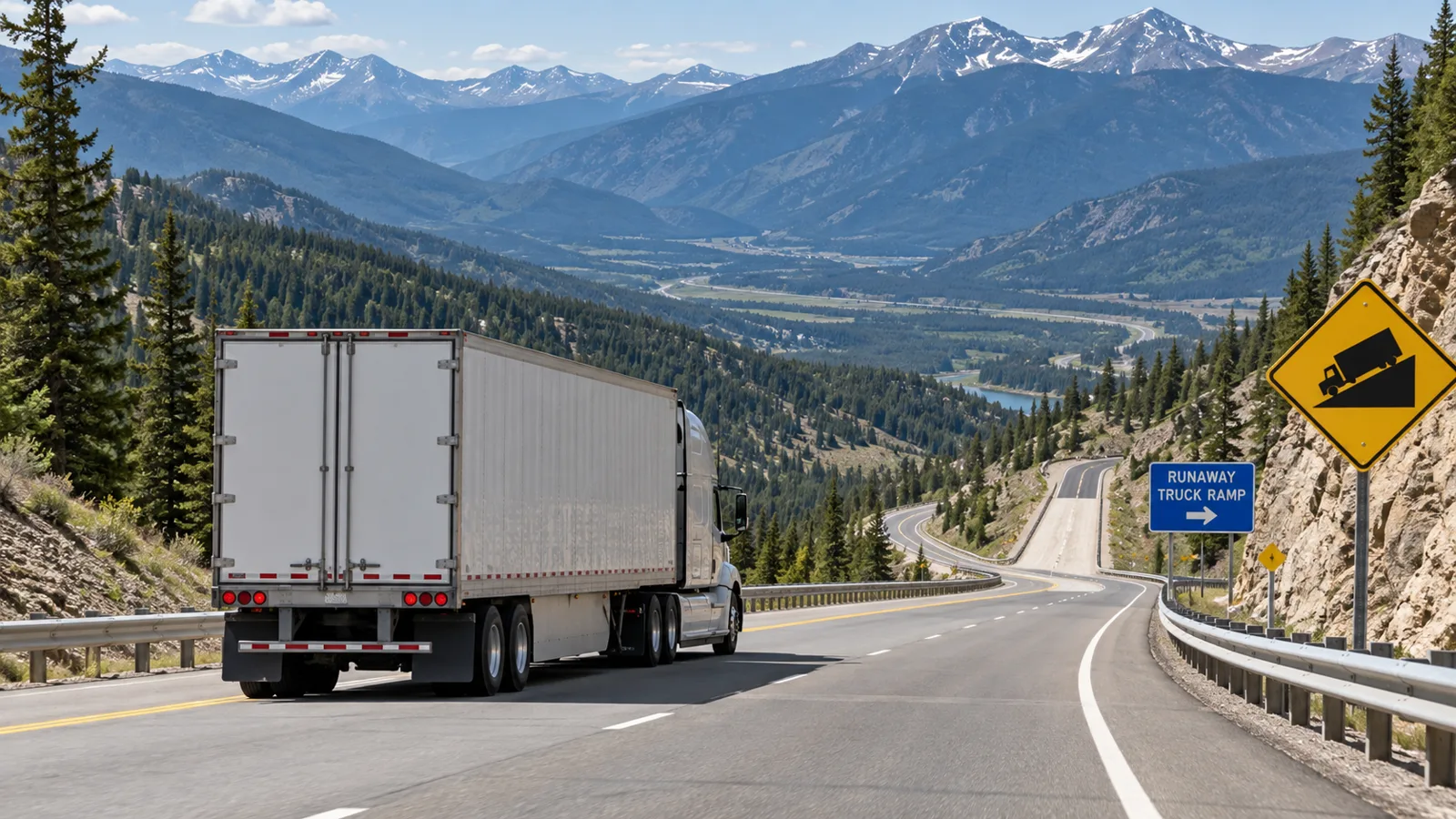
Mountain driving turns small decisions into long consequences. A commercial vehicle gains speed quickly on a downgrade, needs more distance to slow, and can overheat its brakes. Curves, changing weather, falling rocks, narrow shoulders, and traffic make the margin even smaller.
The safe descent begins before the crest, while speed is controlled and the transmission can be placed in the right gear. CDL knowledge standards specifically include mountain driving, safe speed, gear selection, and braking. Entry-Level Driver Training also addresses steep grades and sharp curves, so this is both a test topic and an operating skill.
Study the grade before the truck starts down
Review the route rather than discovering the mountain one sign at a time. Look for the grade percentage, downgrade length, curves, brake-check areas, chain requirements, construction, weather, and escape ramps. A six-percent grade that continues for miles demands a different plan from a short hill.
Pay attention to warning signs and use a safe turnout when provided. If the route is unfamiliar, ask dispatch or an experienced driver about restrictions and hazards before departure. Navigation software can help with planning, but it does not replace posted signs, carrier routing, current road information, or the driver's judgment.
Start with a brake and vehicle check
A downgrade is not the place to discover an air leak, an out-of-adjustment brake, a damaged hose, a low tire, or an unsecured load. Complete the required inspection and confirm that the air system, warning devices, service brakes, parking brakes, and any trailer connections are working. Report a defect before committing the vehicle to a steep route.
At a brake-check area, stop when required or when conditions make another inspection prudent. Check for obvious heat, smoke, odor, air loss, or other abnormal signs without touching a hot drum, rotor, or wheel end. Confirm the load is secure and balanced and that the equipment is within legal weight limits. Extra mass increases the energy the braking system must manage.
Choose a safe speed for this vehicle and this day
A posted speed limit is a maximum under favorable conditions, not a promise that every truck can descend at that speed. The safe speed depends on total weight, the grade's length and steepness, curves, visibility, pavement, weather, traffic, and vehicle condition. A heavily loaded combination may need to travel well below the posted limit.
Reduce speed before entering a curve or downgrade. Braking hard after the vehicle is already turning transfers weight and can reduce traction or stability. Leave a generous following distance and avoid pressure from faster traffic. Use a turnout when it is safe and lawful, but never trade a controlled descent for a rushed lane change or an unsafe shoulder stop.
Select the right gear before the downgrade
Shift to a gear that lets the engine's braking effect help hold the chosen speed before gravity accelerates the vehicle. The Pennsylvania CDL manual advises selecting a low gear before starting down and warns that a driver may be unable to shift to a lower gear after speed has built. The exact gear depends on the truck, load, transmission, grade, and manufacturer guidance.
Do not coast in neutral or depress the clutch for an extended descent. Both actions remove the engine's braking assistance and can reduce control. With an automated transmission, select the approved descent or manual mode as the vehicle instructions require. If the truck has a supplemental engine retarder, use it only as trained and appropriate for traction conditions; it does not replace correct gear selection.
Use service brakes in a controlled cycle
The goal is to keep the vehicle near the planned speed without riding the brakes. The CDL manual's mountain-driving method is to apply the brakes firmly enough to feel a definite slowdown, reduce speed to about five miles per hour below the chosen safe speed, release the brakes, and let the vehicle return gradually to that safe speed before repeating.
This cycle gives the service brakes recovery time while the selected gear and engine braking do most of the continuous speed control. It is not a universal command to use one pressure or interval on every vehicle. Follow the current State CDL manual, vehicle instructions, road signs, and instructor guidance. If speed cannot be controlled with the planned method, slow and stop at a safe place before continuing.
Why light, continuous braking can cause fade
Holding light brake pressure for a long downgrade converts the vehicle's energy into heat without enough cooling time. As temperature rises, brake linings and drums or rotors can lose effectiveness. The driver may press harder but receive less braking. That condition is brake fade, and it can develop into a loss of control.
Warning signs can include a hot or burning smell, smoke, a change in pedal response, the need for increasing pressure, or a vehicle that no longer slows as expected. Do not continue downhill hoping the system will recover. Use the available safe area or emergency option while control remains. Never crawl under the vehicle or touch hot brake parts at roadside.
Manage curves, traffic, and changing conditions
Mountain curves may tighten beyond the driver's first line of sight. Enter at a speed that allows the vehicle to stay in its lane without hard braking. Watch trailer off-tracking, rear swing, oncoming traffic, and the possibility of stopped vehicles around a blind bend. Keep both hands ready for smooth steering and scan well ahead for the next warning.
Weather can change rapidly with elevation and shade. Rain, ice, snow, fog, wind, or loose material reduces the speed that is safe. Engine retarders and aggressive downshifts can affect traction on slippery surfaces, so follow the vehicle manual and carrier training. If conditions become too dangerous for safe operation, federal rules require extreme caution and may require stopping until the vehicle can proceed safely.
Climb without creating a new hazard
On an upgrade, choose a gear early enough to keep the engine within its safe operating range and maintain steady control. Do not wait for speed to collapse before downshifting. Use the right lane where required, monitor engine temperature and gauges, and understand how a heavy load affects acceleration and the ability to merge or cross traffic.
Expect faster vehicles to overtake, but make no sudden lane movement to accommodate them. At the crest, sight distance may be limited and the road can transition immediately into a downgrade. Ease off before reaching the top, scan for grade signs, and establish the next safe speed and gear before gravity takes over.
Know what to do if the brakes stop controlling speed
If the vehicle is accelerating despite the planned gear and braking method, act early. Downshift only if it can be done safely under the vehicle's operating instructions; an unsuccessful shift can leave the truck with less control. Activate hazard warning flashers, alert other road users, and look immediately for the nearest escape ramp or other designated emergency facility.
A runaway-truck ramp is built to stop an out-of-control vehicle through an uphill grade, deep gravel or another energy-absorbing design. Use it when needed. Do not bypass an available ramp because of possible damage, delay, embarrassment, or uncertainty about cost. Stay centered, hold the wheel firmly, follow posted directions, and call emergency services after the vehicle stops. Do not attempt to re-enter traffic without inspection and authorization.
Build a repeatable mountain-driving checklist
Before the grade: review the route and weather, inspect the braking system and load, note brake-check areas and escape ramps, fasten the belt, and remove distractions. At the crest: reduce speed, select the gear, establish following distance, and read every truck warning sign. During the descent: monitor speed and gauges, use disciplined braking cycles, and scan for changing conditions.
After a demanding descent, stop only in a safe and permitted location. Check for abnormal heat, odor, smoke, air loss, tire problems, or shifted cargo and report any concern. Record defects through the carrier's process. A brake system that has overheated or behaved abnormally needs qualified evaluation; cooling time alone does not prove the underlying problem is corrected.
Connect ELDT theory to supervised practice
Class A and Class B ELDT curricula require instruction on extreme driving conditions, and the behind-the-wheel content develops speed and space management on grades and curves when those conditions are available. Online theory can explain the decisions, but it cannot reproduce the weight, sound, sight distance, or brake feel of a loaded commercial vehicle on a mountain road.
Use the CDL Compass Class A or Class B ELDT course to build the federal theory foundation, then practice with a qualified instructor in the vehicle type you expect to drive. Ask the instructor to explain route planning, gear choice, service-brake technique, retarder use, brake-fade cues, and escape-ramp decisions. The strongest habit is formed before the hill: plan early, slow early, and never allow gravity to make the decisions for you.