Hazardous Driving Conditions in 2026: When CDL Drivers Must Slow Down or Stop
Learn how 49 CFR §392.14 applies in snow, ice, fog, rain, dust, and smoke, when reduced speed is not enough, and how to make a defensible stop decision.
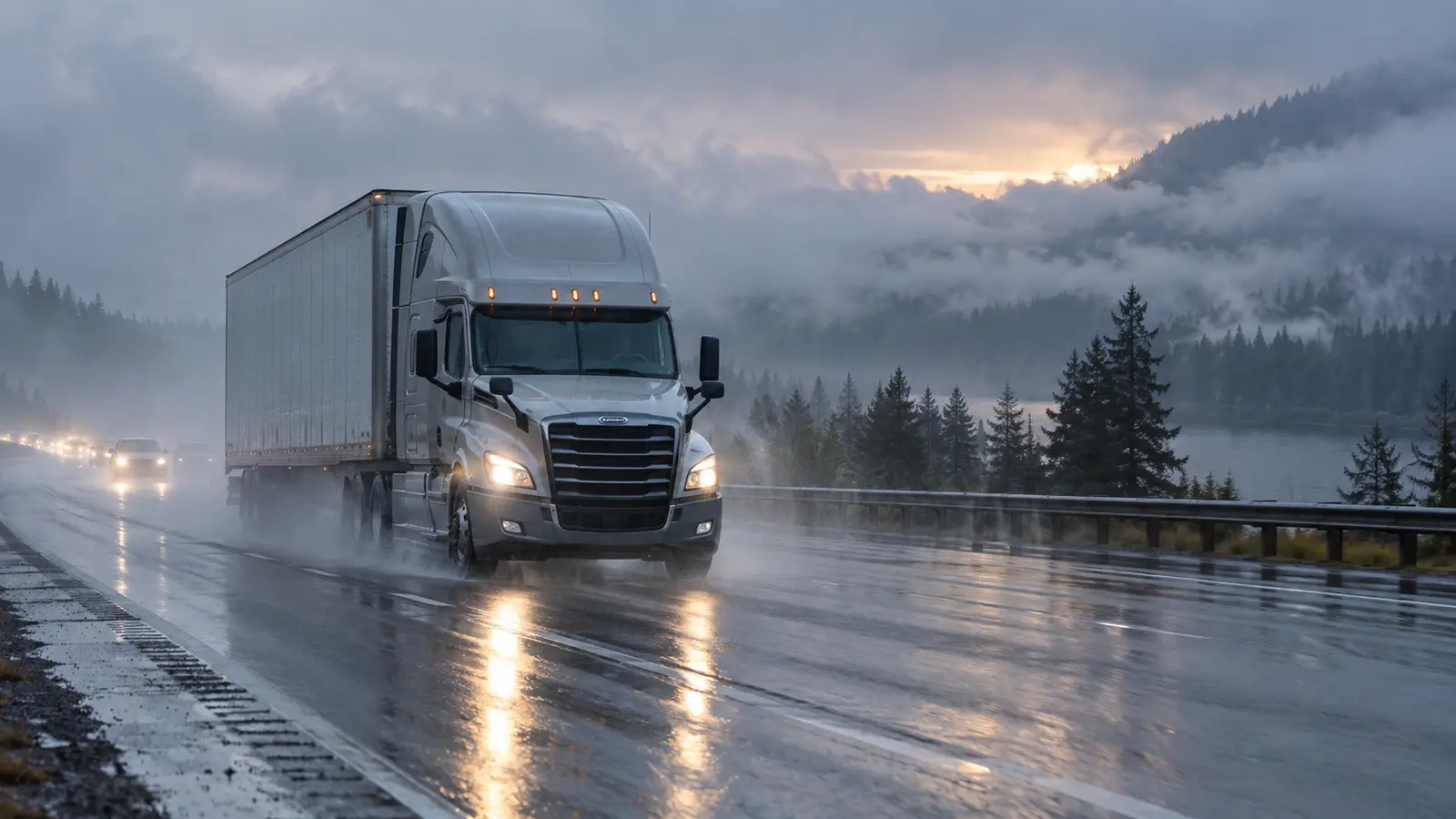
Bad weather does not create one universal safe speed for a commercial vehicle. A speed that is manageable for an empty straight truck may be unsafe for a loaded combination vehicle on the same grade. Visibility, traction, traffic, cargo, vehicle condition, and available stopping distance all matter.
Federal law gives CDL drivers a clear decision framework. Under 49 CFR §392.14, a driver must use extreme caution when hazardous conditions affect visibility or traction, must reduce speed, and must discontinue operation when conditions become sufficiently dangerous. The rule makes stopping part of professional driving—not an admission that the driver failed.
Section 392.14 creates three separate duties
The first duty is extreme caution. The regulation specifically lists snow, ice, sleet, fog, mist, rain, dust, and smoke, but the wording is not limited to those examples. Any condition that adversely affects visibility or traction can trigger the rule.
The second duty is to reduce speed while the condition exists. The third is stronger: if conditions become sufficiently dangerous, operation must stop and may not resume until the commercial motor vehicle can be operated safely. Slowing down does not satisfy the rule when continued movement itself is unsafe.
There is no single federal bad-weather speed
Section 392.14 does not prescribe a fixed percentage below the posted limit. The appropriate reduction depends on the truck, load, surface, grade, curves, wind, sight distance, traffic, and whether surrounding drivers can maintain control. The posted limit describes a maximum under favorable circumstances; it is not a target in hazardous conditions.
Reduce speed before reaching a slick curve, standing water, fog bank, blowing dust, smoke plume, or downhill grade. Smooth steering, acceleration, shifting, and braking help preserve traction. Create more following distance and avoid driving beside another vehicle when spray, wind, or lane movement could remove your escape space.
Know the signs that reduced speed is no longer enough
A stop decision should come before control is lost. Warning signs include being unable to see far enough to stop within the visible roadway, repeated loss of tire grip, uncontrolled lane drift from wind, vehicles disappearing in spray or fog, ice accumulation, road closures, or traffic moving unpredictably around disabled vehicles.
Do not use the behavior of other motorists as proof that the route is safe. Passenger cars have different weight, braking, clearance, and stability characteristics. Another truck continuing ahead also does not transfer responsibility for your vehicle. Evaluate the conditions you can actually see and feel from your driving position.
Choose a stopping place without creating a new hazard
When operation must be discontinued, look for the nearest location that can safely accommodate the complete vehicle. A truck stop, rest area, terminal, approved parking facility, or other lawful off-road space is usually preferable to a shoulder. Account for entrances, grade, surface strength, flooding, overhead hazards, cargo security, and the ability to leave later.
If an immediate emergency forces a roadside stop, move as far from moving traffic as safely possible, activate hazard flashers, secure the vehicle, and follow the warning-device requirements and carrier emergency procedure. Never trade one serious hazard for another by stopping where approaching traffic cannot see the trailer or where snow, water, fire, or unstable ground threatens the vehicle.
The passenger-safety exception is narrow
Section 392.14 allows a passenger-carrying commercial vehicle to continue to the nearest point where passenger safety is assured when stopping under the rule would increase the hazard to passengers. This is not a general permission to finish the schedule or reach a preferred destination.
The driver should choose the nearest safer point and continue only as conditions permit. A bus stopped in an exposed lane, wildfire area, or other immediately dangerous position may need to move, but passenger comfort, appointment timing, or dispatch convenience does not replace the regulation's safety standard.
Hazardous conditions and the HOS exception are different rules
Drivers often confuse §392.14 with the adverse-driving-conditions exception in the hours-of-service rules. Section 395.2 defines adverse driving conditions for HOS purposes as unexpected snow, ice, sleet, fog, other adverse weather, or unusual road or traffic conditions that were not known—or could not reasonably have been known—before the duty day, qualifying rest break, or dispatch.
When the requirements are met, §395.1(b)(1) can allow up to two additional driving hours to complete the run or reach a place offering safety and security. It does not authorize driving through conditions that §392.14 makes too dangerous. Extra legal time is not extra traction, visibility, or stopping distance.
Forecast weather is not automatically an HOS extension
A storm that was known or reasonably knowable before dispatch may fail the HOS definition even though it still requires slower driving under §392.14. The safety rule applies to the condition on the road; the HOS exception depends partly on whether the adverse condition was unexpected at the relevant time.
Record accurate duty status and follow the carrier's process for any exception. Save useful dispatch messages, road-closure notices, weather alerts, or other supporting information according to company policy. An ELD annotation can explain a record, but it cannot turn a planned delay into a qualifying exception or make unsafe driving lawful.
Fatigue can make a weather problem worse
Section 392.3 prohibits driving when fatigue, illness, or another cause impairs—or is likely to impair—the alertness needed for safe operation. Poor visibility and slippery roads increase the attention required, so a driver who could function in ordinary conditions may no longer be able to operate safely during a long storm delay.
Stopping for weather does not erase fatigue. Before resuming, assess both road conditions and personal readiness. The fact that the road reopened, traffic started moving, or a new driving window became available does not override the separate duty to avoid operating while impaired by fatigue or illness.
State rules and carrier policies may be stricter
Under §392.2, a commercial vehicle must follow the laws and regulations of the jurisdiction where it operates, unless an applicable FMCSA rule imposes a higher standard of care. Chain requirements, snow-emergency routes, high-wind restrictions, mountain-pass controls, reduced limits, and road-closure orders can therefore add obligations to the federal baseline.
Carriers may also establish wind thresholds, approved parking locations, route restrictions, tire-chain procedures, or mandatory dispatch check-ins. Know the company plan before the trip. A policy may be stricter than the minimum rule, but no delivery instruction should be treated as permission to continue when the vehicle cannot be operated safely.
Prepare the truck and route before conditions deteriorate
Check forecasts, State 511 systems, road restrictions, fuel range, legal parking options, grades, alternate routes, and customer access before departure. During the vehicle inspection, give special attention to tires, tread, inflation, brakes, lights, wipers, washers, mirrors, defrosters, heater, electrical connections, and required emergency equipment.
Secure cargo and confirm axle weights because load movement and weight distribution affect stability and braking. Clear snow and ice where required and safe to do so. Keep windows, lamps, mirrors, and reflective surfaces usable. Preparation cannot eliminate severe weather, but it gives the driver more time and better options before a stop becomes urgent.
Use a repeatable decision and communication routine
When conditions change, observe visibility and traction, reduce speed smoothly, increase space, identify exits and safe parking, and notify dispatch early. State the location, direction of travel, observed condition, current control issue, and intended safe action. Specific facts are more useful than saying only that the weather is bad.
Once parked, set the parking brakes, secure the vehicle, update duty status correctly, and monitor reliable road and weather sources. Resume only after checking the route, vehicle, load, personal alertness, and a safe way back into traffic. If the reason for stopping remains, a deadline is not evidence that the road is safe.
Build weather judgment during CDL training
Federal Class A and Class B ELDT curricula include extreme driving conditions, hazard perception, speed and space management, skid control, emergency procedures, and trip planning. Theory gives a driver the decision framework; behind-the-wheel training develops vehicle control and helps an instructor evaluate proficiency in a representative commercial vehicle.
New drivers can begin with the CDL Compass Class A or Class B ELDT theory course, then practice weather-related decisions with a registered behind-the-wheel provider. The goal is not to prove that the truck can keep moving. It is to recognize changing risk early, preserve control, communicate clearly, and stop before hazardous conditions remove the safe option.