CDL Alley Dock Backing in 2026: Setup, Reference Points, and Test-Day Safety
Learn a safe, repeatable approach to CDL alley dock backing, including setup, mirror use, GOAL, pull-ups, corrections, and skills-test preparation.
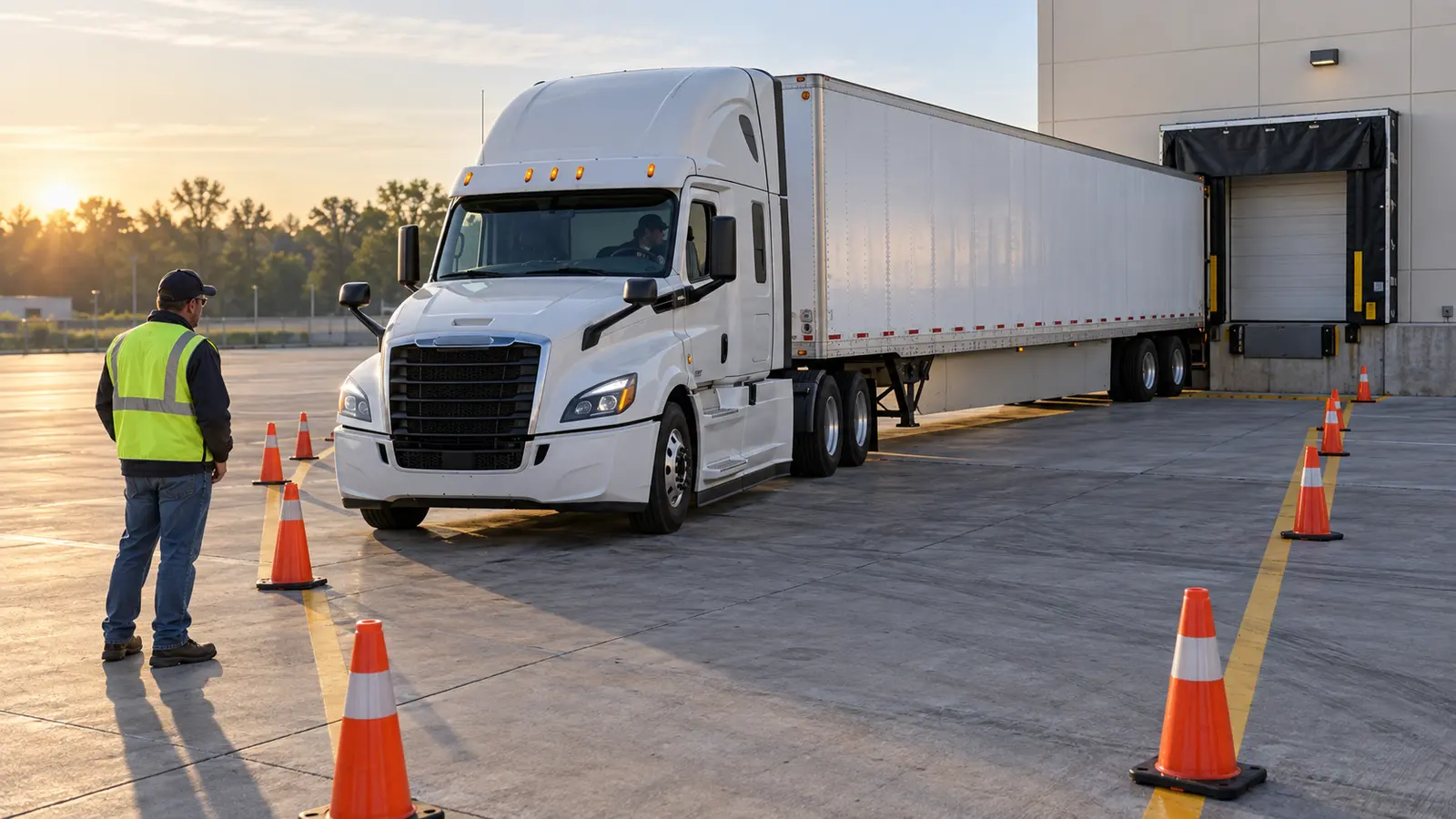
Alley dock backing asks a commercial driver to place a vehicle into a space that begins at an angle. The maneuver combines setup, mirror use, low-speed control, steering timing, clearance judgment, and the discipline to stop when the picture is unclear. Those skills matter at warehouses, terminals, customer lots, and maintenance bays long after the CDL test.
There is no single steering count or mirror marker that works for every truck. Tractor wheelbase, trailer length, tandem position, straight-truck geometry, seat position, mirrors, pavement slope, and starting angle all change the picture. A reliable method uses repeatable phases and vehicle-specific reference points—not a promise that one turn at one cone always works.
What the federal rules actually require
Federal ELDT curricula for both Class A and Class B include behind-the-wheel range training in 45- and 90-degree alley dock backing. The trainee must demonstrate proficiency to appropriate criteria and acceptable tolerances. The range curriculum also requires training providers to teach Get Out and Look, commonly called GOAL, as it applies to backing maneuvers.
The federal CDL skills standard in 49 CFR §383.113 requires applicants to demonstrate straight-line backing while checking path and clearance, plus backing along a curved path. State skills tests must follow FMCSA-approved driver and examiner standards, but the exercises, boundary layout, instructions, scoring events, permitted pull-ups, and GOAL procedure can depend on the State and test version. Study the current manual issued by your licensing agency and follow the examiner's directions.
Begin with the whole area, not the first steering move
Before backing, inspect the approach, target space, dock face, pavement, overhead clearance, adjacent equipment, pedestrians, and escape routes. At a real facility, look for wheel chocks, dock plates, bollards, low canopies, open trailer doors, debris, and moving forklifts. On a training range, identify every boundary and ask which lines represent the entrance, side limits, and final stopping area.
Eliminate avoidable uncertainty before the vehicle moves. Adjust the seat and both mirrors, fasten the belt, silence distractions, and lower a window when conditions and training rules allow. If a spotter is used, agree on hand signals and the stopping rule first. The driver remains responsible for the vehicle; losing sight of the spotter means stop, not continue guessing.
Build a repeatable setup
A good setup gives the rear of the vehicle room to enter the alley without forcing a rushed correction. Approach slowly, control the vehicle's distance from the boundary, and stop at the reference point taught for that specific truck. For a combination vehicle, the tractor and trailer angle created during setup determines how quickly the trailer begins moving toward the space.
Practice the setup until you can describe what you see in the mirrors at the starting position. Use fixed relationships—such as a cone appearing at a certain place in a mirror or the trailer corner aligning with a boundary—only after an instructor confirms them. Record reference points for the exact vehicle, but also learn the geometry behind them so you can adapt when equipment changes.
Control the trailer with small, early inputs
When backing a tractor-trailer, the trailer initially moves opposite the top of the steering wheel. A small steering input held too long can become a large trailer angle. Use idle or the lowest practical speed, scan both mirrors, and return the steering toward neutral as the trailer develops the angle you need. Think ahead of the trailer rather than reacting after it has already crossed the desired path.
Once the trailer is entering the alley, follow it with the tractor while protecting the tractor's front swing and avoiding an excessive articulation angle. If the trailer drifts wide, correct early and modestly. If it cuts too sharply, reduce the angle before the problem grows. Rapid left-right steering often creates a second error and makes the mirror picture harder to interpret.
Class B vehicles need a different mirror picture
A heavy straight vehicle does not pivot at a fifth wheel, so its rear follows a different arc from a tractor-trailer. The steering principles are more familiar, but rear overhang, wheelbase, off-tracking, and front swing still matter. Do not transfer tractor-trailer cone counts or reference points to a box truck, bus, or other Class B vehicle.
Class B trainees should track the rear corner on the side nearest the boundary while checking the opposite side for clearance. Use the mirrors as a coordinated system rather than staring at one target. The safest reference points show both where the rear is going and whether the rest of the vehicle remains inside the available space.
GOAL is a decision tool, not a sign of failure
Stop and get out when a mirror cannot confirm clearance, a cone disappears at the wrong time, the trailer angle feels unfamiliar, or a person or vehicle enters the area. Secure the vehicle exactly as your instructor, employer, or examiner requires. Walk to a safe viewing position, check both sides and the rear, then return by a path that keeps you visible and clear of traffic.
GOAL should answer a specific question: How far is the rear corner from the boundary? Is the trailer square enough to continue? Is there room for the tractor to follow? Has the blind side changed? Looking without a question can waste the opportunity. On test day, use only the procedure and number of exits permitted by the examiner's instructions.
Use pull-ups before a bad angle becomes a contact
A pull-up is a controlled forward repositioning move. It can reduce trailer angle, move the rear away from a boundary, create tractor clearance, or rebuild a failed setup. In training and real operations, a safe pull-up is better than continuing toward a cone, dock, trailer, or person. Make the correction deliberately, then stop and reassess before backing again.
Test scoring may treat pull-ups, boundary encroachments, GOALs, or final position differently, so do not assume a rule from another State or an old online video applies. Learn what your manual and examiner count. Safety remains the controlling habit: a scoring concern is never a reason to knowingly continue into an unsafe path.
Recognize the most common alley dock errors
A common error is an inconsistent setup followed by the same memorized steering sequence even though the starting picture changed. Other problems include backing too fast, watching only the sight-side mirror, correcting late, oversteering, failing to unwind the wheel, and letting the tractor nose swing into an unmonitored area.
Another mistake is chasing the dock line before controlling the entry path. First get the rear into the alley with clearance, then reduce the angle, straighten, and finish. If you no longer know which phase you are in, stop. A pause, GOAL, or pull-up restores information; continued motion removes options.
Practice in phases and measure progress
Break the maneuver into setup, angle creation, entry, follow, straightening, and final stop. Ask the instructor to evaluate one phase at a time. Repeat from the same starting position, then vary the setup slightly so you learn how the mirror picture changes. Practice recoveries from a manageable error under direct supervision.
Keep a short training log: vehicle number, trailer or body length, tandem position, setup reference, correction used, pull-ups, GOALs, boundary contacts, and final position. Progress is not completing the maneuver once. It is producing a safe result repeatedly and explaining why a correction worked.
A practical test-day routine
Before the test, verify which vehicle you will use and practice in that exact configuration when possible. Read the current State CDL manual, bring the required permit and documents, arrive early, and adjust the seat and mirrors before the exercise begins. Listen to the full instructions and ask for repetition if an instruction is unclear; do not ask the examiner to coach the maneuver.
During the exercise, use a consistent scan: target-side mirror, opposite mirror, front swing, path, and back to the target. Keep the speed low enough to stop immediately. Say nothing that distracts you from control. When you believe the vehicle is complete, secure it as directed and confirm the final position before signaling that you are finished.
Connect ELDT theory with supervised range practice
Federal ELDT does not set a minimum number of behind-the-wheel hours for Class A or Class B. The registered training provider must cover the curriculum and document that the trainee demonstrated proficiency. That makes the quality and repetition of range practice more important than reaching an arbitrary hour count. A simulator cannot replace the required behind-the-wheel range training or proficiency demonstration.
Use CDL Compass Class A or Class B ELDT to build the required theory foundation, then complete hands-on range and public-road training with an FMCSA-registered provider. Ask the instructor to connect every alley dock reference point to vehicle geometry, clearance, and GOAL. Passing the skills test matters, but the lasting goal is a backing routine that protects people, equipment, freight, and your CDL career.