School Bus Endorsement Skills in 2026: Danger Zones, Loading, and Railroad Crossings
Prepare for school bus S endorsement training with practical guidance on mirror danger zones, student loading, emergency exits, inspections, and railroad crossings.
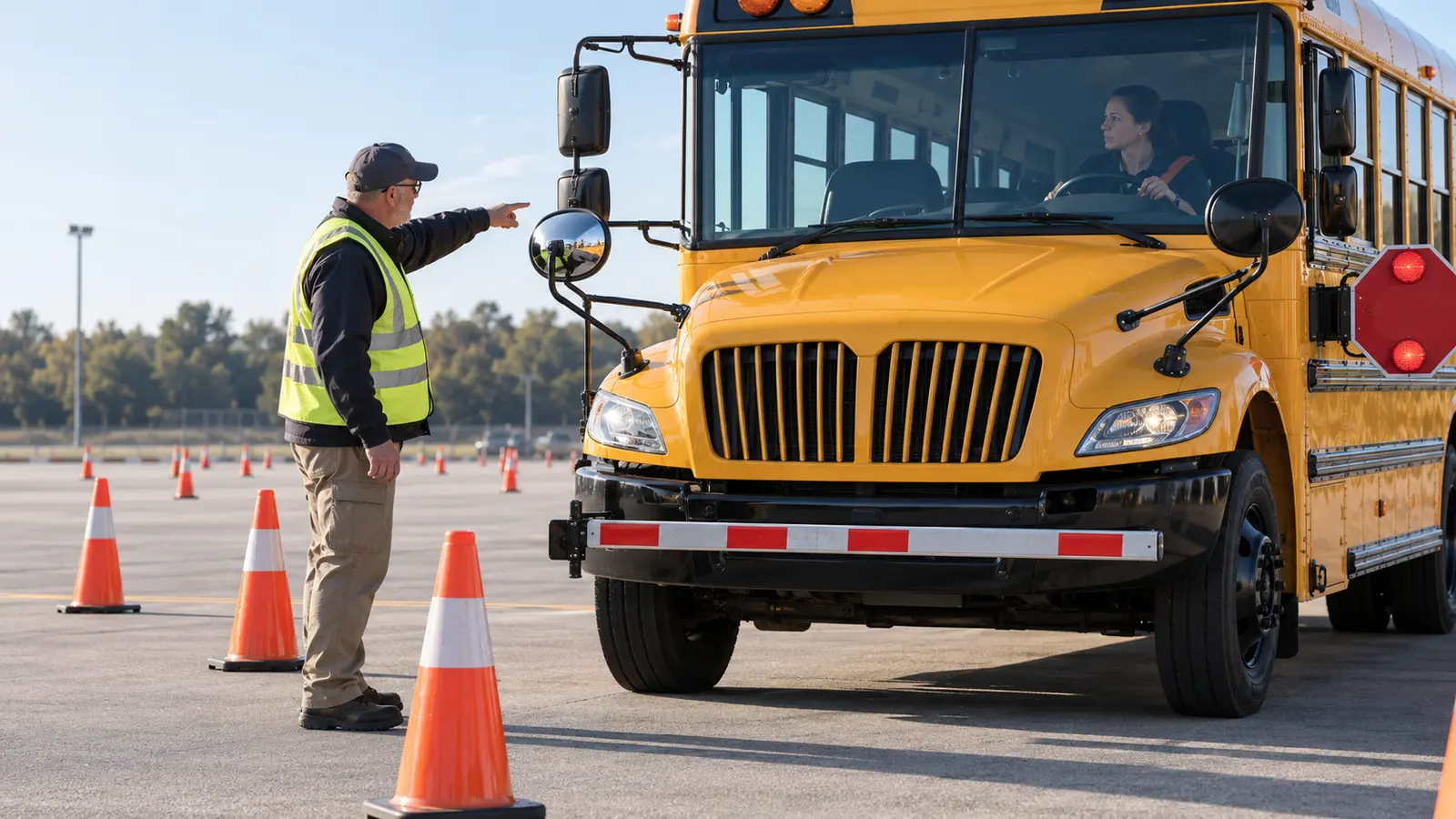
The school bus S endorsement is built around one demanding responsibility: moving students while controlling areas around a large vehicle that the driver cannot see directly. The driver must coordinate mirrors, warning devices, student movement, traffic, vehicle position, and emergency equipment—not merely memorize a loading sequence.
Federal standards define the core skills, but State laws, school-district procedures, examiner instructions, and bus designs can add details. Learn the federal foundation, then practice the exact procedures in the current CDL manual and school-bus handbook for the State where you will test and work.
The S endorsement builds on passenger qualifications
Under 49 CFR §383.123, an S endorsement applicant must first qualify for the passenger endorsement. The school-bus knowledge test covers loading and unloading children, stop-signal devices, mirrors, flashing lights, emergency exits and evacuation, and railroad crossings. The skills test must use a school bus from the same vehicle group the applicant intends to operate.
A new driver may therefore need the correct base CDL class, P training and testing, S training and testing, and a separate State school-bus certificate. Class B is common for full-size buses, but weight, capacity, and test-vehicle group determine the actual class and possible restrictions. Plan the complete credential before choosing equipment.
ELDT requires coverage and demonstrated proficiency
Appendix D to Part 380 is the federal ELDT curriculum for a school bus endorsement. It requires theory instruction plus behind-the-wheel range and public-road training from a provider listed on the Training Provider Registry. Federal rules do not prescribe a minimum number of hours for either portion. The provider must cover every required topic, and the instructor must document that the trainee can perform the behind-the-wheel skills proficiently.
Time alone is therefore a poor measure of readiness. Ask the provider how it evaluates mirror use, loading and unloading, emergency procedures, backing, railroad crossings, and school-bus inspections. Practice must occur in a school bus of the same vehicle group used for the endorsement. Online study can support theory, but it cannot replace the required hands-on range and road instruction.
Map the danger zones before the bus moves
A school bus has critical areas close to the front, sides, and rear where a student may disappear from direct view. Appendix D requires training on danger zones, mirror adjustment and use, the limitations of mirrors, and the risk of students darting into the bus path. Before a route or test exercise, adjust the driver's seat first, then set the flat, convex, cross-view, and other mirrors for that bus according to the State manual and employer procedure.
Do not treat the mirrors as separate pictures. Build a scan that moves from the student-loading area to the front danger zone, both sides, traffic, and back again. During supervised practice, place cones at instructor-approved reference points and identify exactly where an object enters or leaves each mirror field. Stop immediately if a person, cone, or reference point disappears unexpectedly; motion without information is the unsafe choice.
Make every student stop a controlled sequence
The loading zone must be evaluated before opening the door. Approach at the prescribed speed, check mirrors and surrounding traffic, position the bus where students can enter safely, secure it as required, and activate the warning lamps, stop arm, and crossing-control device in the correct sequence for local law and the specific bus. Watch for vehicles that may ignore the signals and never use a student as a traffic-control device.
Keep students at the designated waiting point until the bus is fully stopped and the driver has established control. Count students as they board, monitor the entrance, and confirm that they move to a safe seating position. During unloading, account for every student and track anyone who must cross. The driver should know where each child went before releasing the brake or closing out the stop procedure.
Student crossings require continuous visual confirmation
The federal curriculum requires instruction in safe student crossing procedures, but the exact hand signal, waiting distance, and sequence can be defined by State or local policy. Teach students to remain in the approved location, make eye contact with the driver, and wait for the authorized signal. A driver must never wave a student into a lane without checking for traffic that may pass on either side of the bus.
Scan the roadway and every relevant mirror throughout the crossing. If a student drops an item near the bus, the student should not retrieve it without first getting the driver's attention and following the established procedure. When the crossing is complete, recount the students, confirm that the front and side danger zones are clear, check the door area, and make a final mirror sweep before moving.
Use a disciplined railroad-crossing routine
Federal operating rules in 49 CFR §392.10 generally require a bus transporting passengers to stop between 15 and 50 feet from the nearest rail, listen and look in both directions, and cross only after confirming that no train is approaching. The driver must select a gear that allows the bus to complete the crossing without shifting. The rule lists limited exceptions, but State school-bus laws and employer procedures may require a stop even where a general federal exception exists.
Prepare before reaching the tracks. Check traffic, activate hazard warnings when required, eliminate cabin noise and distractions, and stop where the driver has the best safe view without entering the crossing. Open the service door or window only as the applicable procedure directs. Confirm enough space exists beyond the tracks for the entire bus, including rear overhang, then cross in the selected gear without stopping or changing gears on the rails.
Know the emergency exits and evacuation plan
School-bus ELDT covers emergency exits, evacuation responsibilities, and situations in which staying aboard may be safer than evacuating. The driver must identify every usable exit, explain how it operates, and check warning devices. Practice securing the bus, communicating with dispatch or emergency services, selecting a safe assembly area, directing students away from traffic and hazards, and accounting for everyone after the evacuation.
Evacuation decisions depend on the threat. Fire, smoke, a dangerous vehicle position, rising water, or an unsafe railroad location can require immediate action. Other incidents may expose students to greater risk outside. Follow the State and employer plan, assign student helpers only as trained, accommodate riders who need assistance, and never leave the group unaccounted for while improvising a response.
Inspect the equipment unique to a school bus
The CDL inspection includes ordinary commercial-vehicle systems plus school-bus features. Appendix D highlights the stop arm, crossing arm, emergency exits, fire extinguisher, seating, first-aid equipment, interior lights, and temperature controls. The driver must also understand the warning lights, entrance door, mirrors, and any lift or securement equipment.
Use a consistent path and explain what is being checked, why it matters, and what defect makes the bus unsafe. Verify that exits and alarms operate and that aisles are clear. After a route, secure the bus and walk the full interior to check on and under seats for sleeping children and lost items; a glance from the driver's seat is not enough.
Control backing, tail swing, and route hazards
Appendix D includes backing and tail-swing awareness because the front and rear of a bus can move outside the tire path. Avoid backing when a safer forward alternative exists. When backing is necessary, inspect the area, use an approved spotter when available, keep the speed extremely low, and stop if the spotter or any part of the path disappears. Recheck both sides and the front swing after every steering change.
Route preparation should identify narrow stops, turnarounds, low clearances, steep grades, railroad crossings, poor sight lines, construction, and locations where students may approach from unexpected directions. A navigation app does not replace an approved route review. Report a stop or turnaround that cannot be served safely rather than inventing an unsupervised maneuver with students aboard.
Practice for the test—and the first route
Use the current State CDL manual to learn the examiner's commands, inspection wording, stop procedure, permitted assistance, and scoring rules. Train on the same vehicle group whenever possible, but practice adapting the mirror scan to more than one bus. Ask the instructor to introduce realistic interruptions—an obscured cone, a simulated passing vehicle, a blocked exit, or a student count that does not match—while the bus remains in a controlled setting.
The best preparation is a repeatable safety routine, not a performance that works once. CDL Compass Class B ELDT theory can help applicants build the foundation for the underlying Class B license; P and S endorsement theory and behind-the-wheel training must be completed through providers registered for those curricula. Connect each lesson to supervised practice so the issued endorsements represent skills you can use on every stop, crossing, and route.