Passenger and School Bus Endorsements in 2026: ELDT and Test Requirements
Understand the P and S endorsement rules, required ELDT theory and behind-the-wheel training, testing sequence, CLP limits, and state school-bus requirements.
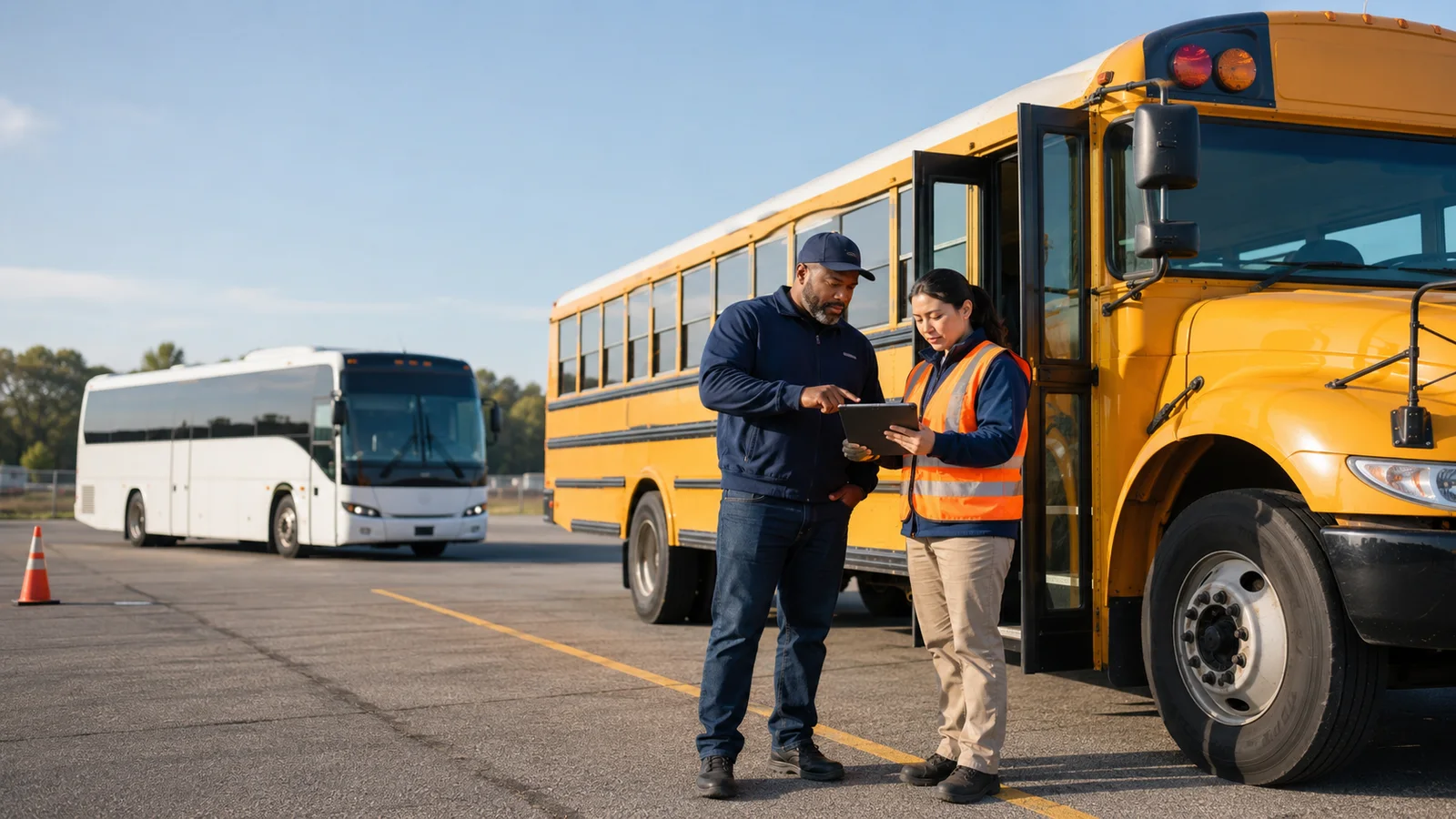
Passenger transportation requires more than the correct CDL class. A driver operating a commercial vehicle designed to carry passengers generally needs the passenger endorsement, shown as P. A driver transporting pre-primary, primary, or secondary students between home and school or to and from school-sponsored events in a school bus needs both the P and school bus S endorsements.
The federal pathway combines endorsement-specific knowledge, hands-on training, and a skills test. States can add school-bus qualifications such as background checks, fingerprinting, first aid, medical standards, or extra training, so applicants should build their plan from both FMCSA rules and their home state’s requirements.
Know the difference between P and S
The P endorsement covers commercial passenger vehicles such as many buses, motorcoaches, and qualifying vans. Federal rules require a passenger knowledge test and a skills test in a representative passenger vehicle. The vehicle’s weight rating and passenger capacity also determine whether the underlying credential is Class A, B, or C.
The S endorsement is specifically tied to transporting school students in a school bus as defined by federal CDL rules. It does not replace P. A school bus driver carrying students on covered trips must hold both endorsements and the CDL class appropriate for the bus.
Purpose matters. FMCSA guidance says a mechanic or delivery driver operating an empty school bus generally needs P, not S. A driver carrying students or adults to an event that is not school-sponsored may also fall under P rather than S. Confirm the trip and state rules instead of assuming that every yellow-bus movement is identical.
First-time P and S applicants must complete ELDT
ELDT applies when a driver seeks a P or S endorsement for the first time. For each endorsement, the driver must complete the applicable theory and behind-the-wheel curriculum with a provider listed on FMCSA’s Training Provider Registry. The requirement is not retroactive for a driver who already held that endorsement before February 7, 2022, and existing federal exceptions may apply in limited cases.
Passenger and school bus ELDT are separate curricula. A new school bus driver typically needs both P and S training because the final credential requires both endorsements. Someone earning a first Class B CDL at the same time may also need the Class B curriculum. Confirm that the provider will submit every required completion record rather than assuming one course covers all three credentials.
An existing Class A or Class B holder adding P for the first time does not normally repeat the original Class A or B ELDT. The driver completes the applicable endorsement training and state testing, subject to any state-specific requirements.
Theory and behind-the-wheel training work differently
Federal ELDT rules do not set a minimum number of theory hours. The registered provider must cover every topic in the applicable curriculum, and the trainee must score at least 80 percent on the written or electronic theory assessment. Passenger topics include safe loading, vehicle orientation, emergency procedures, railroad crossings, prohibited practices, and handling passengers. School bus theory adds student loading and unloading, danger zones, mirror use, emergency exits, evacuation, railroad-highway crossings, and student-management responsibilities.
P and S endorsements also require behind-the-wheel training. Unlike Class A and B curricula, FMCSA’s summary identifies P and S BTW as range or public-road training. Federal rules do not prescribe a fixed number of hours; the instructor must document proficiency in the required skills. A provider or state may require more time.
Online study can support the knowledge portion, but it cannot replace required hands-on P or S instruction. Before paying, search the Training Provider Registry for the exact endorsement and ask who supplies the bus, where training occurs, which vehicle class is used, and when completions are transmitted.
Follow the permit, training, and test sequence
Start with the state driver licensing agency. Verify the required CDL class, application documents, medical or excepted status, fees, knowledge tests, commercial learner’s permit endorsements, waiting periods, and appointment process. Complete any prerequisite knowledge tests and obtain the permit authority required for supervised practice.
A CLP with P or S does not authorize normal passenger service. Federal restrictions limit who may be aboard during permitted operation to specified auditors, inspectors, examiners, other trainees, and the qualified CDL holder accompanying the learner. Do not carry paying passengers or schoolchildren while practicing under the CLP.
Complete theory and behind-the-wheel training with registered providers. The provider reports successful completion to the TPR; the state verifies that record before allowing a first-time P or S skills test. Allow time for reporting and check the driver’s record before test day if the state offers a verification tool.
Prepare for both knowledge and skills testing
For P, expect questions about passenger safety, loading and unloading, vehicle inspection, emergency response, railroad crossings, and operating practices. For S, study school-bus danger zones, student crossings, mirror systems, loading procedures, emergency exits and evacuation, and railroad-highway crossing procedures. Use the current commercial driver manual issued by the testing state because wording and supplemental procedures can differ.
The skills test uses a passenger vehicle or school bus and generally includes vehicle inspection, basic controls, and on-road driving. Practice the exact inspection language, entrance and emergency-exit checks, safe stops, mirror scans, clearance, turns, railroad crossings, and passenger-management procedures expected for the vehicle.
Test in the class of vehicle you intend to drive. FMCSA identifies an M restriction when a Class A CDL holder earns P or S in a Class B vehicle, limiting passenger operation to Classes B and C. A Class B holder who tests in a Class C passenger vehicle receives an N restriction limiting passenger operation to Class C. Ask the state and provider how the test vehicle affects the final credential.
State school-bus rules can go beyond ELDT
Federal ELDT is a national minimum, not a complete school-bus employment credential. FMCSA confirms that a state may require its own school-bus certification, additional classroom or driving hours, CPR or first-aid training, criminal-history screening, driving-record standards, periodic training, or other qualifications.
Employers and school districts may add hiring standards, drug and alcohol testing, route training, student-safety policies, and recurring evaluations. Complete these items in the order given by the state or employer; a valid CDL with P and S does not by itself guarantee eligibility for a specific school-bus position.
Keep copies of course receipts, provider information, permit documents, medical paperwork, background-check instructions, test appointments, and employer forms. Use one checklist with separate columns for federal ELDT, state licensing, state school-bus certification, and employer onboarding.
Use a practical endorsement checklist
First, identify the actual vehicle and service: transit bus, motorcoach, shuttle, school route, activity trip, or another passenger operation. Confirm the required CDL class and whether P alone or P plus S applies. Second, review the state CDL manual and school-bus agency requirements before choosing training.
Third, locate registered providers for every required ELDT curriculum and confirm the test vehicle class. Complete theory to the required score, demonstrate BTW proficiency, and verify that the provider submitted each record. Fourth, pass the applicable knowledge and skills tests, then inspect the issued CDL for P, S, the correct class, and any M, N, air-brake, or transmission restrictions.
If you still need the underlying Class B credential used for many buses, the CDL Compass Class B ELDT course can complete the online federal theory portion of that base-license pathway. You must separately arrange registered Class B behind-the-wheel training and any required P and S endorsement training. Plan the whole credential before scheduling the first test so the courses, bus, and career target all match.