HazMat Route Planning in 2026: Restricted Roads, Tunnels, and Written Plans
Learn how HazMat drivers and carriers should identify restricted routes, evaluate tunnels and populated areas, handle legal deviations, and know when a written route plan is required.
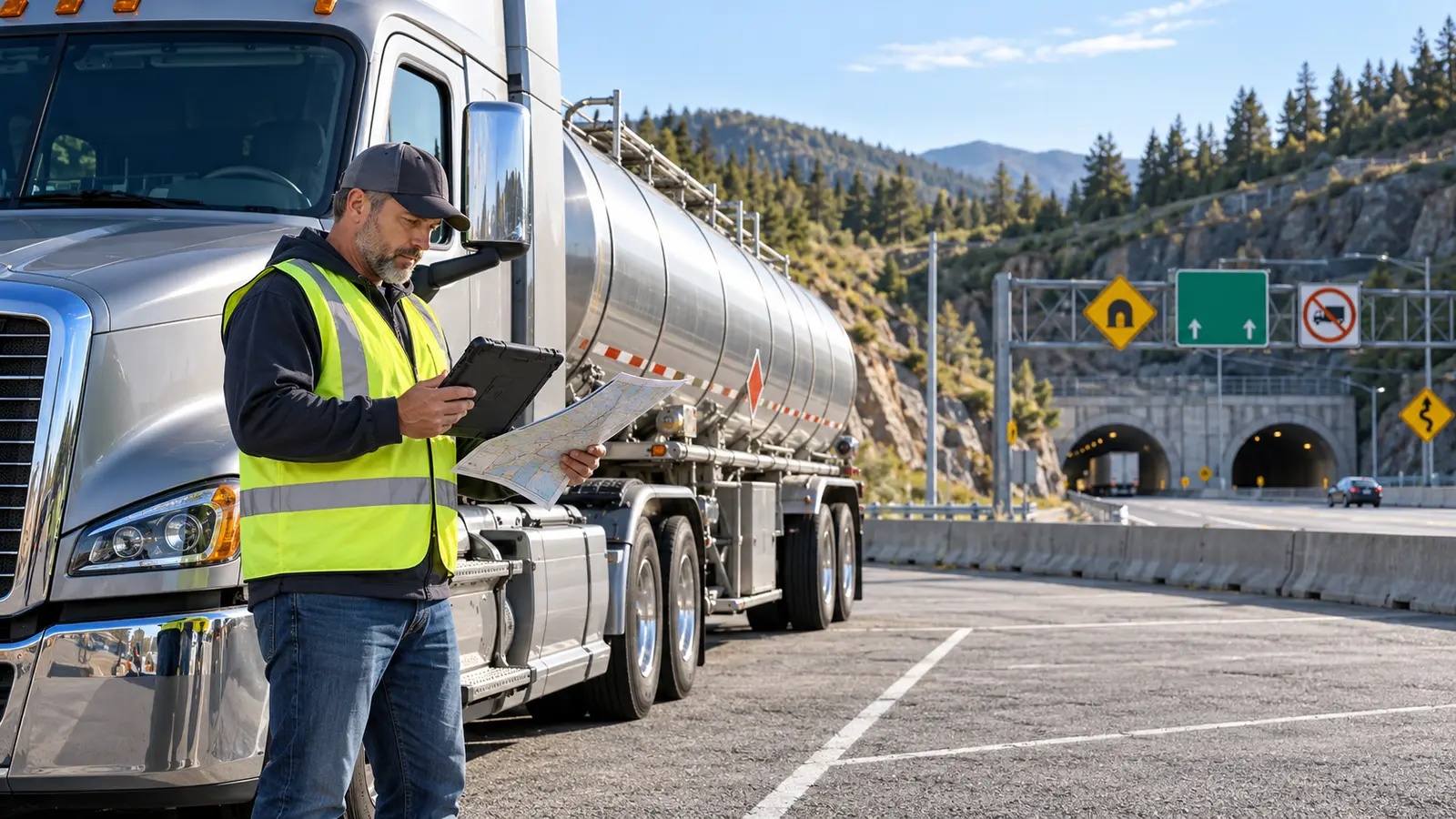
Hazardous-materials route planning is not simply choosing the shortest highway or accepting the first path from a navigation app. The carrier and driver must know what material is aboard, which routing rules apply, where state or Tribal designations restrict or prefer travel, and whether a tunnel, bridge, urban area, curfew, or local delivery changes the plan.
A compliant plan should be settled before departure and checked when conditions change. Match the shipping papers and placards to the route, confirm fuel and rest locations, keep an approved alternate, and know whom to contact when a closure makes the assigned route unusable.
Start with the material, quantity, and route category
The analysis begins with the shipment. Review the proper shipping description, hazard class or division, identification number, quantity, packaging, placards, and carrier instructions. A routing rule for explosives, poison-inhalation hazards, or highway-route-controlled radioactive material cannot be applied accurately from the word HazMat alone.
Part 397 defines non-radioactive hazardous material, or NRHM, for routing as non-radioactive material transported in types and quantities requiring placards under Table 1 or Table 2 of §172.504. A smaller regulated package does not automatically fall into that definition. Ask qualified carrier personnel when the classification or threshold is uncertain.
Follow official State and Tribal routing designations
Under 49 CFR §397.67, a carrier transporting NRHM must comply with applicable routing designations. A designation can include a preferred or prohibited road, curfew, lane restriction, port-of-entry requirement, travel-time limit, routing ban, or route-weight restriction. The rule may differ by material class and direction.
FMCSA's National Hazardous Materials Route Registry organizes preferred and restricted routes by State and affected hazard category. Use it for planning, then verify the description, map, times, terminal-access provisions, and permit or escort requirements with the responsible authority. A map symbol without its legend is not a complete instruction.
Avoid high-exposure locations when a practicable alternative exists
For placarded or marked hazardous-material vehicles not governed by an NRHM designation, §397.67 directs carriers to use routes that avoid heavily populated areas, assembled crowds, tunnels, narrow streets, and alleys. Limited exceptions exist, but operating convenience is not enough.
Compare lawful alternatives for population exposure, roadway design, tunnel and bridge rules, grades, construction, weather, dimensions, safe stops, and emergency access. The shorter route may be inappropriate if it creates a prohibited tunnel movement or unnecessary exposure. Document the selection under company procedure.
Know when a deviation is allowed
Section 397.67 permits a reasonable deviation when it is necessary to reach a terminal, loading or unloading point, food, fuel, repair, rest facility, or safe haven. It also recognizes emergency conditions such as an official detour or a law-enforcement direction. Those provisions do not create permission to improvise any route that feels faster or more convenient.
When leaving the primary route, choose a lawful segment that serves the necessary purpose and minimizes avoidable exposure. Confirm that the fuel stop, repair shop, parking location, or customer can accept the vehicle and material. Record the reason when carrier policy requires it. If an unexpected closure appears, stop in a safe legal location and contact dispatch before letting a consumer GPS select a tunnel, residential street, or restricted bridge.
A written route plan is not required for every HazMat load
The federal written-plan requirement in §397.67(d) is specific: before operating a vehicle containing Class 1 explosives in Divisions 1.1, 1.2, or 1.3, the carrier or its agent must prepare a compliant written route plan and provide a copy to the driver. When the trip starts away from the carrier's terminal, the driver may prepare the plan as the carrier's agent.
Do not turn that narrow rule into either extreme. It does not say every placarded load requires the same written document, and it does not mean other HazMat trips can depart without route planning. Carrier security plans, permits, State rules, customer requirements, and operating procedures may require written or electronic route records for additional materials. Follow the most specific lawful instruction that applies to the shipment.
Radioactive shipments have separate preferred-route rules
Placarded Class 7 radioactive material is addressed separately in §397.101. The carrier must select a route that minimizes radiological risk, considering available information about accident rates, transit time, population density and activity, time of day, and day of week, and must tell the driver both the assigned route and that the vehicle contains Class 7 material.
Highway-route-controlled quantities generally must use preferred routes. A preferred route can be an Interstate highway without a State-designated alternative or a route designated by the State routing agency. Interstate bypasses or beltways are generally used around cities when available, unless the State has designated another route. Deviations for pickup, delivery, fuel, rest, repairs, or emergencies are subject to detailed limits; these movements need specialist carrier planning, not a generic HazMat shortcut.
Treat every tunnel and bridge as location-specific
There is no single nationwide answer that all HazMat vehicles may use every tunnel or that all are prohibited. Restrictions can depend on hazard class, quantity, bulk packaging, vehicle type, time of day, direction, escort, permit, or facility operating condition. A road may be open to ordinary trucks while restricting tank vehicles, explosives, flammable gases, or other named materials.
Check the registry and official facility source before the trip, and watch regulatory signs on approach. Confirm the restriction applies to the current load rather than relying on memory from an empty return trip or a different cargo. If signage conflicts with the dispatch route, do not enter while trying to resolve it. Stop safely, contact dispatch or the authority, and use the approved alternative.
Navigation apps support the plan; they do not authorize it
Truck navigation can help with dimensions, commercial-road restrictions, traffic, and arrival times, but its database may be incomplete. A screen does not override a HazMat restriction, sign, permit, closure, police direction, or carrier instruction. Consumer navigation may optimize for passenger vehicles.
Enter the vehicle dimensions and HazMat settings accurately, compare the path with official sources, and save critical instructions where coverage is unreliable. Watch for prohibited-road signs before the last safe exit. Never handle a phone or attempt complicated rerouting while driving; stop lawfully first.
Build fuel, parking, and contingency stops into the route
A route is incomplete if the driver cannot take required rest, fuel safely, or respond to a defect without entering a prohibited area. Preselect more than one compliant stop, confirm operating hours and vehicle access, and consider hours-of-service limits, parking availability, weather, construction, and the material's attendance or security requirements. A legal roadway does not make every parking lot along it suitable for HazMat.
Create a simple contingency chain: approved primary route, approved alternate, dispatch and emergency contacts, official road-information sources, and a safe decision point before each restricted segment. If conditions change after departure, protect the vehicle and public first, then obtain updated direction. Do not wait until the tunnel portal, bridge toll, or urban restriction to begin solving the problem.
Use a practical pre-departure route check
Before moving, confirm the shipping papers, placards, endorsement, required permits, security instructions, route category, and customer address. Compare the assigned route with the National Hazardous Materials Route Registry and current State, Tribal, and facility information. Mark tunnels, bridges, curfews, designated bypasses, terminal-access segments, fuel, rest, repairs, safe parking, and an alternate route.
Brief the driver on the exact route and any stop restrictions. Make the route plan and emergency contacts immediately usable in the cab without distracting device interaction. Recheck weather, closures, and official alerts. During the trip, obey signs and law-enforcement directions, report deviations, and never enter a questionable segment merely because traffic pressure makes stopping inconvenient.
Connect route planning to HazMat ELDT
Appendix E to Part 380 requires HazMat endorsement theory to cover tunnels and railroad-highway grade crossings as well as routes and route planning for radioactive and non-radioactive hazardous materials. First-time H-endorsement applicants must complete the curriculum through an FMCSA-listed provider before taking the State HazMat knowledge test.
CDL Compass offers online HazMat ELDT theory covering the federal foundation, including routing responsibilities. Passing theory is the start, not the end: drivers must still complete the TSA and State endorsement process and follow shipment-specific carrier training, permits, route instructions, and emergency procedures. Experienced drivers should also review an unfamiliar corridor before accepting a load whose restrictions they have not handled.
The bottom line
A safe HazMat route is verified, material-specific, and practical for the entire trip. Identify the shipment category, comply with official designations, avoid high-exposure locations when a practicable alternative exists, and understand the special rules for certain explosives and radioactive material. Plan necessary stops and legal deviations before they become urgent.
Treat maps and navigation as tools, not authority. When a tunnel, sign, closure, or dispatch instruction creates doubt, stop safely and resolve it with official information. The professional choice is the lawful route that controls risk—not automatically the fastest line on the screen.