Foodservice Trucking Jobs in 2026: CDL Class, Touch Freight, Schedule, and Pay
Explore foodservice delivery trucking in 2026, including Class A versus Class B vehicles, touch-freight demands, route schedules, pay questions, safety, and employer training.
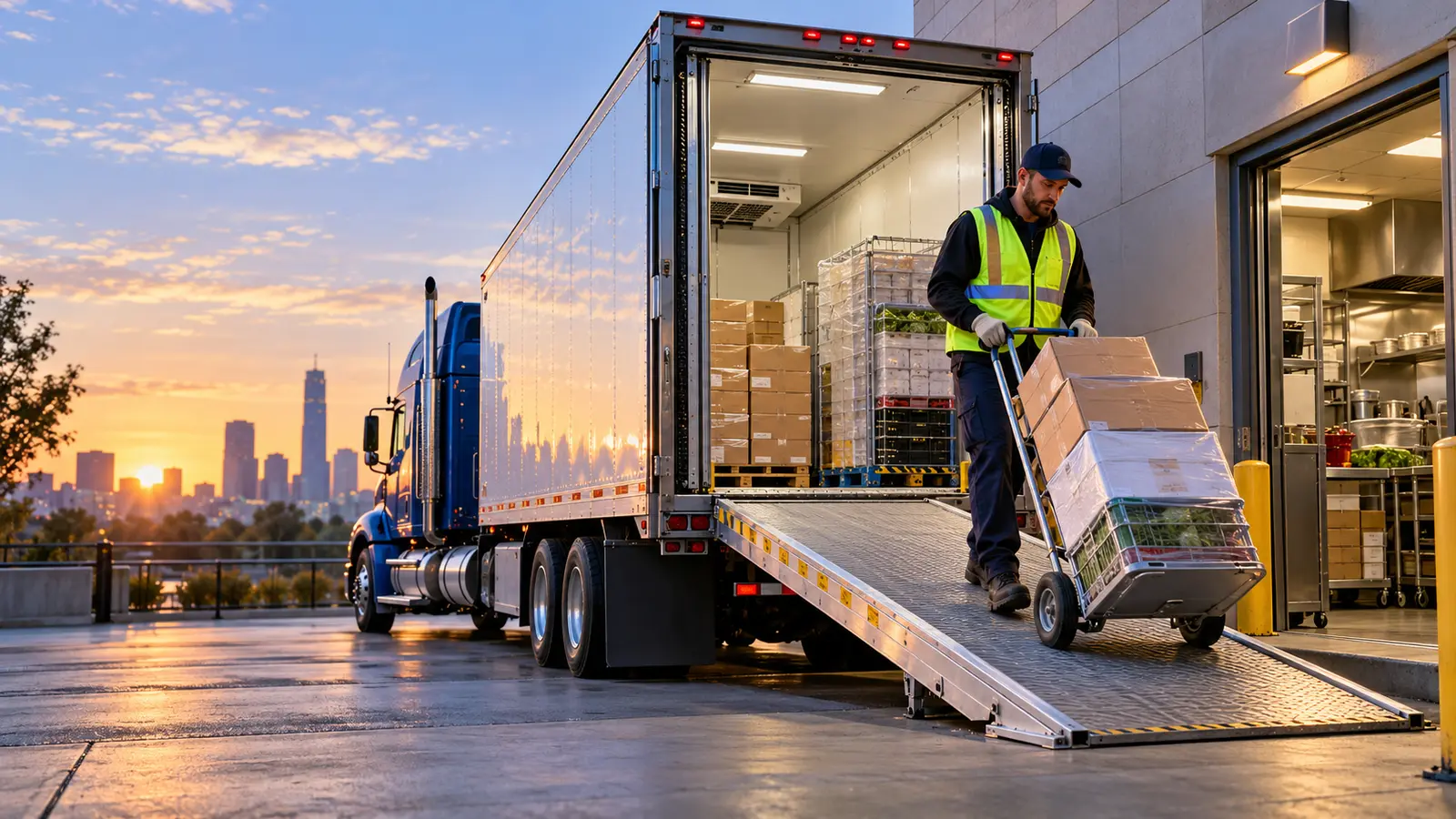
Foodservice trucking links a distribution center with restaurants, schools, hospitals, hotels, and other commercial kitchens. The work can offer local or regional routes and frequent customer contact, but it is rarely a driving-only job. A route may combine an early start, multiple stops, tight delivery windows, repeated backing, and hands-on unloading of dry, refrigerated, and frozen products.
That mix attracts some new CDL holders and exhausts others. Before accepting an offer, understand the equipment, physical duties, compensation plan, route expectations, and training. A clear picture of a normal day is more useful than a recruiter describing the position only as home-daily or high earning.
What a foodservice delivery route actually involves
A driver typically begins by inspecting the truck, checking route paperwork or a handheld device, and confirming that the load, seals, temperatures, and stop sequence match the assignment. At each customer, the driver may position the vehicle in a narrow alley or lot, set up a ramp or liftgate, sort cases by invoice, and move product with a two-wheel hand truck. The delivery can continue through a receiving door, hallway, elevator, or kitchen storage area.
Accuracy is part of the job. Drivers may verify item counts, obtain signatures, record shortages or damaged cases, collect returns, and communicate substitutions or service problems. O*NET lists checking load documents, inspecting cargo securement, positioning vehicles for unloading, obtaining receipts or signatures, and maintaining required records among the occupation's common tasks. Foodservice work concentrates many of those duties into every route.
Class A or Class B depends on the vehicle—not the job title
Foodservice companies operate tractor-trailers, heavy straight trucks, and smaller vehicles. Under 49 CFR §383.91, a Class A vehicle is a combination with a gross combination weight rating of at least 26,001 pounds when the towed vehicle has a GVWR over 10,000 pounds. Class B covers a single vehicle with a GVWR of at least 26,001 pounds, including one towing a vehicle rated at 10,000 pounds or less.
That means two drivers delivering similar products can need different CDL classes. Review the power unit, trailer, GVWR, and GCWR for the actual position. Ask whether routes ever require a tractor-trailer, whether a Class B driver can progress to Class A work, and which restrictions the employer accepts. Do not choose training based only on the words route driver or delivery truck.
ELDT is the entry point, not the entire job qualification
A person applying for a Class A or Class B CDL for the first time, or upgrading to one of those classes, generally must complete entry-level driver training through a provider listed on the FMCSA Training Provider Registry. Theory training establishes the federal knowledge foundation, while behind-the-wheel training develops vehicle-control and road skills. The state must be able to verify the required completion before the applicant takes the applicable CDL skills test.
Foodservice employers may add their own requirements for experience, age, driving record, medical qualification, manual-transmission operation, or customer-service ability. Their orientation should also cover the company's equipment, loading system, refrigeration procedures, delivery device, accident reporting, and site hazards. Completing ELDT does not replace supervised training on a loaded ramp or an unfamiliar customer location.
Touch freight makes physical capacity a core job requirement
Foodservice is commonly touch freight: the driver physically handles cases instead of leaving a sealed trailer at a dock. A shift can involve repeated pulling, pushing, bending, gripping, walking, and controlling a loaded hand truck on grades or thresholds. Case weights, stop counts, stairs, surface conditions, and delivery distance vary, so an average case weight alone does not describe the workload.
Ask for a realistic route observation or ride-along before committing. Find out the heaviest routine item, average cases and stops, whether helpers are assigned, and how often deliveries involve stairs or long carries. Learn whether the company uses ramps, liftgates, powered equipment, carts, or pallet drops. Good technique, suitable footwear, hydration, pacing, and reporting pain early matter more than trying to prove speed on the first week.
The schedule may start while customers are still asleep
Many routes leave at night or before sunrise so restaurants receive products before meal service. A home-daily position can still mean reporting at 10 p.m., 2 a.m., or 4 a.m., working weekends, and finishing later when traffic, weather, loading errors, or customer delays interrupt the plan. Route bidding and seniority may affect which schedules a new driver receives.
Request the actual report-time range, typical and high stop counts, average finish time, weekend rotation, and policy for mandatory extra work. Ask whether routes are fixed or changed daily and whether drivers return to the same terminal. Then consider sleep, commuting, childcare, meals, and recovery. A local job is not automatically an easy schedule; its advantage is often predictable time at home, not fewer working hours.
Evaluate pay by the whole workday
The Bureau of Labor Statistics reports a May 2025 median annual wage of $58,640 for heavy and tractor-trailer truck drivers overall. That national figure is not a foodservice-specific promise, and an individual offer may use hourly pay, mileage, component pay, stop pay, case incentives, guarantees, or a combination. A headline annual estimate is meaningful only when the driver understands the hours and conditions behind it.
Ask for a sample pay statement from a representative week and identify every paid activity: driving, unloading, stops, cases, delay, breakdown, training, holidays, overtime, and returns. Compare guaranteed minimums, benefit costs, retirement contributions, paid leave, and schedule premiums. Calculate gross pay against total on-duty hours, not just miles. Also ask how route changes, rejected product, missing cases, and customer delays affect compensation.
Safety decisions continue after the truck is parked
Foodservice routes combine normal commercial-driving risks with frequent transitions between road, parking lot, trailer, ramp, sidewalk, and customer building. Before moving the truck, complete the required inspection and confirm doors, ramps, liftgates, and cargo are secured. At a stop, choose the safest legal position available, use warning equipment or high-visibility clothing as required, and never assume restaurant staff or passing drivers can see you.
Keep the hand truck under control, maintain a clear path, and follow the employer's limits for stacking height and load weight. Do not rush down a wet, icy, greasy, or damaged ramp. Stop when a customer entrance, grade, traffic pattern, or equipment defect creates a hazard and contact the appropriate supervisor. Delivery speed never cancels the driver's responsibility for safe vehicle operation and cargo handling.
Customer service and inventory discipline affect the route
The driver often represents the distributor more frequently than a salesperson or manager. Professional communication matters when a delivery is late, a case is damaged, an invoice differs from the load, or a receiving area is blocked. Follow the documented process instead of promising an unauthorized credit, leaving product in an unsafe location, or signing on someone else's behalf.
Organization saves time and prevents claims. Keep invoices or digital stop records aligned with the freight, protect frozen and refrigerated products from unnecessary exposure, and document exceptions promptly. Ask how the company handles refusals, temperature concerns, product recalls, cash or check collections, and disputes. A strong employer provides an escalation path so the driver is not forced to choose between customer pressure and company policy.
Questions to ask before accepting the job
Ask what percentage of routes use Class A versus Class B vehicles, whether equipment has automatic or manual transmissions, and whether trailers are loaded in stop order. Request typical cases, stops, route miles, report times, finish times, and the frequency of stairs or helper routes. Confirm how route assignments, bids, overtime, weekends, holidays, and extra-board work operate for a new hire.
Then examine training and support. How many days are spent with a qualified trainer? Is ramp and hand-truck practice included before a production route? Who decides whether a driver is ready? What happens after an injury, equipment failure, vehicle damage, missed delivery window, or unsafe customer condition? Ask about turnover on the specific terminal and position. Detailed, consistent answers are more credible than a top-earner example without the hours or route attached.
Is foodservice trucking a good fit for you?
Foodservice delivery can suit drivers who want active work, frequent problem-solving, customer contact, and the possibility of returning home after a route. It can build strong backing, trip-planning, delivery, and time-management skills. It may be a poor fit for someone seeking no-touch freight, a low-physical-demand role, or a conventional daytime schedule.
Start by matching the CDL class to the equipment you want to drive. CDL Compass offers online Class A and Class B ELDT theory for first-time applicants; required behind-the-wheel training follows with an eligible provider. Then compare employers on safe training, realistic workload, transparent pay, and respect for fatigue and injury reporting. The right foodservice job is demanding, but its demands should be explained, trained, equipped, and paid—not hidden until the first solo route.