Can You Take ELDT in Another State in 2026? TPR, CLP, and CDL Rules
Learn when CDL applicants may complete ELDT outside their home state, how online theory and behind-the-wheel training work, and which state rules still apply.
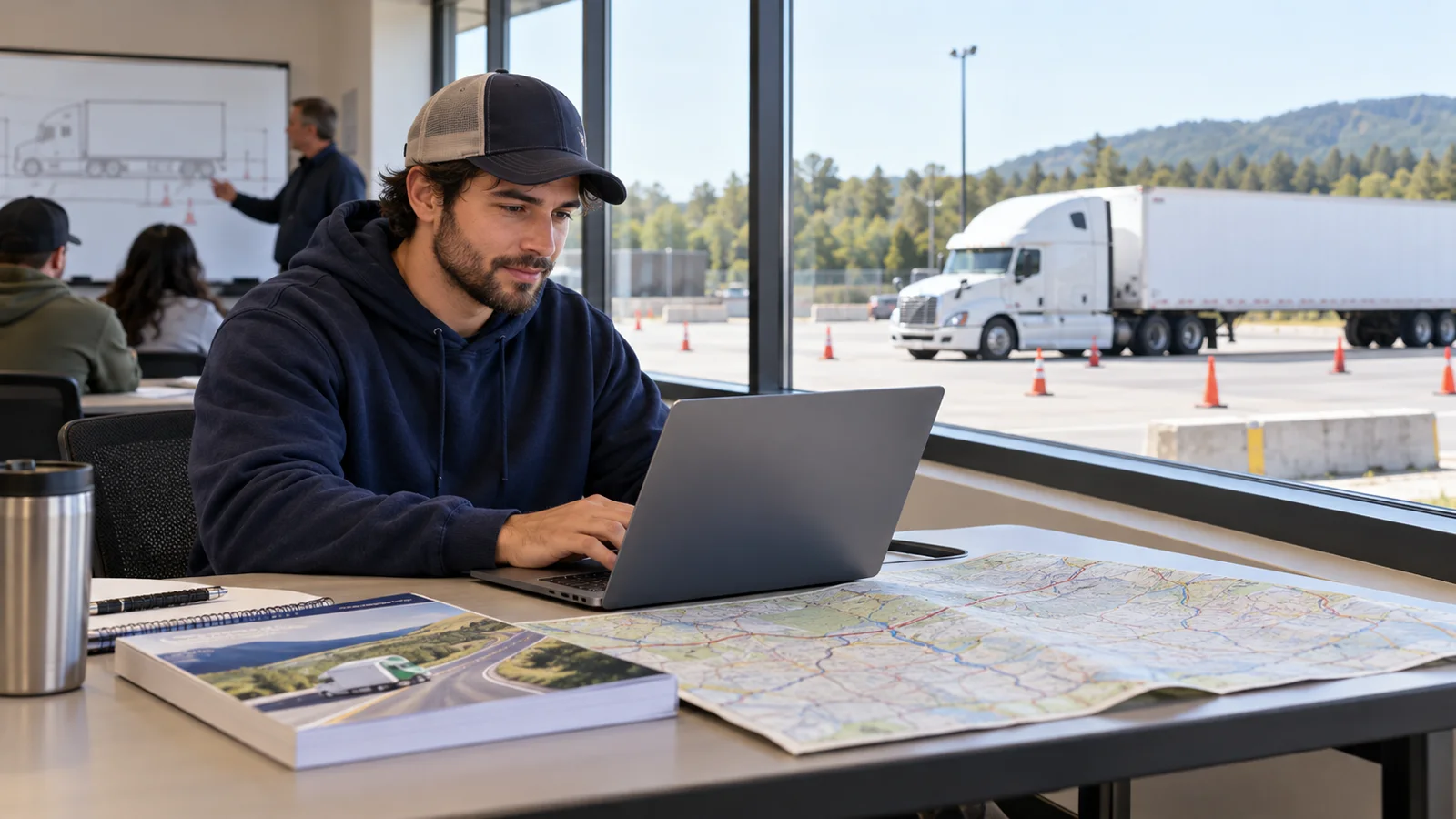
Yes. Federal Entry-Level Driver Training rules do not prohibit a CDL applicant from taking training outside the applicant's state of domicile. That can make an online theory course, a school near a state border, or a company-sponsored program in another state a practical option.
The important distinction is that federal ELDT, state training rules, the commercial learner's permit, the skills test, and the final CDL are related but separate pieces. An out-of-state plan can work, but only when the providers are registered, the records match, and the applicant checks the requirements of every state involved before paying or traveling.
The federal rule allows out-of-state ELDT
FMCSA's Training Provider Registry FAQ states that the regulations do not prohibit driver-trainees from obtaining training outside their state of domicile. It also explains that a driver domiciled in State A may receive behind-the-wheel training and pass the skills test in State B. Under 49 CFR 383.79, the licensing state must accept qualifying results transmitted by the testing state.
This flexibility does not mean every school can train every applicant in every location. The provider must be listed on the TPR for the exact curriculum it delivers, and it must follow applicable requirements in the state where that training occurs. Confirm the location, curriculum, and current registry status before enrollment rather than relying only on an advertisement.
Online theory is usually the simplest cross-state option
Class A, Class B, passenger, school bus, and HazMat theory may be delivered online by a registered provider. A student can therefore complete theory from home even when the provider's business address is in another state. The federal standard focuses on the approved curriculum, qualified instruction, assessment, and electronic certification—not on matching the provider's address to the student's address.
For Class A and Class B theory, all required topics must be covered and the student must score at least 80 percent on the written or electronic assessment. Online theory does not provide the physical vehicle practice required for a Class A or Class B CDL, and a simulator cannot replace mandatory behind-the-wheel training.
Behind-the-wheel training follows the training state's rules
Behind-the-wheel training must include the applicable range and public-road portions and must occur in a representative commercial motor vehicle for the class or endorsement sought. A TPR-listed instructor must evaluate proficiency in each required element. Federal ELDT rules do not prescribe a minimum number of BTW hours, but a state may impose additional hours or other standards.
FMCSA says additional state-based training requirements generally depend on where the applicant obtains the training. If State B requires a minimum number of range hours, an applicant training in State B may have to satisfy that requirement even when State A will issue the CDL. Ask the school which state's standards govern the course and whether any local instructor, school, or vehicle approvals apply.
Your licensing state can require more than federal ELDT
Federal ELDT establishes minimum national standards; it does not erase stricter state requirements. The applicant's state of domicile may require extra documents, fees, medical certification steps, training hours, or state-specific qualifications before issuing the CDL. School bus applicants are a common example because a state may require first aid, CPR, background checks, or additional school-bus training.
Read the current CDL manual and licensing-agency instructions for your home state before choosing an out-of-state program. If the plan includes theory in one state, BTW in another, and testing in a third, contact each relevant agency or provider. Get any important answer in writing and confirm that the licensing state can receive the test result electronically.
The CLP still controls public-road practice
A commercial learner's permit authorizes supervised practice on public roads; online theory completion alone does not. Federal rules do not require ELDT theory before an applicant obtains a CLP, but the applicant must hold the proper CLP and comply with its restrictions before conducting public-road training. States set their own application process, accepted identity and residency documents, testing appointments, and fees.
Also check whether the training state recognizes the permit for the planned instruction and whether the school requires a permit before range work. A Class A or Class B applicant must hold the CLP for at least 14 days before the CDL skills test and complete applicable ELDT before that test. State rules may create a longer timeline.
Theory and BTW may come from different providers
FMCSA permits theory and behind-the-wheel instruction to be delivered by separate registered providers. This makes a cross-state plan straightforward: complete theory online with one TPR-listed provider, then arrange local or out-of-state vehicle training with another provider listed for both range and public-road instruction. Each provider submits its own completion certification.
Do not assume one completion record covers the other provider's work. Class A and Class B applicants need both applicable components before the skills test. Passenger and school bus applicants need their required theory and BTW components, while first-time HazMat applicants need theory only before the State-administered H knowledge test.
Make sure the TPR record matches your license record
The training provider reports the student's name, date of birth, driver's-license or permit number, licensing state, training type, completion date, and other required information to the TPR. Under 49 CFR 380.717, that certification is generally due by midnight of the second business day after completion. The state verifies the record before administering the covered test.
Enter your legal name and license details exactly as shown on the CLP or driver's license. A transposed number, nickname, old license state, or incorrect date of birth can keep the state from matching the record. After each component, use FMCSA's Check My Record tool and contact the reporting provider promptly if anything is missing or wrong.
An out-of-state skills test is possible, but plan it early
49 CFR 383.79 allows a state to test a person who trained there but will be licensed in another U.S. jurisdiction. The testing state must send the result electronically and securely to the state of domicile, and the licensing state must accept a properly administered result. This rule supports out-of-state students; it does not guarantee that every testing site accepts them.
Before scheduling, ask whether the examiner tests nonresident applicants, which CLP and vehicle documents are required, who supplies the test vehicle, and how the result reaches the licensing state. Confirm the vehicle class, endorsements, air-brake equipment, transmission, and fifth-wheel configuration because the test vehicle can place restrictions on the CDL.
If you move during training, update the plan
A permanent move can change the state of domicile, driver's-license number, CLP, and agency responsible for issuing the CDL. Do not assume the old CLP or a pending appointment transfers automatically. Contact both state licensing agencies before surrendering a license, and ask the training providers what identifying information they used for the TPR submission.
Keep receipts, completion notices, provider contact details, and screenshots of your TPR record. If the new state issues a different license or permit number, ask how the existing training record will be matched. Avoid repeating training until the agencies and provider have checked whether a correction or verification will solve the problem.
Use this checklist before enrolling across state lines
First, search FMCSA's provider list by curriculum and confirm the exact training location or online offering. Second, read the training state's rules and your licensing state's CDL instructions. Third, verify prerequisites, total price, refunds, equipment, instructor qualifications, schedule, and whether the course includes theory, range, public road, or only one component.
Then confirm CLP acceptance, transportation and lodging, the skills-test plan, and how records will be reported. Use the same legal identity information everywhere and check the TPR after completion. A legitimate provider should explain its registry listing and the part of ELDT it certifies without promising that federal completion overrides separate state requirements.
Build a clean path from theory to the CDL
For many applicants, the most efficient route is online theory followed by behind-the-wheel instruction near home. The CDL Compass Class A and Class B ELDT courses provide the federally required theory through a registered-provider process, allowing students to complete the knowledge component before coordinating vehicle training. Choose the course that matches the license class you intend to test for.
Out-of-state training is a valid option, not a shortcut around licensing rules. Treat it as a coordination project: verify each provider, know which state governs each step, protect the accuracy of your TPR record, and confirm the testing and licensing handoff before travel. That preparation can prevent missed appointments, duplicate costs, and delays at the licensing counter.