CDL Tanker Surge in 2026: Baffles, Smooth-Bore Tanks, and Safe Control
Learn how liquid surge changes tanker handling, how baffles and bulkheads differ, and how smooth driving, braking, and curve planning reduce rollover risk.
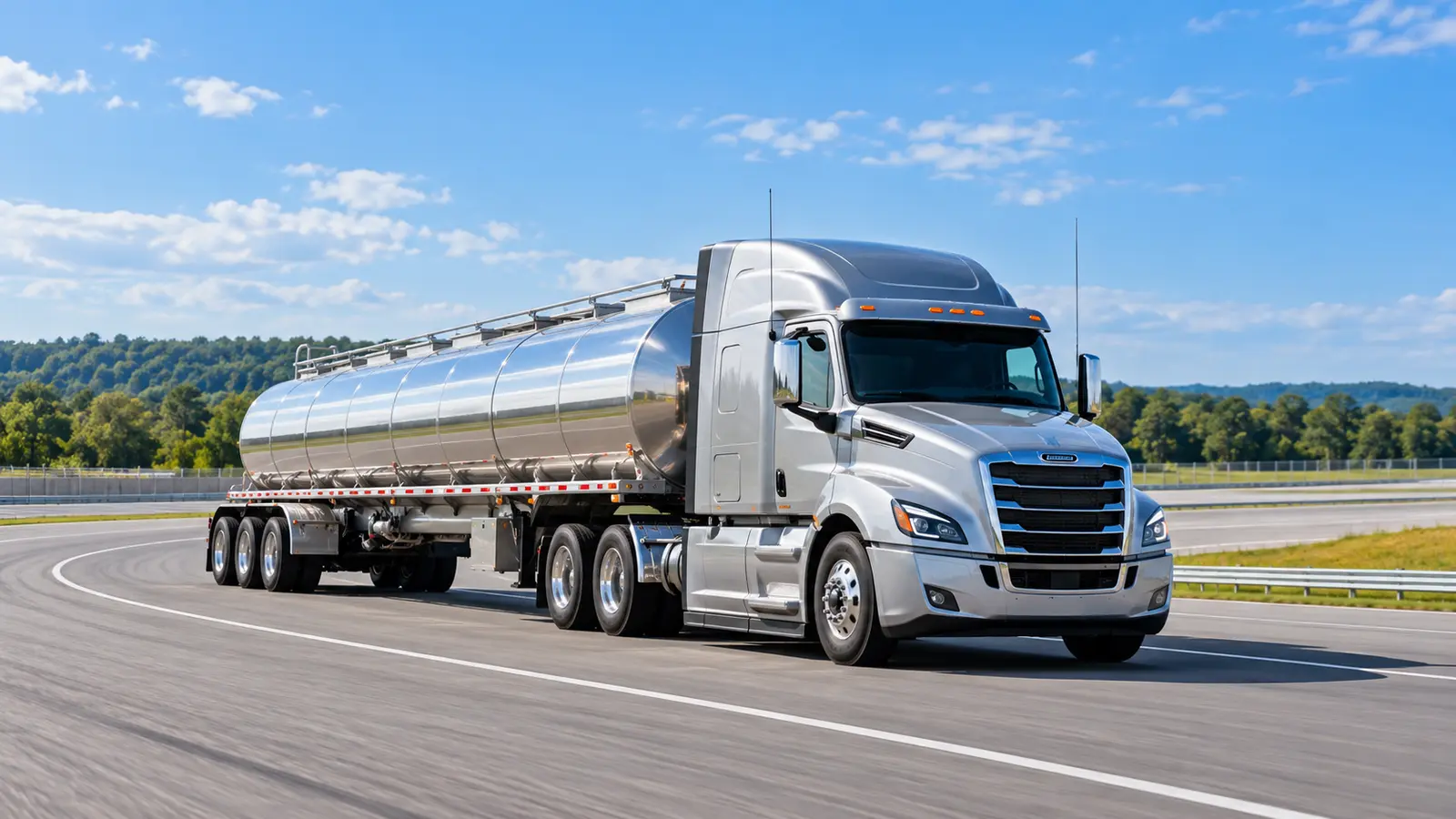
A liquid tanker can keep moving after the driver has stopped accelerating, turned the wheel, or applied the brakes. The cargo shifts inside the tank, changing the forces acting on the vehicle. That movement—liquid surge—is why a familiar road can feel very different in a tanker than in a dry van or straight truck.
Federal tanker-endorsement standards require knowledge of surge, braking, tank construction, product density, grades, curves, and emergency systems. The test is only the beginning. Safe tanker work depends on understanding the assigned equipment, load, route, and carrier procedures before moving.
Why liquid surge changes vehicle control
In a partly filled tank, liquid can travel forward and backward as speed changes. When the moving wave reaches the end of the tank, it can push in the same direction. A driver who brakes late may feel the load drive the vehicle forward, then rock again after the first stop. On a slick surface, that extra movement can reduce the margin for staying stopped and aligned.
Side-to-side movement matters just as much. Tank vehicles carry much of their cargo weight above the road, creating a high center of gravity. A quick lane change, sharp steering input, or excessive curve speed can combine lateral surge with that high center of gravity. The safer response is not a stronger correction; it is planning early enough to keep every acceleration, brake application, and steering movement smooth.
Bulkheads and baffles are not the same thing
A bulkhead divides a tank into separate compartments. Each compartment can hold product independently, so the driver and loader must protect weight distribution rather than placing too much weight at one end. Separate compartments do not make the vehicle immune to surge; liquid can move within every partly filled compartment.
A baffle is an internal divider with openings that allow liquid to pass through. It slows some forward-and-back movement instead of creating fully separate compartments. That can moderate longitudinal surge, but it does not eliminate it, and side-to-side movement can still contribute to rollover. Before a trip, know whether the tank is compartmented, baffled, or unbaffled and how the actual fill pattern affects handling.
Smooth-bore tanks demand extra anticipation
An unbaffled tank—often called a smooth-bore tank—has no internal baffles to slow the cargo's forward-and-back flow. These tanks are common in some food-grade operations because an unobstructed interior is easier to clean. Their stronger surge makes gentle starts and early, steady stops especially important.
Timing learned in a baffled tank may not work in a smooth-bore unit. Tank shape, suspension, product density, fill level, grade, and surface conditions all change the response. New drivers need equipment-specific instruction and supervised practice before operating an unfamiliar configuration.
Full, partial, and empty tanks each handle differently
A partial load usually creates more room for liquid movement, but a full tank has its own weight and stopping demands. An empty tank may have less traction than a loaded unit and can still carry regulated residue or vapor. Empty does not mean harmless.
Drivers also need to understand outage—the unfilled space required for liquid expansion. The correct amount depends on the product, temperature, density, legal weight, tank design, and loading instructions. Verify the documents, compartment plan, weights when required, seals, valves, and loading information instead of guessing.
Brake early and keep the application controlled
Create stopping distance before it is needed. Ease off the accelerator early, keep the vehicle straight, and apply steady brake pressure. Releasing too soon can let surge push the vehicle forward; abrupt pedal changes can make the stop less stable. Leave additional following distance so ordinary traffic changes do not become emergencies.
Use the braking system as trained for that vehicle and road condition. Anti-lock brakes help preserve wheel rotation during hard braking, but they do not cancel surge. Avoid combining severe braking with sudden steering. In an emergency, use the approved technique while keeping the vehicle as stable and straight as conditions allow.
Enter curves slower than a dry-van habit may suggest
Posted curve speeds are not a promise that every commercial vehicle can travel safely at that number. Tankers can roll at speeds that may feel routine in another vehicle. Reduce speed before the curve, use the correct gear, maintain a steady path, and avoid hard braking inside the turn. On ramps, off ramps, construction shifts, and decreasing-radius curves deserve the same preparation.
Watch the full route, not only the bend immediately ahead. A downgrade leading into a curve increases the energy that must be managed. Crosswinds, uneven pavement, wet or icy surfaces, a high-density load, and a partially filled smooth-bore tank can shrink the margin further. If the approach feels rushed, slow sooner; entering too fast leaves few safe corrections once lateral force has built.
Inspect the tank system, not only the tractor
Before loading, unloading, or driving, inspect the tank body and mounting, piping, hoses, joints, manhole covers, vents, valves, and discharge equipment required for that unit. Look underneath and around the vehicle for leakage. Confirm that covers and valves are properly secured and that emergency shutoff, grounding, vapor-recovery, fire-protection, or other special equipment is present and functional when required.
A leak, unsecured valve, damaged fitting, or blocked vent is not a handling lesson to learn on the road. Stop the process and follow the carrier, facility, and emergency procedure. During the vehicle inspection, also cover tires, wheels, brakes, suspension, lights, coupling equipment, and required emergency gear. Product-specific hazards may require precautions beyond the general tanker knowledge test.
Match the endorsement to the actual operation
The N endorsement is for qualifying tank vehicles and requires a specialized knowledge test. Under the federal definition, the tank or tanks generally have individual rated capacities above 119 gallons and an aggregate rated capacity of at least 1,000 gallons, whether permanently or temporarily attached. The liquid or gas does not have to be hazardous for the tank endorsement to apply.
If the operation also transports hazardous material that requires the H endorsement, the driver needs both tank and HazMat authority, commonly displayed as an X endorsement. A first-time H applicant must complete HazMat ELDT theory, pass the state knowledge test, and satisfy the TSA security threat assessment. Adding N alone does not trigger federal ELDT, although ELDT may apply to the first Class A or Class B license used for the job.
Study for the test, then train for the equipment
Use your home state's current CDL manual because the state administers the endorsement test. Be ready to explain surge, bulkheads, baffles, smooth-bore tanks, outage, density, curves, grades, stopping distance, inspections, and emergencies. Learn the reasons behind the answers; memorizing a phrase about baffles will not tell you how the vehicle will respond at the next stop.
Then ask the employer or training provider practical questions: Which tank designs and products will I handle? How are compartments loaded? What are the shutdown and spill-reporting steps? How does the unit behave empty, full, and at common partial loads? Where can I practice smooth stops and turns under supervision? Carrier qualification and product training may be more specific than the licensing minimum.
Build a repeatable tanker-driving routine
Before departure, identify the tank configuration, product, fill level, compartment distribution, gross and axle weights, route, weather, and emergency contacts. Complete the vehicle and tank inspection, verify documents and endorsements, and make sure every valve, cover, hose, and piece of equipment is secured. Adjust mirrors, belt in, and create a larger following-distance plan before entering traffic.
On the road, look far ahead, change speed gradually, slow before curves, avoid abrupt lane changes, and reassess after loading conditions or weather change. If you are preparing for a first Class A or Class B CDL, CDL Compass theory can build the foundation for braking, inspections, and safe operating practices before registered behind-the-wheel training. Drivers adding first-time HazMat authority can complete the separate HazMat ELDT theory course, then apply it with job-specific tanker instruction.
The bottom line
Baffles can reduce some forward-and-back movement, but no tank design removes surge or rollover risk. Smooth-bore tanks need even more anticipation, compartmented tanks require careful weight distribution, and every configuration rewards the same basic habits: inspect thoroughly, look farther ahead, slow sooner, steer gently, and brake with controlled pressure.
The N endorsement proves required knowledge, not mastery of every tank or product. Treat a change in equipment, cargo, fill level, route, or weather as a reason to re-plan. The best tanker drivers make the vehicle feel uneventful because they manage the forces before those forces demand a correction.