CDL Tanker Endorsement in 2026: N vs. X, ELDT, and Test Preparation
Learn when a tanker endorsement is required, how N differs from X, which ELDT rules apply, and how to prepare for the state knowledge test.
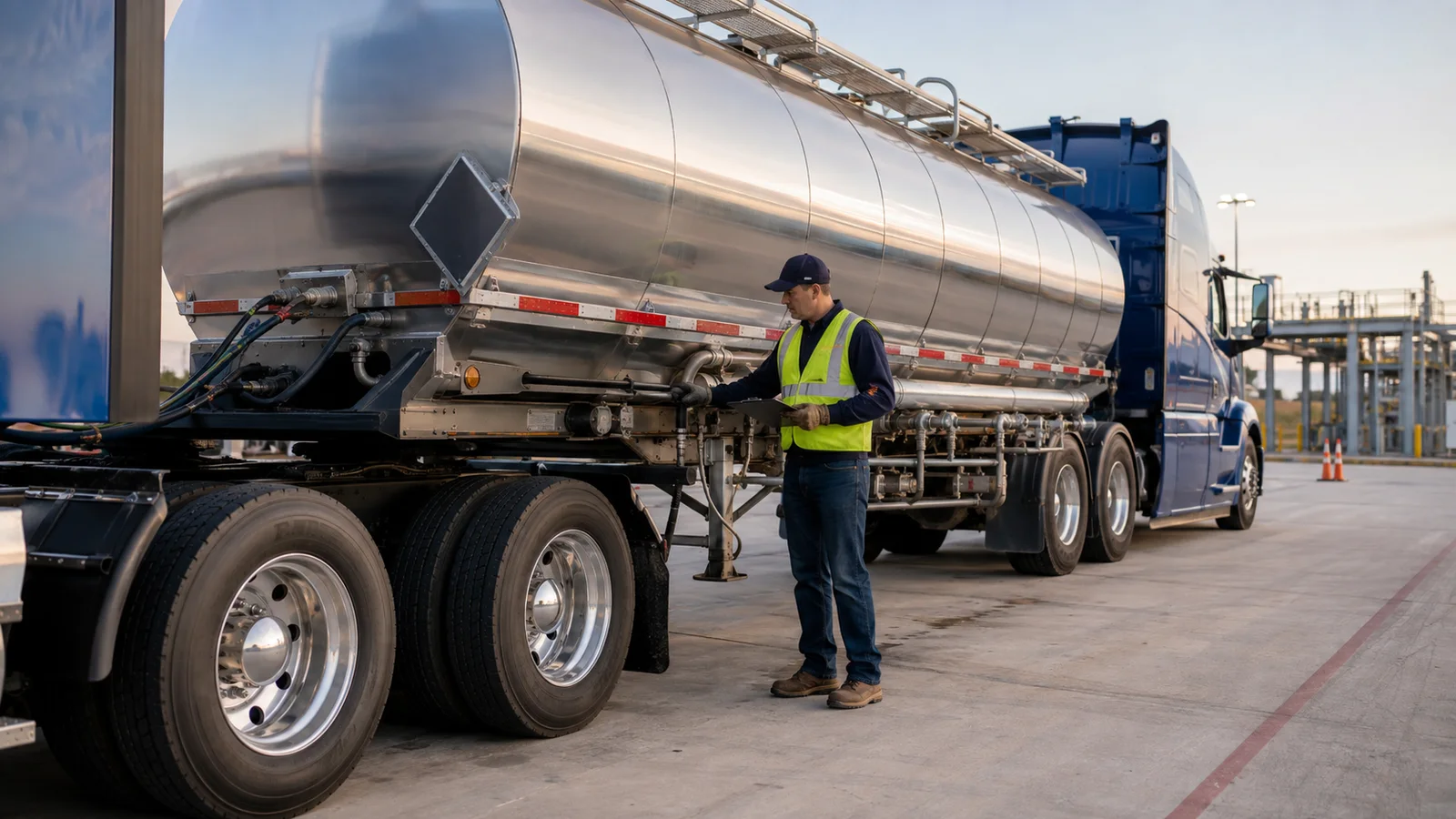
A tanker endorsement can open work in fuel, food-grade liquid, water, chemical, sanitation, agriculture, and industrial transport. It also represents a different driving problem: liquid or gas can move inside the tank, change how the vehicle responds, and increase rollover risk when speed, braking, or steering is poorly managed.
As of August 11, 2026, the federal N endorsement covers tank vehicles, while X combines tank-vehicle and hazardous-materials authority. The correct credential depends on the vehicle’s tank capacity and whether the cargo requires a hazardous materials endorsement—not simply whether a trailer looks like a traditional highway tanker.
When federal rules treat a CMV as a tank vehicle
Under 49 CFR §383.5, a tank vehicle is a commercial motor vehicle designed to transport liquid or gaseous materials in one or more tanks. At least one tank must have an individual rated capacity of more than 119 gallons, and the aggregate rated capacity must be 1,000 gallons or more. The tank may be permanently or temporarily attached to the vehicle or chassis.
Both parts of the capacity definition matter. A group of small containers does not become a tank vehicle merely because their combined capacity reaches 1,000 gallons when none exceeds 119 gallons. Likewise, one tank larger than 119 gallons does not meet the federal definition if the applicable aggregate capacity remains below 1,000 gallons.
An empty storage tank not designed for transportation and temporarily attached to a flatbed is excluded under the rule. Near a threshold, use manufacturer-rated capacities and confirm the classification with the state and carrier.
N, H, and X endorsements serve different purposes
The N endorsement authorizes operation of a qualifying tank vehicle carrying non-hazardous cargo. Common examples can include water, milk, liquid food ingredients, or other products that do not require hazardous-material placarding. The cargo still may be regulated by weight, sanitation, food-safety, environmental, or company rules.
The H endorsement authorizes transportation of hazardous materials that require the endorsement under federal and state rules. It is not limited to tank vehicles; placarded hazardous materials can travel in vans, containers, cylinders, or other packages. The X endorsement represents the combination of tank-vehicle and hazardous-materials endorsements for drivers who need both authorities.
Cargo classification, quantity, packaging, concentration, and placarding determine whether H is needed. Use current shipping information; when a qualifying tank carries material requiring H authority, the driver generally needs X rather than N alone.
Does the tanker endorsement require ELDT?
The federal Entry-Level Driver Training list includes a first Class A CDL, first Class B CDL, Class B-to-A upgrade, and first passenger, school-bus, or hazardous-materials endorsement. The N tanker endorsement is not on that list. A driver adding N to an existing CDL therefore does not complete a separate federal tanker ELDT course before the N knowledge test.
A first-time H applicant does need the H theory curriculum from a provider listed in FMCSA’s Training Provider Registry before the state may administer the H knowledge test. Because X includes hazardous-materials authority, a driver seeking X who has never held H should plan for HazMat ELDT as part of the process.
ELDT can still apply to the underlying first Class A or Class B CDL. CDL Compass offers registered online Class A, Class B, and HazMat theory; state tests and required hands-on training remain separate.
How to add N or X to a CDL
Begin with your home-state licensing agency. Ask about the application, identity documents, medical status, tests, fees, appointments, and credential issuance. Procedures and test lengths vary by state.
For N, study the tanker section of the current official state CDL manual and pass the tank-vehicle knowledge test. Federal rules list N as a knowledge-test endorsement; they do not create a separate tanker skills test. A carrier can still require a road evaluation, loading qualification, product training, or supervised experience before assigning a tank vehicle.
For a first X, complete HazMat ELDT, verify the Registry record, pass required state tests, and complete TSA’s threat assessment and fingerprint process. Follow the state’s sequence; TSA approval alone does not add X to a CDL.
CLP holders face strict tanker limits
Federal rules allow only P, S, and N endorsements on a commercial learner’s permit. A CLP holder who passed the N knowledge test may operate only an empty tank vehicle and must follow all normal CLP supervision requirements. The supervising CDL holder must have the correct license class and endorsements for the vehicle.
The permit holder may not operate a tank vehicle that previously carried hazardous materials unless it has been purged of residue. A CLP holder also may not transport hazardous materials as defined in the federal CDL rules. These limits prevent a learner from treating an N-marked permit as authority to haul revenue cargo or practice loaded tanker work.
Before training, confirm that equipment is empty and properly purged. Residue, vapors, placards, cleaning records, and carrier policy matter; keep uncertain equipment out of learner service.
What to study for the tanker knowledge test
Start with liquid surge. When a partially filled tank accelerates, brakes, turns, or changes grade, the liquid continues moving and can push the vehicle forward, backward, or sideways. Smooth control and increased following distance give the driver more time to manage that movement.
Understand baffled, unbaffled, and multiple-compartment tanks. Baffles can reduce forward-and-back surge but do not eliminate side-to-side movement. An unbaffled smooth-bore tank can produce strong surge and requires especially gradual starts and stops. Separate compartments change how weight is distributed and may hold different amounts or products.
Study outage, expansion, density, axle weights, and legal load limits. A tank may need unused space so liquid can expand, and different liquids have different weights per gallon. A tank can reach an axle or gross-weight limit before it is full. The driver must know the load’s weight and distribution rather than assuming tank volume equals legal capacity.
Review inspection points, valves, manholes, covers, vents, hoses, connections, leaks, placards when applicable, emergency equipment, and loading or unloading responsibilities. The knowledge test measures rules and safe concepts, but employers will expect those ideas to become a consistent inspection routine.
Drive a tanker with a rollover-prevention mindset
Tank vehicles often carry a high center of gravity. Excess speed in a curve, ramp, roundabout, or turn can roll the unit. Set speed before the curve and steer smoothly.
Leave additional braking space and avoid last-second lane changes. Surge can affect the vehicle again as liquid rebounds. Reduce speed further on wet, icy, or uneven roads and avoid abrupt inputs.
Loading and unloading add hazards including pressure, static electricity, falls, contamination, and spills. Follow site procedures, product training, protective-equipment rules, emergency instructions, and carrier policy.
Use this endorsement-planning checklist
Confirm the vehicle meets the federal tank definition using rated capacity, then determine whether the cargo needs hazardous-materials authority. Choose N for tank-only work or plan H and N for X.
Read the current state CDL manual, complete HazMat ELDT when H is new, and verify state and TSA prerequisites. Keep identifying information consistent across every record.
After issuance, inspect the CDL for the correct endorsement and all restrictions. Before accepting a load, complete employer training for the vehicle, product, loading, unloading, and emergencies. Safe tanker work requires understanding the equipment, cargo, route, and facility procedure before movement.
Build the license that matches the work
N can expand a CDL into non-hazardous tank work without a separate federal ELDT curriculum, while X adds the more demanding HazMat pathway. The distinction is easy to remember: tank equipment drives the N requirement, hazardous-material authority drives H, and needing both produces X.
If you are still earning the underlying CDL, use the Class A or Class B course that matches the vehicle you plan to operate. If X is the goal and H is new, complete registered HazMat theory before the state knowledge test. Then prepare beyond the exam—because safe tanker work depends on smooth control, careful inspection, accurate loading information, and disciplined decisions on every trip.