CDL Railroad Crossing Rules in 2026: Who Must Stop, Clearance, and Gear Choice
Learn which commercial vehicles must stop at railroad crossings, where to stop, when exceptions apply, and how every CDL driver should confirm a clear path across the tracks.
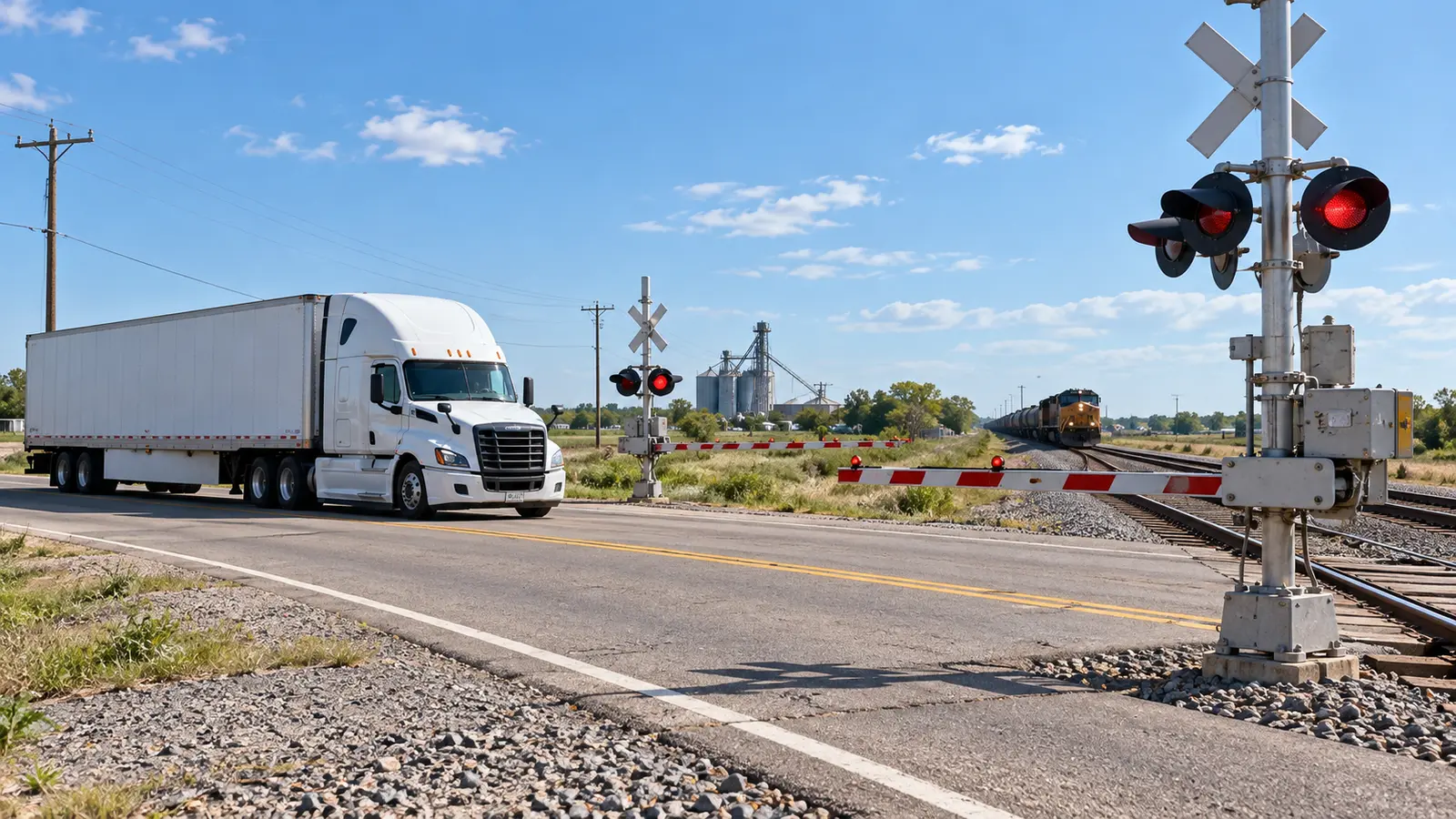
A railroad crossing gives a commercial driver one safe objective: enter only when the entire vehicle can clear the tracks without stopping. The decision must account for train movement, signals, road traffic, the length and ground clearance of the truck, and the rules that apply to the vehicle and cargo.
Federal regulations do not require every commercial motor vehicle to perform the same stop. Certain buses, hazardous-material vehicles, and cargo tank operations must stop 15 to 50 feet from the nearest rail. Other CMVs must approach slowly enough to stop and use due caution before crossing. Every CMV, however, needs enough space on the far side to clear the crossing completely.
Know whether your CMV is in the mandatory-stop group
Under 49 CFR §392.10, a bus transporting passengers must stop. The rule also covers a CMV carrying any quantity of Division 2.3 chlorine, vehicles required to display specified hazardous-material markings or placards, and several cargo tank operations. The cargo-tank provisions can apply whether the tank is loaded or empty when it was used to transport hazardous material.
Do not reduce this to the memory shortcut that only school buses and explosives stop. The federal list includes multiple hazard classes and particular cargo-tank conditions. Before departure, identify the material, packaging, placards or markings, tank status, and carrier instructions. If the load profile is unclear, resolve it through the shipping papers and qualified carrier personnel before reaching the tracks.
Stop between 15 and 50 feet from the nearest rail
A driver covered by §392.10 must stop within 50 feet of the tracks but not closer than 15 feet to the nearest rail. The position needs to preserve a useful view without placing the cab, mirrors, bumper, or load inside the crossing envelope. Pavement stop lines can help with positioning, but the federal distance is measured from the nearest rail.
At the stop, listen and look in both directions and determine that no train is approaching. Control noise and distractions according to the vehicle, state law, and company procedure. Do not move merely because the vehicle ahead crossed, a gate is raised, or another road user waves. The driver of the CMV remains responsible for the decision.
Select a gear that completes the crossing without shifting
When it is safe to proceed, §392.10 requires the covered CMV to cross in a gear that allows the vehicle to finish without changing gears. Shifting on the tracks creates an avoidable chance of a missed gear, stall, rollback, or loss of attention while the driver should be monitoring the path.
Choose the gear before moving and maintain controlled momentum. Leave enough following space that a vehicle ahead cannot trap the truck on the rails. For a manual transmission, follow the equipment-specific method taught by the instructor or carrier. For an automatic, select the appropriate drive range and avoid unnecessary control changes while crossing.
Other CMVs must slow and confirm the course is clear
A commercial vehicle not listed in §392.10 is governed by §392.11. It must approach at a speed that permits a stop before the nearest rail, and the driver must use due caution to determine that the path is clear before driving onto or over the crossing. This is not permission to roll through at ordinary road speed.
The correct approach depends on sight distance, surface, grade, traffic, weather, vehicle weight, and the crossing design. Cover the brake as appropriate, scan both directions, watch signals and gates, and be prepared to stop. A driver who is not legally required to make the special 15-to-50-foot stop may still need to stop because of a train, signal, traffic, law-enforcement direction, local law, or unsafe visibility.
Never enter without room beyond the tracks
Section 392.12 applies to every CMV: do not drive onto a highway-rail crossing unless there is enough space to drive completely through without stopping. Look past the rails before committing. A green traffic light, moving queue, or open gate does not create clearance if congestion on the far side can hold the trailer on the tracks.
Estimate the full combination length, not only the tractor. Include rear overhang, multiple trailers, and the room needed to straighten after a turn. If traffic is backed up, wait before the crossing even when a following driver becomes impatient. Enter only after a space large enough for the entire unit is visibly available.
Check low-ground-clearance and route risks
A raised or sharply crowned crossing can high-center low equipment. Lowboy trailers, car carriers, moving vans, buses, and equipment with long wheelbases or low-mounted components deserve route review. Warning signs, pavement scars, carrier route notes, and dispatch instructions may identify a crossing that should not be attempted.
Do not improvise after the tractor has entered the tracks. If clearance is uncertain, stop in a lawful safe place before the crossing and contact dispatch, the road authority, or law enforcement as appropriate. Use an approved alternate route. Never try to solve a clearance problem by racing, crossing diagonally without traffic control, or relying on a spotter who cannot control trains and road traffic.
Understand the federal stop exceptions carefully
Section 392.10 lists limited places where its special stop is not required: certain streetcar or industrial-switching crossings within a business district; a crossing where a police officer or flagger directs traffic to proceed; a functioning highway signal displaying green when local law permits passage without slowing or stopping; a signed abandoned crossing; and an industrial or spur crossing officially signed Exempt.
An exception is not a general waiver of caution or clearance. A faded track, quiet rail line, navigation-app note, or unofficial sign does not establish abandonment or exempt status. State law, school-bus rules, facility procedures, and employer policy may be stricter than the federal minimum. When rules differ, follow the requirement that lawfully applies to the operation.
Respond correctly to gates, lights, and an unexpected stop
Never drive around a lowered gate or enter while warning devices indicate an approaching train. Do not assume that a second track is clear after the first train passes; another train can approach from the opposite direction. Wait until the signals, gates, traffic conditions, and view support a lawful crossing.
If a vehicle stalls or becomes stuck on the tracks, evacuate occupants away from the tracks and toward the direction from which a train could approach, so debris is less likely to be pushed toward them. Call 911 and use the blue Emergency Notification System sign at the crossing to contact the railroad with the crossing identification. Company reporting comes after immediate life-safety actions.
Build a repeatable approach checklist
Before the trip, review the route for crossings, low-clearance warnings, construction, detours, and prohibited HazMat routes. Know whether the vehicle is in the mandatory-stop group. Confirm the shipping papers, placards, endorsements, bus status, tank history, and carrier crossing procedure. Secure loose items and explain passenger expectations when applicable.
On approach: scan early, check traffic behind, reduce speed smoothly, choose the lawful stop position when required, silence distractions, look and listen both ways, and verify space beyond the rails. Before moving: select the crossing gear, recheck signals and tracks, and confirm that the full vehicle can clear. During the crossing: stay in lane, avoid shifting, and keep moving until every part of the unit is beyond the tracks.
Railroad crossings are part of CDL knowledge and ELDT
Federal CDL knowledge standards include railroad-highway grade crossings, and the Class A and Class B ELDT curricula cover crossing procedures in theory and behind-the-wheel public-road training. A theory lesson can explain the rule, but a trainee must also demonstrate safe visual search, speed control, gear selection, vehicle positioning, and clearance judgment with a qualified instructor.
CDL Compass offers online Class A and Class B ELDT theory to build that regulatory foundation. Applicants must still complete the applicable range and public-road training with a registered behind-the-wheel provider. Drivers pursuing passenger, school-bus, tanker, or HazMat work should add the credential-specific training, testing, screening, and employer instruction required for that operation.
The bottom line
Railroad-crossing compliance begins before the tracks are reached. First identify whether the vehicle must make the 15-to-50-foot stop. Then approach at a controllable speed, look and listen, select the proper gear, and confirm that the entire CMV has room beyond the crossing. Never enter a crossing that traffic, grade, or clearance could block.
Treat raised gates and quiet tracks as information, not guarantees. A professional driver verifies the path, respects official signals, and waits when the situation is uncertain. Losing a few minutes before the crossing is always preferable to stopping on it.