Who Is Exempt from ELDT in 2026? CDL Training Exceptions Explained
Learn which CDL applicants may be exempt from federal ELDT requirements, why common assumptions are wrong, and how to confirm your status before testing.
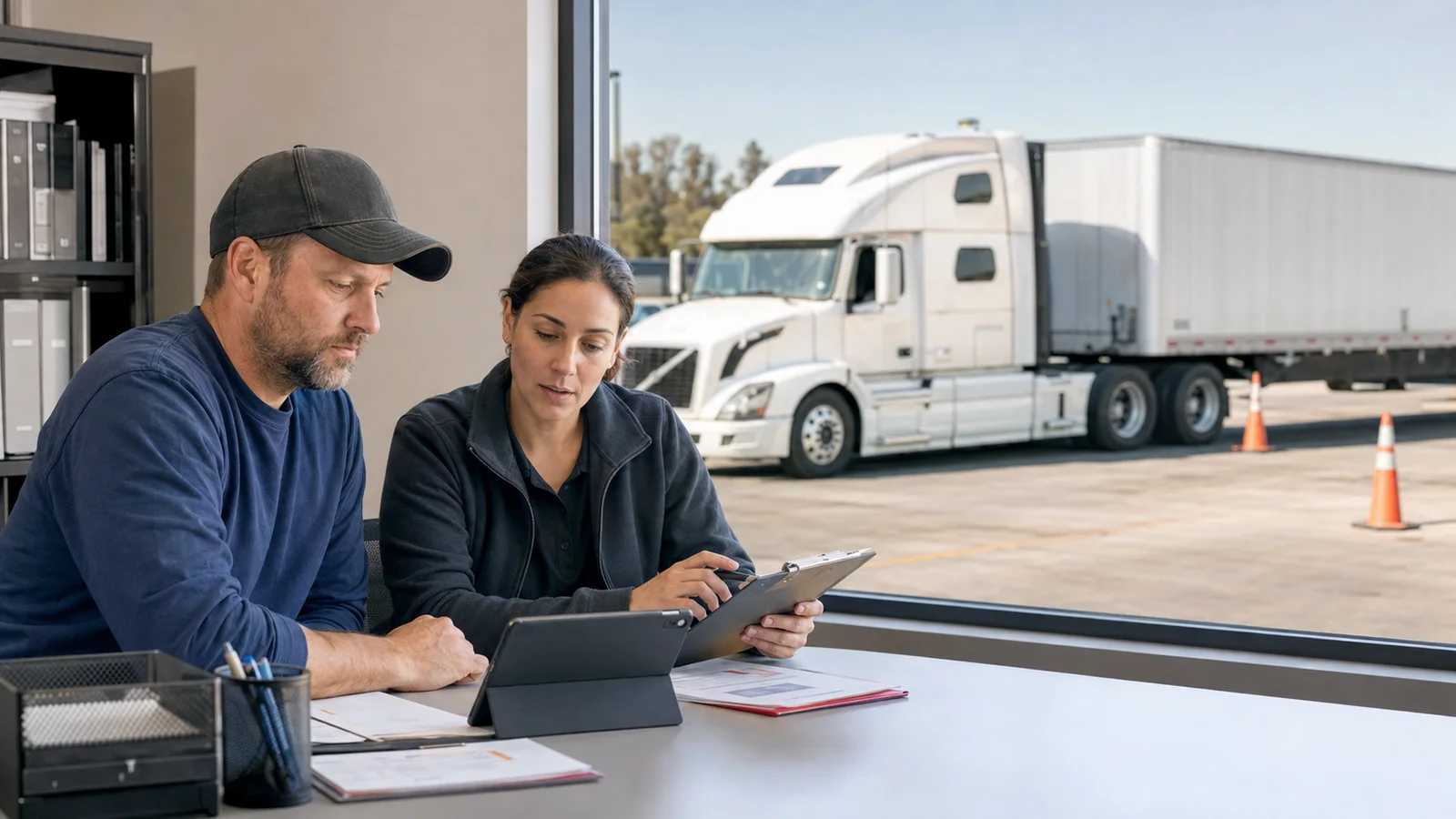
Most first-time Class A and Class B CDL applicants must complete Entry-Level Driver Training before taking the applicable state skills test. ELDT also applies to a Class B holder upgrading to Class A and to drivers obtaining a hazardous materials, passenger, or school bus endorsement for the first time. However, federal rules contain limited exceptions tied to existing CDL rules, military experience, restricted licenses, and certain restriction-removal tests.
An exception is not simply permission to skip a course because a driver already knows how to operate a truck. Eligibility depends on the credential, the applicant’s history, the vehicle and operation, and sometimes the state’s decision to use a federal option. Confirm the exact situation with the State Driver Licensing Agency before scheduling a test.
Start with the normal ELDT rule
Federal ELDT requirements apply to people seeking a Class A or Class B CDL for the first time, upgrading a Class B CDL to Class A, or adding an H, P, or S endorsement for the first time. Class A and Class B applicants complete the applicable theory and behind-the-wheel curricula with providers listed in the FMCSA Training Provider Registry. A first-time HazMat applicant completes the H endorsement theory curriculum before the state knowledge test.
ELDT is a federal minimum. A state may impose additional training, licensing, testing, or school requirements that are separate from FMCSA’s baseline. Being outside the federal ELDT rule does not automatically remove every state requirement or eliminate the need to pass an applicable knowledge or skills test.
Credentials issued before February 7, 2022
The ELDT rule is not retroactive. A driver issued a Class A CDL, Class B CDL, or an H, P, or S endorsement before February 7, 2022 is not required to complete ELDT for that same CDL class or endorsement. The protection applies to the credential the person already held; it does not automatically cover a later Class B-to-Class A upgrade or a new endorsement.
Federal regulations also preserve a transition rule for an applicant who obtained a commercial learner’s permit before February 7, 2022 and obtained the CDL before that CLP or renewed CLP expired. If the permit expired before the CDL was issued, the applicant could not continue relying on that transition provision.
Routine renewal of the same existing CDL or endorsement is not one of the first-time or upgrade events that triggers ELDT. A transfer to another state generally does not create a new federal ELDT obligation by itself when the driver keeps the same class and endorsements, but the new state may require documents, tests, or other licensing steps.
People excepted from CDL requirements
Section 380.603 links ELDT exceptions to specific CDL exceptions in 49 CFR 383.3. Certain military personnel operating CMVs for military purposes are excepted from the CDL requirements. States may also choose limited exceptions for qualifying farm-vehicle operators, firefighters and emergency-response vehicle drivers, and eligible local-government employees temporarily removing snow or ice under the conditions in the rule.
Drivers of covered farm vehicles, as defined in federal regulations, are another listed group. These provisions are narrow and operation-specific. Owning a farm, hauling one agricultural load, volunteering with an emergency organization, or driving a government vehicle does not by itself prove that the exception applies.
Some provisions are discretionary for states and may be limited to the home state unless reciprocity exists. An applicant should obtain written guidance from the licensing agency or employer rather than relying on an informal interpretation from another driver in a different state.
Restricted CDL applicants
ELDT does not apply to drivers seeking certain restricted CDLs under 49 CFR 383.3(e) through (g). These federal provisions cover specialized situations: limited operations on qualifying roads in Alaska, seasonal work for designated farm-related service industries, and a narrow pyrotechnic-industry license.
Each restricted credential carries detailed limits on eligible applicants, vehicles, cargo, location, distance, season, or operating dates. A restricted CDL is not a shortcut to an ordinary unrestricted Class A or Class B license. A driver who later wants broader commercial privileges may need to complete the standard testing and ELDT path.
Military drivers and the skills-test waiver
Military personnel who have operated military commercial motor vehicles may qualify for state-administered CDL test waivers under 49 CFR 383.77. When an applicant satisfies all federal conditions for the waiver, the person is not subject to ELDT for the waived skills-test path identified in 49 CFR 380.603.
Eligibility is not automatic for every veteran or service member. The state evaluates the application, military driving experience, safe-driving record, timing, vehicle equivalency, certifications, and any disqualifying events. The military waiver may remove the skills test, but an applicant can still be responsible for required knowledge tests and state application steps.
This route is different from the CDL exception for personnel currently operating CMVs for military purposes. One concerns military-only operation; the other helps qualifying personnel convert relevant experience into a civilian CDL. Applicants should use the military waiver forms and instructions published by their licensing state.
Removing E, L, or Z restrictions
A CDL holder removing the E restriction for no manual-transmission-equipped CMV, the L restriction for no air-brake-equipped CMV, or the Z restriction for no full air-brake-equipped CMV is not subject to ELDT for that restriction removal. FMCSA lists these applicants under the exception tied to 49 CFR 383.135(b)(7).
No ELDT does not mean no test. The driver generally must complete the state-required skills testing in a representative vehicle with the equipment needed to remove the restriction. For example, removing an E restriction requires demonstrating skills in a CMV with a manual transmission. State appointment, permit, vehicle, sponsor, fee, and retest rules still apply.
This exception also does not cover a Class B-to-Class A upgrade merely because the applicant intends to use a manual vehicle. If the requested transaction upgrades the CDL class, the applicable Class A ELDT requirements still apply.
Situations that usually are not exemptions
Having years of experience driving a pickup, box truck below CDL thresholds, farm equipment outside a covered exception, or a commercial vehicle in another country does not independently create a federal ELDT exemption. Neither does completing an employer orientation program unless the employer is a registered training provider and delivers the required curriculum for the credential.
A CLP issued on or after February 7, 2022 does not qualify for the old-permit transition. A first-time P, S, or H endorsement is still covered even if the driver has held a CDL for years. Likewise, a Class B holder moving to Class A is completing an upgrade and must follow the Class A ELDT path unless a specific regulatory exception applies.
Do not confuse an ELDT exception with a waiver from medical qualification, drug-and-alcohol testing, state testing, or employer training. These are separate systems with separate eligibility rules.
How to confirm your ELDT status
First, identify the exact transaction: first Class A, first Class B, Class B-to-A upgrade, first H, P, or S endorsement, renewal, transfer, or restriction removal. Second, review your issue dates and permit status. Third, compare your facts with FMCSA’s ELDT Applicability page and 49 CFR 380.603.
Then contact the State Driver Licensing Agency that will issue the credential. Explain the current class and endorsements, the desired transaction, relevant military or restricted-license status, and any restriction you want removed. Ask what documentation and tests are required. Keep the agency’s response or published instruction with your records.
If ELDT applies, choose a provider listed in the Training Provider Registry. CDL Compass offers online Class A, Class B, and HazMat ELDT theory courses, while Class A and Class B applicants must also complete the required behind-the-wheel training with a registered provider. Confirm that the provider reports completion using the same legal name, date of birth, license or permit number, and issuing state shown on your credential.
The safest approach is to verify before paying a testing fee or arriving for an appointment. A clear applicability check prevents unnecessary training for a genuine exception—and avoids delays when ELDT is required.