$200 Million Truck Parking Expansion in 2026: Projects, Spaces, and Driver Planning
See where 14 federally funded truck-parking projects will add an estimated 2,403 spaces—and what drivers should do while construction is still ahead.
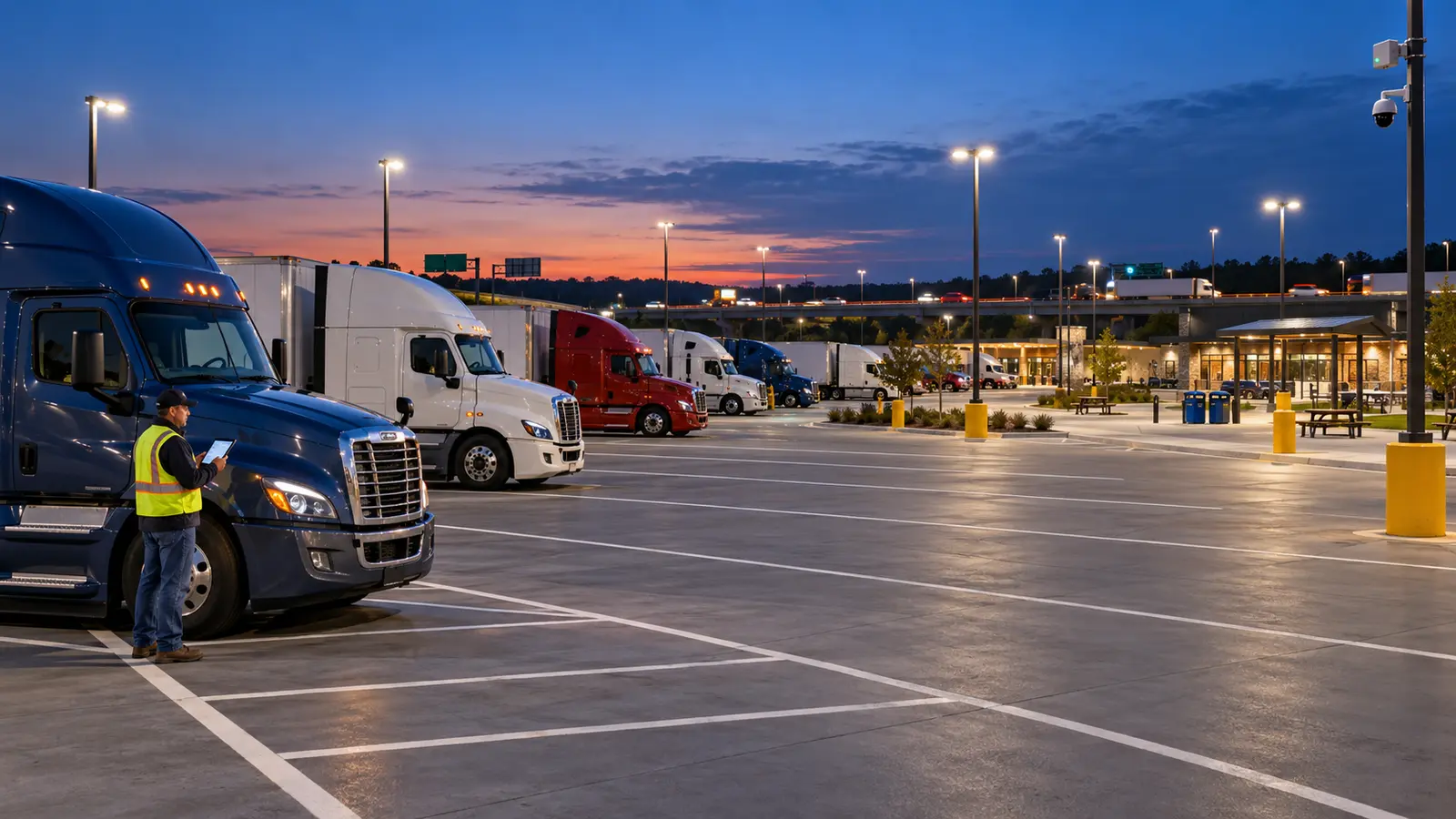
The U.S. Department of Transportation announced a $200 million investment in commercial motor vehicle parking on October 14, 2026. Fourteen projects in 12 states were selected through the FY 2026 Nationally Significant Multimodal Freight and Highway Projects program, commonly called INFRA. The official award sheet estimates that the projects will create 2,403 new truck parking spaces.
That is meaningful capacity, but it is not 2,403 spaces available tonight. An award starts or supports project delivery; land acquisition, environmental review, design, procurement, construction, and local opening decisions can still come afterward. Drivers and dispatchers should treat the announcement as a map of future improvements, not as a current parking directory.
Where the new truck parking is planned
The selections reach Arkansas, California, Connecticut, Georgia, Iowa, Illinois, Minnesota, North Carolina, Nebraska, Tennessee, Texas, and Wisconsin. They target major routes and freight generators including I-49, I-40, I-91, I-75, I-80, I-57, I-94, I-24, I-35W, I-41, the ports of Savannah and Wilmington, and the Los Indios Port of Entry.
The largest single estimate is Tennessee's 500-space network at five locations along I-40 and I-24. Texas projects account for about 405 spaces near Fort Worth and Los Indios, while two Georgia projects total about 384 spaces near I-75 and the Port of Savannah. Connecticut is slated for up to 260 spaces on I-91. The award sheet says all space counts are estimates and may change.
The 14 projects are not all the same
Some awards build new facilities. Arkansas plans a 137-space safety rest area along future I-49, California plans a 100-space site near I-40 and CA-95 in Needles, and Minnesota plans a 63-space rest area near Fergus Falls. Nebraska's I-80 work will replace aging facilities, while Iowa will expand and modernize six I-80 rest areas with about 150 additional spaces.
Other projects add capacity at ports, existing rest areas, or private travel centers that will provide public parking. The selected scopes include lighting, restrooms, security cameras, better circulation, pavement upgrades, oversize staging, severe-weather refuge, and real-time occupancy technology. For drivers, those operating details can matter as much as the raw stall count because safe access, visibility, information, and usable amenities determine whether a space works in practice.
Why parking capacity is a safety and compliance issue
FMCSA's announcement says 40 percent of truckers spend more than an hour a day searching for parking. FHWA has long identified the shortage as a national safety concern: when official spaces are unavailable, a tired driver may continue driving or stop on a shoulder, ramp, roadside, or another unsafe location. The new awards focus on corridors where that pressure is already visible.
Parking also intersects with hours-of-service planning. Most property-carrying interstate drivers may drive up to 11 hours within a 14-consecutive-hour window after 10 consecutive hours off duty, subject to applicable rules and exceptions. Finding a safe legal space is not an exception that automatically extends those limits. A good trip plan builds a parking decision into the clock before the final minutes become an emergency.
What the award changes now—and what it does not
The announcement gives drivers a reliable list of selected projects and intended locations. It also signals that federal funding is moving toward public capacity, technology, and corridor gaps. It does not provide one national opening date, guarantee that every estimated space will survive final design, or make a construction site available for overnight parking.
Check the responsible state DOT, port, city, regional council, or facility operator for design milestones, construction notices, temporary closures, and opening information. A project may temporarily reduce capacity before it adds spaces. Confirm availability through official 511 systems, posted signs, carrier-approved tools, and current facility information rather than assuming a site shown in an award announcement is ready.
Build a parking plan with more than one option
Before departure, identify a preferred stop and at least two lawful alternatives that fit the route, vehicle, cargo, amenities, and remaining hours. Mark decision points—not just destinations—where you will switch to the next option if occupancy, weather, traffic, or a shipper delay changes the plan. Parking earlier can be the safer choice when the next realistic option is far away.
Dispatch should know the planned stopping range and any location that repeatedly fills. During the trip, update the plan while legally stopped, not while driving. Treat crowdsourced availability as helpful but temporary, and verify restrictions on time limits, reservations, hazardous materials, oversize vehicles, idling, or local access. Never create a space on a ramp or shoulder because an app showed a full lot too late.
Technology is part of several projects
The award documents describe real-time occupancy sensors or monitoring at projects in California, Connecticut, Georgia, Iowa, Illinois, Minnesota, Tennessee, Texas, and Wisconsin. Some information is expected to connect with state 511 systems, electronic signs, navigation tools, or mobile applications. Those systems can reduce blind searching when they are accurate and widely available.
Availability data is still one input, not a reservation unless the operator expressly says so. A displayed opening can fill before arrival, sensors can be delayed, and a nominal space may not suit the combination. Keep a backup and use technology before moving or through a compliant hands-free setup. The safest tool is a plan that remains workable when the first data point is wrong.
Facilities will serve different operations
Port projects in Savannah and Wilmington combine parking with freight staging or gate coordination. The Los Indios project is tied to an international border corridor. Tennessee and Fort Worth use public-private travel-center expansions, while several state projects improve rest areas. A port drayage driver, long-haul sleeper team, oversize operator, and local delivery driver may therefore benefit in different ways.
Read the eventual operating rules before routing around a new facility. Ask whether spaces are free, time-limited, reservable, gated, open around the clock, or intended for staging rather than a full rest period. Check fuel and food access, restrooms, lighting, security, winter operations, and whether a trailer may be dropped. A space count alone does not answer those practical questions.
Use the construction period to strengthen trip planning
Drivers do not need to wait for new pavement to improve parking decisions. Track recurring trouble spots by day and time, save lawful alternatives in the carrier's route tools, and report reliable capacity problems to dispatch. If a shipper or receiver regularly consumes the margin needed to reach safe parking, document the delay and raise the scheduling problem before the next load.
New CDL drivers should practice this thinking during training. ELDT theory covers trip planning, fatigue and wellness awareness, hours of service, and safe vehicle operation, but online theory is only one part of readiness. CDL Compass offers registered Class A and Class B online theory courses; behind-the-wheel range and public-road proficiency must be completed with an appropriate registered provider.
The practical takeaway for drivers
The 2026 INFRA selections are substantial: 14 projects, 12 states, $200 million, and an estimated 2,403 new spaces. They address both obvious capacity gaps and the less visible problems of lighting, circulation, information, amenities, and safe access. The corridor list is worth watching if your routes cross I-40, I-80, I-91, I-94, I-75, I-57, I-49, I-41, I-24, or major ports and border facilities.
For today's trip, however, use only locations that are officially open and lawful. Start the search early, protect a backup, keep dispatch informed, and stop before fatigue or the clock removes your options. Follow the project sponsor for verified opening updates. Federal selection is the beginning of delivery; safe parking becomes useful only when the facility is complete, operating, and part of a realistic plan.