How to Get a CDL in 2026: From Learner’s Permit to Skills Test
Follow the CDL process step by step—from choosing a license class and earning a CLP to completing ELDT and passing all three parts of the skills test.
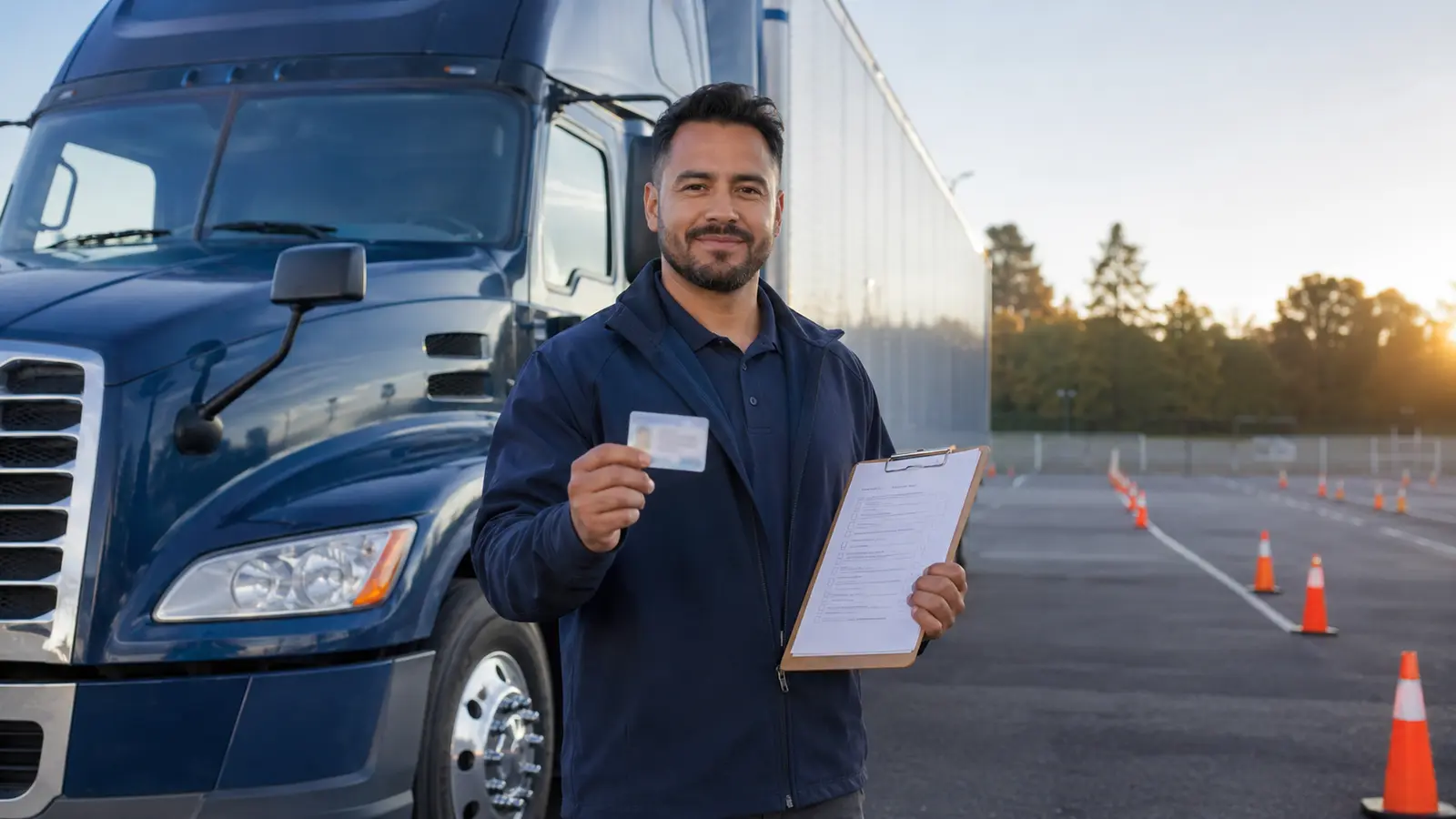
Getting a commercial driver’s license is a sequence, not a single test. You first decide what kind of commercial vehicle you want to operate, confirm that you meet your state’s eligibility and medical requirements, earn a commercial learner’s permit, complete any required Entry-Level Driver Training, practice behind the wheel, and pass the CDL skills test. Planning those steps in the right order can prevent delays and unnecessary expenses.
The Federal Motor Carrier Safety Administration sets nationwide minimum standards, but your State Driver Licensing Agency issues the permit and license. That means application forms, fees, appointment systems, acceptable documents, permit validity, and some training rules can differ by state. Use this roadmap as a federal baseline, then confirm the details with the licensing agency in your home state.
Step 1: Choose the CDL class that matches your career goal
A Class A CDL generally covers combination vehicles with a gross combination weight rating of 26,001 pounds or more when the vehicle being towed is rated over 10,000 pounds. This is the path commonly chosen for tractor-trailers, and it usually provides the broadest range of trucking opportunities. A Class B CDL generally covers a single vehicle rated at 26,001 pounds or more, or that vehicle towing a vehicle rated at 10,000 pounds or less. Common Class B work includes straight trucks, dump trucks, mixers, refuse vehicles, and some buses.
Choose based on the equipment and jobs you actually want—not simply which test appears easier. Also identify any endorsements you may need. Passenger, school bus, tanker, double/triple trailer, and hazardous materials work can involve extra knowledge tests, skills tests, training, restrictions, or background checks. Selecting the correct class and endorsements early helps you study the right material and train in the right vehicle.
Step 2: Confirm eligibility, documents, and medical status
CDL applicants normally apply through their state of domicile and cannot hold driver licenses from multiple states. Expect the licensing agency to verify your identity, residency, driving record, and current license status. Bring documents exactly as your state lists them, and make sure your legal name is consistent across your driver license, permit application, medical record, and training enrollment.
Commercial drivers must also declare the type of commerce in which they expect to operate through the state self-certification process. Many interstate drivers must be medically qualified and maintain a valid Medical Examiner’s Certificate. Medical requirements depend on the type of operation and any applicable exceptions, so use your state’s current instructions and an examiner listed on the National Registry when an examination is required. Do not assume that another student’s paperwork requirements are identical to yours.
Step 3: Study for and obtain the commercial learner’s permit
The commercial learner’s permit, or CLP, allows you to practice operating the appropriate commercial vehicle on public roads under required supervision. To obtain it, you must pass the knowledge tests associated with the CDL class and endorsements you are pursuing, along with the vision and other checks required by your state. Your state CDL manual should be the primary study reference for those tests.
FMCSA’s current CDL guidance states that an applicant must hold the CLP for at least 14 days and complete applicable ELDT before becoming eligible for the CDL skills test. A state may impose a longer waiting period or additional conditions. A CLP is not permission to operate independently: during public-road practice, you generally need a qualified CDL holder with the proper class and endorsements in the required supervising position.
Step 4: Complete the correct ELDT program
Federal ELDT requirements apply to first-time Class A and Class B applicants, Class B drivers upgrading to Class A, and first-time applicants for passenger, school bus, or hazardous materials endorsements. Covered applicants must complete training with a provider listed on FMCSA’s Training Provider Registry. The state checks the registry for the required completion record before administering the applicable skills test—or the HazMat knowledge test.
Class A and Class B ELDT include theory and behind-the-wheel components. Theory training builds knowledge in vehicle systems, inspections, safe operating procedures, hours of service, hazard awareness, and driver responsibilities. Behind-the-wheel training includes range and public-road instruction. Federal rules use proficiency-based requirements for behind-the-wheel training rather than one universal minimum number of hours, although a state or training program may require specific hours.
Step 5: Build skills deliberately during supervised practice
Passing the knowledge tests does not mean you are ready for the skills test. Use the CLP period to develop a repeatable inspection routine and safe control habits. Practice vehicle inspection language, coupling and uncoupling when applicable, straight-line and offset backing, parking or docking maneuvers, turns, lane positioning, mirror use, speed and space management, railroad crossings, and safe interaction with traffic.
Train in a vehicle that represents the class of CDL you want and understand how the test vehicle can affect license restrictions. For example, testing in a vehicle without a full air-brake system or with an automatic transmission may produce restrictions that limit the equipment you can legally operate. Ask the school or test provider what vehicle will be used and what restrictions may result before your test date.
Step 6: Prepare for all three parts of the CDL skills test
According to FMCSA, the CDL skills test has three parts: the Vehicle Inspection Test, Basic Controls Test, and Road Test. You must pass all required parts. The inspection portion evaluates whether you can identify and explain safety-critical components and determine if the vehicle is safe to operate. The basic controls portion measures low-speed vehicle handling. The road test evaluates safe operation in real traffic conditions.
Treat the test as a complete process. Arrive with the permit, identification, medical or self-certification documentation required by your state, and a properly registered, insured, and test-ready vehicle. Confirm the appointment location and vehicle requirements in advance. A mechanical defect, missing document, unsuitable vehicle, or late arrival can stop a test before your driving ability is evaluated.
Step 7: Review the license before you leave
After passing, follow your state’s process for issuance of the physical or temporary CDL. Before leaving the licensing office, verify your name, address, CDL class, endorsements, and restrictions. If something does not match the tests you passed or the vehicle you used, ask the agency to review it immediately.
A CDL is the beginning of professional responsibility, not the end of training. Employers may require orientation, road evaluation, drug and alcohol testing, background checks, or equipment-specific instruction. Keep your medical status current when applicable, protect your driving record, and continue learning the safety procedures used by your carrier and the freight you haul.
A practical checklist before you start
Write down your target CDL class, desired endorsements, home-state requirements, medical self-certification category, training provider, expected vehicle, possible restrictions, test location, and total third-party costs. Then build a schedule that includes permit study, ELDT theory, behind-the-wheel training, supervised practice, and test preparation. A clear plan turns a complicated licensing process into manageable steps.
If your goal is Class A, Class B, or a first-time HazMat endorsement, ELDT Info offers online ELDT theory courses that can be completed around your schedule. Select the course that matches your exact licensing goal, enter your driver information accurately, and keep your state testing timeline in view while you train.