How Many Hours of ELDT Are Required in 2026? Theory and Behind-the-Wheel Rules
Learn why federal ELDT rules do not set one required hour total, how theory and behind-the-wheel completion are measured, and when State requirements can add hours.
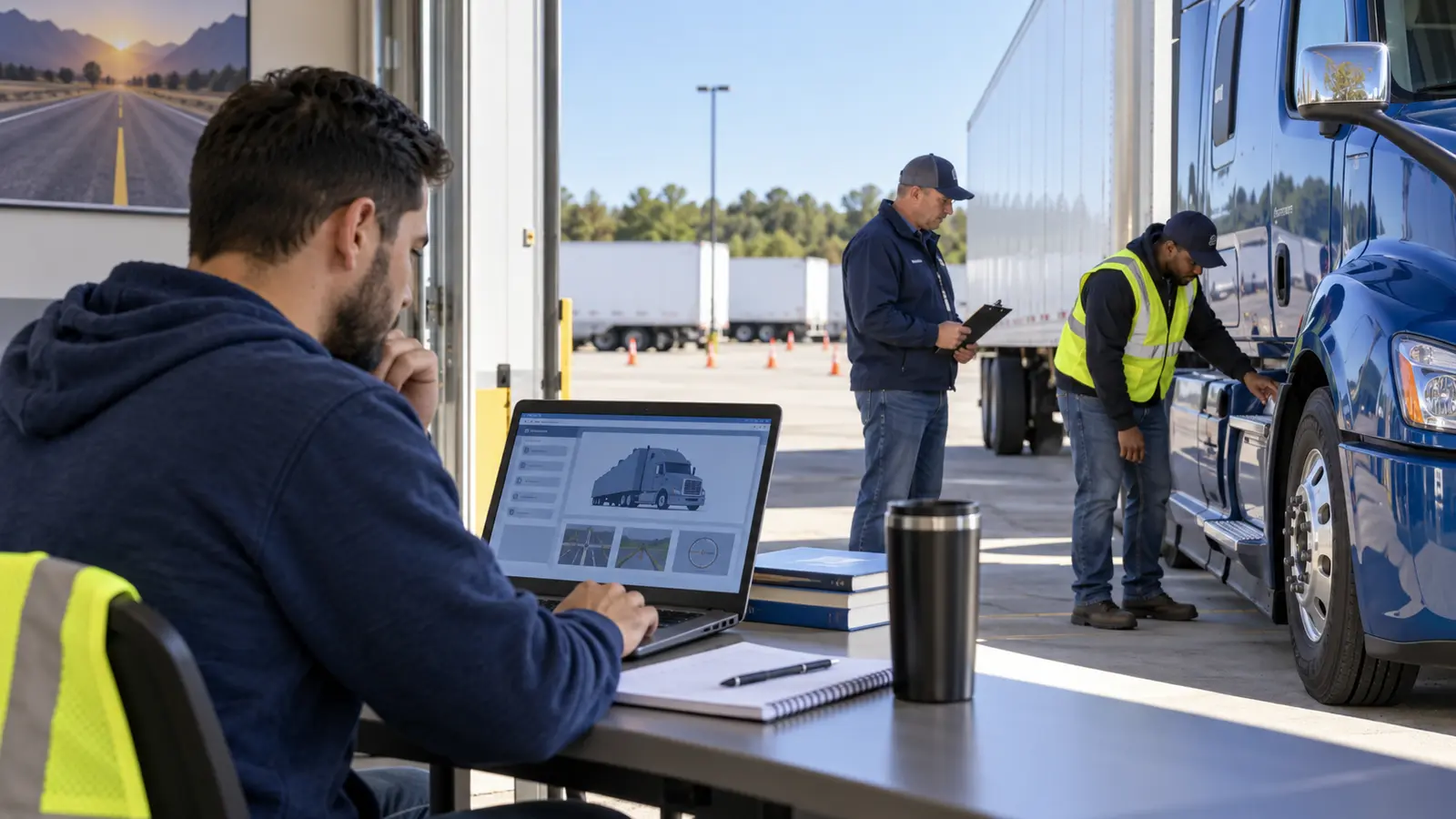
A common CDL question sounds simple: how many hours of Entry-Level Driver Training are federally required? For Class A and Class B applicants, the answer is not a fixed number. Federal ELDT rules require complete curriculum coverage, an 80 percent theory score, and documented behind-the-wheel proficiency, but they do not prescribe one universal minimum hour total.
That does not mean training can be rushed or reduced to a quick certificate. A registered provider must teach every required topic and cannot certify behind-the-wheel completion until the instructor determines that the student is proficient in the applicable range and public-road skills. State law, school policy, or a specific program may also require more time than the federal baseline.
The federal rule measures completion, not seat time
Appendices A and B to 49 CFR Part 380 state that Class A and Class B theory instruction has no required minimum number of hours. The instructor must still cover every topic in the applicable curriculum. The same appendices say there is no federal minimum number of hours for range or public-road training, while requiring all behind-the-wheel topics to be covered in the correct class of commercial motor vehicle.
FMCSA chose a performance-based structure. Theory is measured through knowledge assessment, and BTW is measured through an instructor's evaluation of demonstrated skills. Two trainees may therefore finish at different times. A person with relevant experience may progress quickly in one area, while another may need additional practice with inspection language, backing setup, shifting, turns, visual search, or space management.
Theory training ends with an 80 percent assessment
Under 49 CFR §380.715, a provider must use written or electronic assessments to measure proficiency in the knowledge objectives. The driver-trainee must earn an overall minimum score of 80 percent. A course is not complete merely because every lesson was opened, a video played, or a certain number of hours passed.
The provider must cover the curriculum that applies to the credential: Class A, Class B, passenger, school bus, or HazMat. Class A and B theory include subjects such as vehicle systems, inspections, safe operating procedures, hours of service, fatigue, cargo, railroad crossings, emergencies, medical requirements, and regulatory responsibilities. Providers may organize and present the material differently, and they may add topics beyond the federal minimum.
Online theory can be flexible without being optional
Federal rules allow theory instruction to be delivered online by a provider listed on the Training Provider Registry. Because the rule does not impose a theory-hour minimum, a compliant online course can be self-paced. The provider still has to deliver the complete curriculum, verify the trainee's identity as required by its process, administer the assessment, retain required records, and report successful completion.
Speed should not be the only factor when choosing a theory course. Look for clear explanations, knowledge checks, review opportunities, mobile access, support, and coverage of the complete curriculum. CDL Compass offers online Class A and Class B ELDT theory designed to help applicants study the required material before moving into hands-on preparation with a registered BTW provider.
Behind-the-wheel training is based on demonstrated proficiency
For Class A and Class B ELDT, BTW training includes range and public-road components. The instructor must evaluate and document proficiency in the applicable skills. Those skills include vehicle inspection, basic controls, straight-line and offset backing, alley dock, parallel parking, turns, lane changes, speed and space management, visual search, signaling, safe driver behavior, and other curriculum elements.
A provider cannot substitute an arbitrary hour threshold for that evaluation. Reaching 10, 20, or 40 hours does not automatically prove proficiency, and finishing in fewer hours does not excuse missing a required skill. The instructor determines readiness based on the trainee's individual performance and the provider's documented standards.
Simulators do not replace required BTW time
A simulator can support theory instruction, demonstrations, or discussion, but it cannot be used to conduct mandatory behind-the-wheel training or to demonstrate BTW proficiency. Class A training must occur in a vehicle that requires a Class A CDL, and Class B training must occur in a representative Class B vehicle.
That distinction matters when comparing programs. Ask how much time is spent actually operating the vehicle rather than observing another student, watching a demonstration, or using a simulator. Group training can be useful, but the provider must evaluate each trainee individually and record the actual clock hours that each person spends completing the BTW curriculum.
Why schools still advertise 40-, 120-, or 160-hour programs
Many CDL schools publish a fixed program length even though the federal ELDT rule does not. Those hours may come from State licensing rules, an approved school curriculum, employer expectations, workforce-funding conditions, accreditation, scheduling, or the school's own training model. A longer program is not automatically better, but a very short promise deserves careful questions about equipment access and individual practice.
Separate the school's program requirement from the federal ELDT minimum. If a school contract says the program contains 160 hours, the student may be expected to complete that schedule even though Part 380 is proficiency-based. Ask how the advertised total is divided among theory, observation, range practice, public-road driving, testing preparation, breaks, and administrative time.
States may impose additional hour requirements
FMCSA's Training Provider Registry guidance explains that federal ELDT standards generally do not preempt stricter State requirements. A State may require a minimum number of BTW hours or additional training topics. School bus applicants may also face State-specific classroom hours, bus-driving hours, first-aid training, or other certification requirements.
Check both the State where training occurs and the licensing rules in the State of domicile. The details can matter when training or testing across State lines. Use the official driver licensing agency, current CDL manual, or State education and training authority rather than relying solely on a national advertisement.
ELDT hours are different from the CLP waiting period
The 14-day commercial learner's permit holding period is a separate CDL testing rule, not an ELDT hour requirement. Federal guidance does not require theory to be completed before obtaining a CLP, and it does not impose a mandatory order among theory, range, and public-road instruction. However, required ELDT must be completed and reported before the applicable State skills test is administered.
In practical scheduling, most students complete or begin theory early, obtain the correct CLP, and then arrange BTW training in the appropriate vehicle. The permit must authorize the operation being practiced, and the trainee must follow supervision and restriction rules whenever driving on a public road.
What completion should look like in the TPR
The theory provider and BTW provider may be different registered organizations. Each reports the component it delivered to FMCSA. For Class A or Class B, the State must be able to verify both required components before administering the skills test. A course receipt or school completion email does not replace the electronic training record.
Confirm that your legal name, date of birth, CDL or CLP information, and licensing State match across registration and training records. Ask when the provider will submit completion and what to do if the State cannot verify it. Do not schedule a skills test so tightly that a spelling error or delayed correction leaves no time to resolve the record.
Questions to ask before paying for training
Ask whether the exact location and curriculum are listed on the TPR, which components are included, and whether the price covers both theory and BTW. For hands-on training, ask about instructor qualifications, student-to-truck ratio, individual driving time, range access, public-road practice, retest or extra-hour charges, vehicle class, transmission type, and the provider's proficiency standard.
Also ask whether State law sets minimum hours, how attendance is documented, and what happens if you need more practice than the advertised package includes. Get the schedule, cancellation terms, refund policy, and additional fees in writing. A trustworthy provider can explain the difference between its program hours and the federal completion standard without promising an automatic pass.
Plan for proficiency, not the shortest possible clock
The most useful answer to “How long will ELDT take?” is personal. Theory lasts until the required topics are completed and the trainee earns at least 80 percent. BTW lasts until all required instruction is delivered and the instructor documents proficiency. State rules and the provider's program may extend the schedule.
Choose training that prepares you to inspect, control, and operate the vehicle safely—not merely to reach a number on a timesheet. Start with the CDL Compass Class A or Class B online ELDT theory course, then coordinate the correct CLP, a registered hands-on provider, and enough individual practice to approach the skills test with repeatable, safe habits.