Emergency Triangles for CDL Drivers in 2026: Placement, Timing, and Safety
Learn the federal 10-minute rule, correct emergency-triangle distances for two-way and divided roads, special rules for curves and hills, and safer roadside setup.
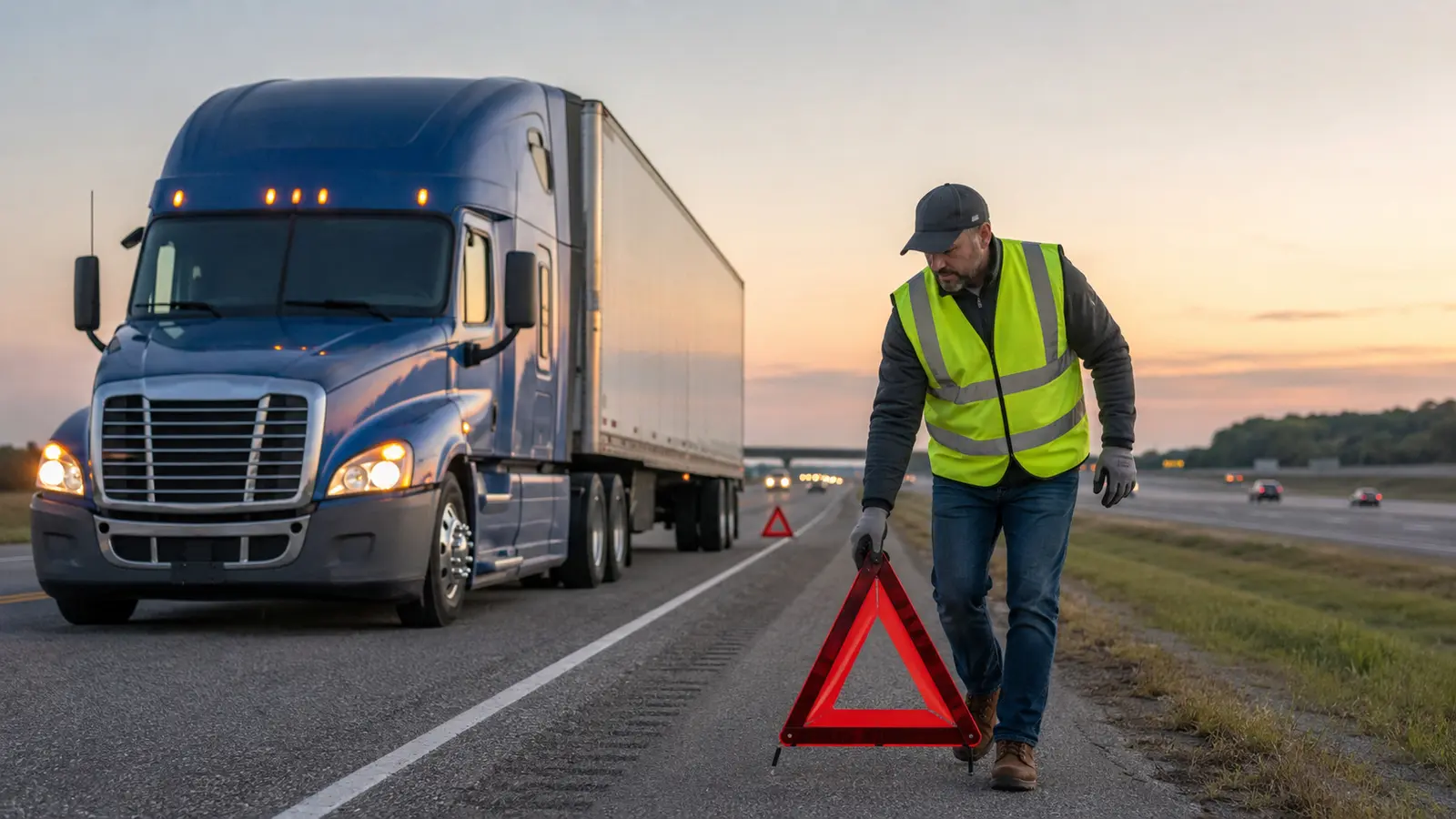
A disabled commercial motor vehicle can become a second crash before the driver opens the tool compartment. Approaching motorists may not realize that a tractor-trailer on the shoulder is stopped, especially at night, in rain, or near a curve. Federal warning-device rules create a predictable pattern that gives traffic more time to recognize the hazard.
For most CDL drivers, the key numbers are immediate hazard flashers, warning devices as soon as possible and within 10 minutes, and placement measured from the stopped vehicle. The pattern changes for two-way roads, divided or one-way roads, and locations near hills or curves. Learning those differences before an emergency prevents guesswork while standing beside live traffic.
When the federal stopped-CMV rule applies
Under 49 CFR §392.22, the rule applies when a commercial motor vehicle stops on the traveled portion or shoulder of a highway for a reason other than a necessary traffic stop. A breakdown, flat tire, mechanical warning, cargo problem, or other unplanned stop can trigger it. Waiting normally at a traffic signal or in congestion is not the same situation.
Move as far from moving traffic as the vehicle can safely go, secure the vehicle, and immediately activate the four-way hazard warning flashers. Keep them flashing until the required warning devices are in place. The flashers may remain on afterward, but they do not replace the triangles or other required devices. Turn them on again while collecting the devices before moving the truck.
Personal safety comes first when the location presents an immediate threat. Call 911 for a crash, fire, medical emergency, hazardous leak, vehicle blocking a live lane, or another urgent danger. Notify dispatch through the carrier's procedure and follow instructions from law enforcement or incident responders when they control the scene.
The equipment every power unit must carry
Section 393.95 generally requires each truck, truck tractor, and bus to carry an approved warning-device option. The most common is three bidirectional emergency reflective triangles that conform to Federal Motor Vehicle Safety Standard No. 125. The rule also permits at least six compliant fusees, with additional fusees when necessary to keep every required location continuously marked.
Make the warning devices part of every pre-trip inspection. Confirm that three triangles are present, clean, undamaged, reflective, and able to stand securely. Know the compartment location and make sure freight, tools, or personal belongings do not block access. Opening the box for the first time beside traffic wastes critical minutes.
The standard pattern on a two-way or undivided road
On an ordinary two-way or undivided highway, place one triangle on the traffic side of the vehicle approximately 10 feet away in the direction of approaching traffic. Place a second device approximately 100 feet toward approaching traffic and the third approximately 100 feet in the opposite direction. The two distant devices belong in the center of the lane or shoulder occupied by the stopped CMV.
The near triangle marks the vehicle's location while the other two warn traffic approaching from either direction. Think of the pattern as 100 feet behind, about 10 feet at the traffic-side corner, and 100 feet ahead, adjusted for the direction the truck is facing and the side from which traffic approaches.
The divided or one-way highway pattern
Traffic approaches from only one direction on a divided or one-way highway, so all three devices warn that flow. Place one within 10 feet of the rear of the vehicle on the traffic side, one approximately 100 feet behind, and one approximately 200 feet behind. Put the two distant devices in the center of the lane or shoulder occupied by the truck.
Do not place one triangle ahead of the truck merely because that pattern applies on a two-way undivided road. The 10-, 100-, and 200-foot sequence should lead approaching traffic toward the stopped vehicle. If the shoulder narrows, a barrier blocks access, or traffic conditions make walking the normal pattern unsafe, contact dispatch or emergency authorities and follow scene-specific direction rather than stepping into a travel lane.
Curves, hills, and blocked sight distance
The normal distances may not warn traffic early enough when the truck stops within 500 feet of a curve, hillcrest, or another obstruction to view. In that situation, §392.22 requires the warning device in the obstructed direction to be placed 100 to 500 feet from the truck so approaching road users receive ample warning.
The practical goal is to put the far device where a driver sees it before reaching the blind area, not after entering it. Evaluate both directions on an undivided road, because a hill or curve may hide the CMV from either traffic stream. Terrain, barriers, ditches, snowbanks, and limited shoulders can make placement dangerous; request traffic control when the scene cannot be marked safely.
Business districts and other special rules
Federal rules contain a limited exception for business or residential districts. Warning-device placement is generally not required there unless vehicle lamps are required and street or highway lighting is insufficient to make the stopped CMV clearly visible from 500 feet. State law, local rules, carrier policy, or the actual hazard may still call for additional protection, so do not treat the exception as a reason to ignore a poorly visible truck.
Flame-producing devices require special caution. Section 393.95 prohibits carrying fusees on vehicles transporting specified explosive materials, on cargo tank vehicles used for certain flammable gases or liquids whether loaded or empty, and on CMVs using compressed gas as motor fuel. Section 392.22 also prohibits placing a flame near leaking gasoline, flammable liquid, combustible liquid, or gas unless the distance prevents fire or explosion. Reflective triangles avoid an ignition source but do not make a leaking-material scene safe.
If a spill, vapor cloud, fire, or suspected hazardous-material release exists, move people away, protect yourself, call emergency services, and use the shipping papers and emergency-response information as trained. Do not walk through the release simply to place a triangle.
Deploy triangles without becoming the next hazard
Before exiting, check mirrors and approaching traffic. Wear a high-visibility vest when available, take all three triangles in one trip, and use the door away from traffic when that is the safer exit. Stay on the shoulder, face traffic whenever practical, and never turn your back for longer than necessary. The CDL manual advises holding a triangle between your body and approaching vehicles so its reflective surface helps drivers see you.
Set each triangle firmly and orient it for approaching traffic. Wind from passing trucks can overturn a poorly opened base. Avoid standing directly behind the stopped trailer, lingering beside the traffic-side wheels, or working underneath the vehicle while traffic is uncontrolled. If visibility is dangerously poor or the shoulder is too narrow, retreat to a safer location and request professional traffic control.
Triangles warn motorists; they do not create a protected work zone. Diagnose or repair the truck only when the location, equipment, and carrier procedure make that work safe.
A roadside routine worth practicing
Use a simple sequence: steer to the safest available stopping position, secure the CMV, activate flashers, assess injuries or immediate hazards, notify emergency services and dispatch as needed, retrieve the warning devices, and complete the correct pattern within 10 minutes. Reassess the setup when weather, darkness, traffic, or the vehicle's position changes.
Before departure, confirm the repair and vehicle condition, plan a safe merge, and collect the devices without rushing. Keep the four-way flashers operating while the triangles are picked up. Account for all three, secure the storage box, enter the cab safely, fasten the seat belt, and wait for an adequate traffic gap before moving.
Class A and Class B ELDT theory includes safe operating practices, hazard recognition, emergency procedures, and vehicle inspections that support this roadside decision-making. CDL Compass offers online ELDT theory courses for both license classes. Combine that foundation with carrier training and hands-on practice so the correct warning pattern is automatic when a real breakdown occurs.