Dedicated Truck Driving Jobs in 2026: Routes, Pay, Home Time, and Questions to Ask
Learn what a dedicated trucking account really offers, how routes and pay work, and which questions CDL drivers should ask before accepting the job.
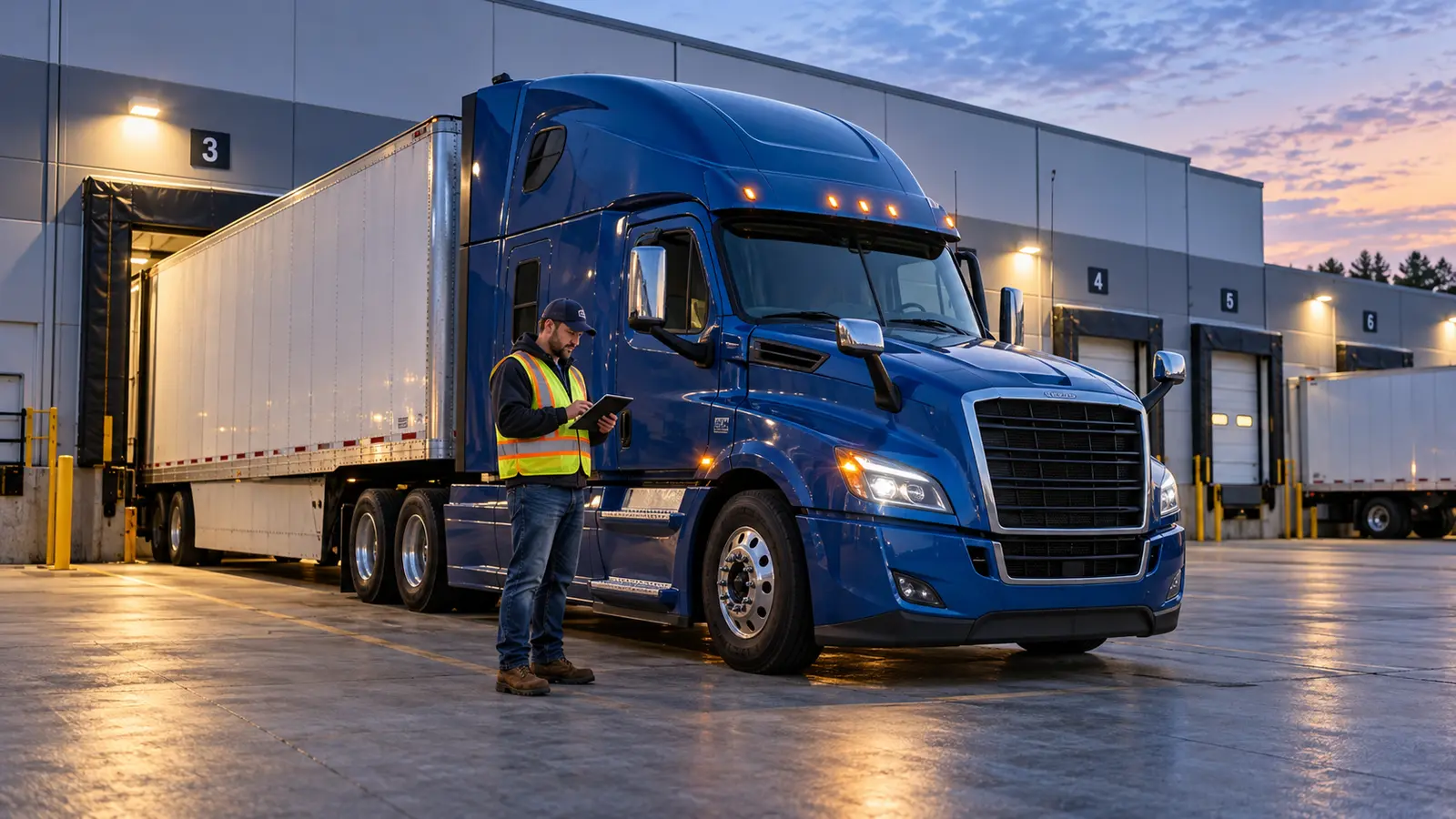
A dedicated truck driving job assigns a driver or fleet to freight for a particular customer, group of facilities, or repeat operation. The driver may serve the same distribution centers, stores, plants, or suppliers each week. That repetition can make the lanes, contacts, parking options, and delivery procedures more predictable than general over-the-road freight.
Predictable does not mean easy or identical every day. Freight volume, weather, traffic, customer delays, equipment, start times, and backhauls can change. A job advertisement may call an account dedicated even when drivers cover several routes or sleep away from home. Treat the label as the beginning of the interview, not as a guarantee about schedule, income, or duties.
Dedicated is an operating model, not a CDL class
There is no dedicated endorsement or separate federal license category. The required CDL depends on the vehicle. Most tractor-trailer positions require a Class A CDL. Some dedicated delivery operations use heavy straight trucks that fit Class B. Tanker, doubles and triples, passenger, school bus, or HazMat work can require the corresponding endorsement and may involve additional training or screening.
A first-time Class A or Class B applicant generally must complete applicable Entry-Level Driver Training through providers listed on FMCSA's Training Provider Registry before the required skills test. The dedicated customer does not change that rule. Carrier experience standards can also be stricter than the minimum licensing requirements, so confirm whether the account accepts recent graduates before applying.
Understand the main dedicated-account patterns
A regional dedicated account may move full truckloads between a customer's plants and distribution centers across several states. A store-delivery account may run multiple stops from one warehouse and return empty, with pallets, carts, or cases handled at each location. A shuttle position may move trailers between nearby facilities, while an inbound supplier account may collect freight from several vendors on a fixed schedule.
These jobs can be solo or team, daytime or overnight, no-touch or driver-unload. Some drivers use one tractor, while others slip-seat into assigned equipment. Some accounts provide repeat lanes but dispatch different routes by seniority, bid, or daily need. Ask the recruiter to describe a normal week in sequence—from report time and pre-trip through the final post-trip—instead of relying on a broad account name.
Home daily and home weekly need exact definitions
A home-daily account may still involve a long duty day, nights, weekends, holidays, or a start time that changes with store demand. Home weekly may mean a planned reset near home, not five fixed days out and two complete days off. Ask where the truck is parked, whether commuting time is unpaid, when home time begins, and whether a late return changes the next report time.
Request the normal start-time window, average release time, typical days worked, weekend rotation, holiday policy, and how often drivers lay over unexpectedly. Learn whether routes are bid by seniority or assigned, whether extra-board coverage is required, and how much notice accompanies schedule changes. A repeat route only improves quality of life when its actual hours fit your sleep, transportation, and family needs.
Compare the entire pay plan, not one headline number
Dedicated compensation may combine cents per mile, hourly pay, salary, route pay, stop pay, unloading pay, detention, trailer moves, safety incentives, or a weekly minimum. Ask which activities create pay, when the clock starts, which miles are used, and what conditions cancel a guarantee. A high mileage rate can produce a weak week when the account has short routes and unpaid customer time.
For context, the Bureau of Labor Statistics reported a May 2025 median annual wage of $58,640 for heavy and tractor-trailer truck drivers and projected about 214,500 openings per year on average from 2025 through 2035. Those national figures describe the occupation, not a promised dedicated-account wage. Location, experience, industry, schedule, freight, and duties can move an individual offer substantially above or below the median.
Customer work can be more demanding than the highway miles
O*NET lists document checks, cargo inspection, vehicle inspection, logs, coupling, route verification, delivery signatures, loading or unloading, and maneuvering at customer facilities among common heavy-truck-driver tasks. On a dedicated account, the same customer procedures repeat often, so accuracy and professional communication become part of performance—not optional extras after driving.
Ask whether freight is no-touch, driver-assist, tailgate, liftgate, hand-unload, pallet-jack, cart, or case delivery. Confirm expected lifting, walking, climbing, dock work, store access, keys, seals, temperature checks, and paperwork. Find out which equipment requires separate authorization and training. A job that pays well may still be a poor fit if its physical work or customer contact does not match what you can sustain safely.
Repeat lanes still operate under hours-of-service limits
For most property-carrying interstate operations, 49 CFR §395.3 limits driving to 11 hours within a 14-consecutive-hour window after 10 consecutive hours off duty, subject to exceptions in §395.1. It also addresses the 30-minute interruption after eight cumulative driving hours and the 60/70-hour limits. A customer's appointment schedule does not replace those requirements.
Dedicated drivers should learn how loading, unloading, inspections, fueling, yard moves, and other work affect available time. Ask whether the account uses a short-haul exception, an electronic logging device, or another lawful record method, and how dispatch plans delays. A legal clock does not guarantee alertness; fatigue, overnight schedules, and repeated early starts still require honest safety decisions.
Learn how freight volume affects job security and earnings
A dedicated account depends on a commercial relationship between the carrier and customer. Seasonal demand, a plant shutdown, store closures, route redesign, or loss of the contract can reduce miles or reassign drivers. Ask what work is available during slow weeks and whether any minimum pay survives a customer disruption.
Find out what happens if the account ends: Can the driver transfer to another account or general fleet? Does seniority carry over? Would home time, pay, terminal, or equipment change? A strong offer explains the fallback, not only the best week. Keep copies of the offer, pay plan, bonus terms, and any written guarantee so later settlements can be compared with what was promised.
Ask these questions before saying yes
Request the customer type, freight, route area, average weekly miles or hours, number of stops, normal gross range, pay components, guarantee conditions, unpaid tasks, schedule, home-time definition, physical requirements, equipment, slip-seat policy, endorsements, training length, and experience requirement. Ask what current drivers actually averaged over a recent ordinary period—not the theoretical maximum.
Also ask about preventable-incident policy, inward- and outward-facing cameras, speed settings, tolls, parking, uniforms, benefits, paid time off, probation, route bidding, forced dispatch, and transfer options. If the recruiter cannot answer, request the account manager or terminal contact. Do not resign from another job or travel to orientation until the carrier confirms the position, location, qualifications, and compensation in writing.
Watch for promises that do not match the documents
Red flags include a guaranteed amount with undefined conditions, home-daily advertising without a report-time range, missing pay for stops or unloading, vague contractor classification, pressure to pay an unknown recruiter, or instructions to ignore log, inspection, or qualification rules. A legitimate carrier should be able to identify the employing entity and explain how payroll, deductions, insurance, orientation, and safety reporting work.
Compare the written offer with the application, handbook, pay sheet, and lease or contractor agreement if one is proposed. Ask about chargebacks and training repayment before signing. If the position is advertised as W-2 employment but the documents describe an independent business relationship, pause and obtain qualified tax or legal advice rather than relying on a verbal explanation.
Choose training that supports the account you want
Dedicated jobs reward the same fundamentals tested throughout CDL preparation: inspections, backing, coupling, visual search, speed and space management, hours of service, trip planning, fatigue awareness, cargo responsibilities, and professional communication. Store delivery may demand precise backing and physical work; plant-to-plant freight may emphasize trip timing, trailer exchanges, and highway consistency.
Start with the CDL Compass Class A or Class B ELDT theory course that matches the vehicle you plan to operate, then complete behind-the-wheel instruction with a registered provider. When comparing dedicated offers, choose the operation whose real schedule, pay method, duties, and safety culture fit your goals. Choose a transparent, sustainable job.