Do You Need a Class B CDL for a Box Truck in 2026? Weight, ELDT, and Restrictions
Learn when a box truck requires a Class B CDL, how GVWR and actual weight affect the 26,001-pound threshold, what towing changes, and how to avoid test restrictions.
A box truck can look like a commercial vehicle without requiring a Class B commercial driver's license—or cross the CDL threshold while carrying the same kind of cargo as a smaller rental truck. The body style, number of axles, air brakes, rental status, and the words printed on the side do not decide the federal license class. Weight rating, actual operating weight, trailer, passengers, cargo, and State rules do.
For an ordinary freight box truck used in commerce, the first federal question is whether the single vehicle has a gross vehicle weight rating or gross vehicle weight of at least 26,001 pounds, whichever is greater. If it does, it is a Group B heavy straight vehicle. A driver generally needs a Class B CDL unless a specific exception applies. If neither measure reaches 26,001 pounds, the truck may be non-CDL—but that does not automatically make the operation unregulated.
Start with the manufacturer's GVWR label
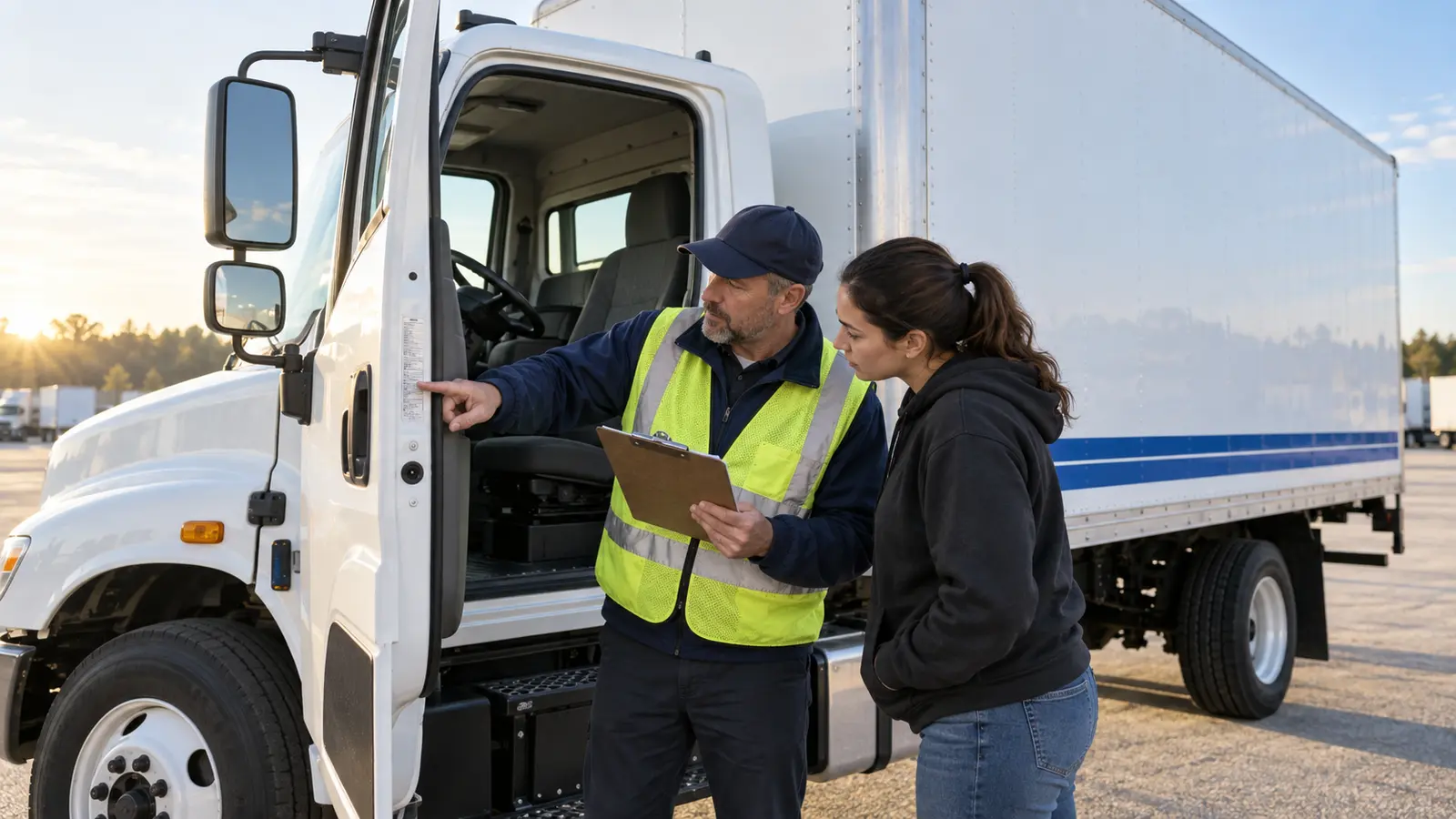
GVWR is the manufacturer's specified loaded weight for one vehicle. Look for the Federal Motor Vehicle Safety Standard certification label, commonly on the driver's door edge, door jamb, or cab area. Record the stated GVWR exactly. Do not substitute curb weight, payload capacity, registered weight, the cargo-box length, or a salesperson's description.
Federal CDL definitions also consider gross vehicle weight, meaning what the vehicle actually weighs in operation. The Class B threshold uses GVWR or actual GVW, whichever is greater. A truck rated at 26,000 pounds does not become safe or lawful to overload merely because the label falls one pound below the CDL threshold. Use a certified scale when the loaded weight is uncertain, follow axle and tire limits, and never plan a load around exceeding any rating.
Why 26,000 and 26,001 pounds are different
Under 49 CFR §§383.5 and 383.91, a single vehicle at 26,001 pounds or more by rating or actual weight is Group B. A 26,000-pound-rated truck operating below that weight does not enter Group B solely because it is used for deliveries, has a large cargo box, or earns revenue. This one-pound line is why visually similar box trucks can require different licenses.
The federal rule is a minimum national CDL standard. A State may use additional license classes, endorsements, age limits, medical rules, registration categories, or intrastate requirements. Before driving, compare the certification label and planned operation with the current instructions from the State Driver Licensing Agency that issued—or will issue—the license.
Towing can change Class B into Class A
Class B covers a qualifying heavy straight vehicle towing a unit with a GVWR of 10,000 pounds or less. When the towed unit has a GVWR or actual GVW over 10,000 pounds and the combination has a GCWR or actual GCW of at least 26,001 pounds, the operation fits Group A and generally requires a Class A CDL. The empty trailer weight is not the only figure that matters.
Check the trailer's certification label, the power unit's displayed GCWR when applicable, and the actual weights of the complete loaded combination. Do this before accepting a job that involves equipment trailers, mobile storage units, or other heavy towed equipment. A Class B license does not authorize Group A merely because the power unit is a box truck. Drivers who expect to tow heavy trailers should evaluate Class A training instead of testing for a credential that will not cover the planned work.
Air brakes do not create the CDL requirement
A common myth says every air-brake box truck requires a CDL. Federal vehicle groups are based on weight and use, not the braking system alone. Air brakes can still matter enormously during testing: under 49 CFR §383.95, testing in a vehicle without air brakes results in an L restriction, which prevents operation of an air-brake-equipped CMV. Testing in an air-over-hydraulic system results in a Z restriction, which prevents operation of a CMV with full air brakes.
Transmission choice matters too. A skills test in a vehicle with an automatic transmission produces an E restriction against operating a manual-transmission CMV. Before reserving a test truck, check the equipment used by likely employers. A convenient test vehicle can limit future job options even when it satisfies the Class B weight requirement.
Cargo or passengers can trigger a CDL below 26,001 pounds
A smaller vehicle can still be a Group C CMV if it is designed to transport 16 or more people including the driver, or if it is used to transport hazardous materials requiring placards under the federal definition. Those operations require the appropriate CDL and endorsements even when the vehicle is below the Group B weight threshold.
Ordinary packaged freight does not create a special CDL endorsement by itself. HazMat, passenger, school-bus, and qualifying tank operations do. Classify the vehicle and its use separately: first determine A, B, or C; then identify endorsements and restrictions. A driver moving furniture in a 26,000-pound box truck faces a different licensing analysis from a driver carrying placarded hazardous material in a lighter truck.
First-time Class B applicants must complete ELDT
A driver applying for a Class B CDL for the first time is subject to the federal Entry-Level Driver Training rule. Before taking the State Class B skills test, the applicant must complete Class B theory instruction plus behind-the-wheel training on a range and public road with providers listed on FMCSA's Training Provider Registry. Theory and behind-the-wheel instruction may come from different registered providers.
Federal rules do not set a minimum number of Class B behind-the-wheel hours. The registered instructor must assess the required skills and determine that the trainee is proficient; a State or training program may require additional hours. Theory may be delivered online. CDL Compass offers the Class B ELDT theory course, while the learner arranges required behind-the-wheel training with a qualified provider.
Test in a representative Class B vehicle
The skills-test vehicle must represent the group the applicant expects to operate. For Class B, use a single vehicle that meets the Group B definition—not a lighter box truck that merely looks similar. The federal skills standards cover the vehicle inspection test, basic vehicle-control skills, and on-road driving. State scheduling and scoring procedures vary.
Match the test vehicle to the intended career as closely as practical. Verify its GVWR, brake system, transmission, registration, insurance, inspection status, and safety condition before test day. Ask the provider or testing agency which documents must be presented and whether the State imposes a waiting period, appointment rule, or additional maneuver.
A non-CDL box truck may still be a regulated CMV
The safety-regulation definition in 49 CFR §390.5T is broader than the CDL definition. In interstate commerce, a vehicle or combination rated or actually weighing 10,001 pounds or more can be a commercial motor vehicle for Federal Motor Carrier Safety Regulations even though it remains below the 26,001-pound CDL threshold. Depending on the operation and exceptions, rules involving carrier registration, driver qualification, medical certification, hours of service, vehicle inspection, and records may apply.
That distinction matters to contractors, moving companies, last-mile carriers, and businesses buying their first box truck. “No CDL required” is not the same as “no compliance duties.” The motor carrier should evaluate the vehicle, route, cargo, business model, and applicable exceptions under both federal and State law before dispatch.
Box-truck license checklist
First, photograph the power unit's certification label and record its GVWR. Obtain a scale weight for the complete loaded truck when actual weight could approach the limit. Second, if towing, record the trailer's GVWR and loaded weight and calculate the combination figures. Third, check whether the vehicle carries passengers, placarded hazardous materials, or tanks that could require an endorsement.
Finally, confirm the required license with the licensing State, choose registered ELDT providers if this is a first Class B application, and select a representative test vehicle with the brakes and transmission you intend to drive. Drivers whose job needs a heavy straight truck can begin the CDL Compass Class B ELDT theory course; those planning to tow a trailer over 10,000 pounds should compare the Class A path before enrolling.