CDL Seat Belt Rules in 2026: Drivers, Passengers, and Sleeper Berths
Learn the federal CMV seat-belt rules for drivers and passengers, how sleeper-berth restraints differ, what to inspect, and which common shortcuts create risk.
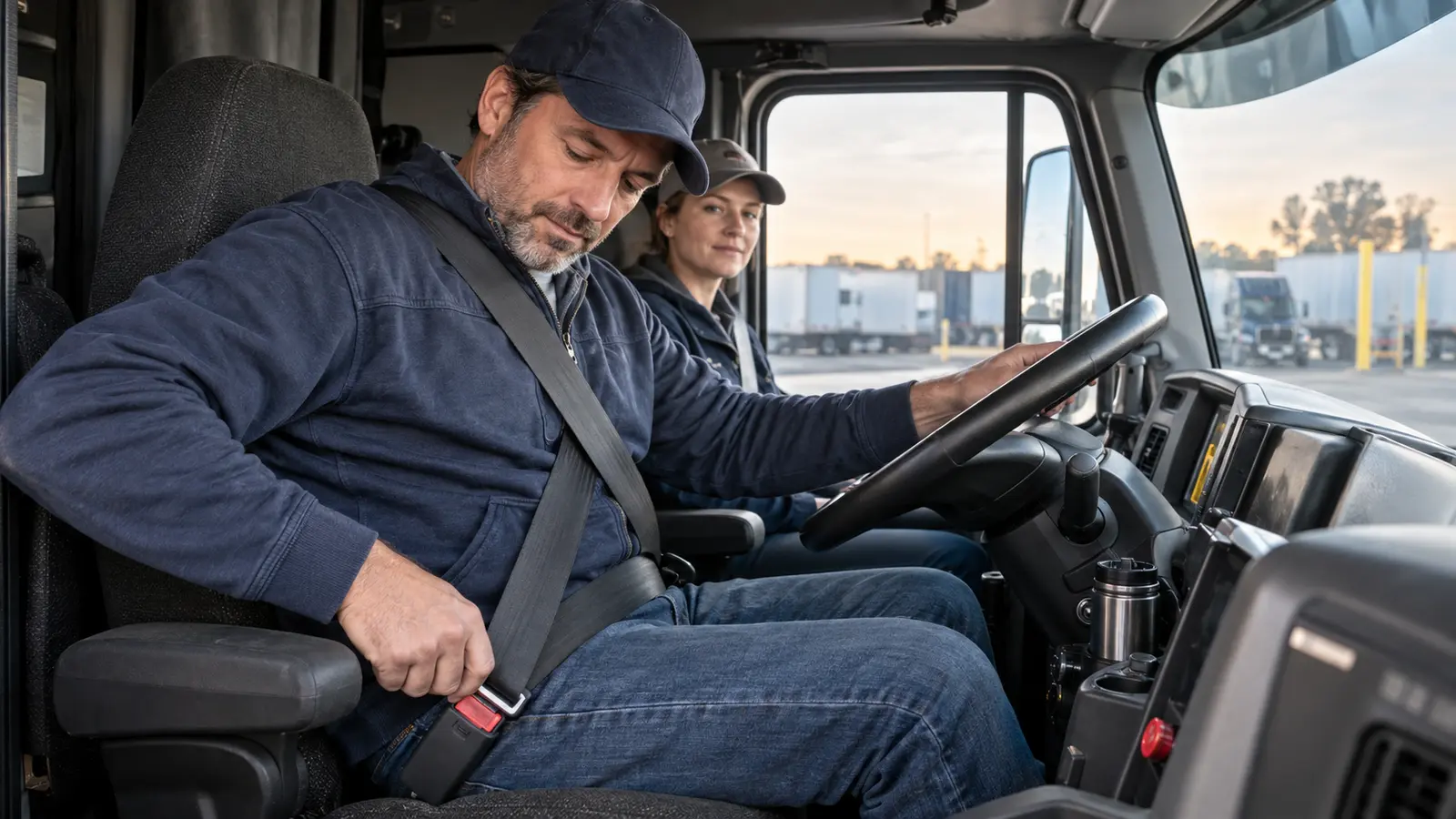
A seat belt may be the simplest item in a commercial truck cab, but its legal and safety role is easy to underestimate. Federal rules place responsibility on both the driver and the motor carrier, and a property-carrying driver can also be responsible for other occupants who are not properly restrained.
The safe routine is straightforward: inspect the restraint, adjust the seat, buckle before the vehicle moves, require seated passengers to buckle, and use the sleeper-berth restraint provided by the manufacturer. Those steps matter on a highway trip, a short repositioning move, and every ordinary mile between terminals.
The federal rule for CMV drivers
Under 49 CFR §392.16(a), a driver may not operate a commercial motor vehicle equipped with a seat-belt assembly at the driver's seat unless the driver is properly restrained by that assembly. The rule also says a motor carrier may not require or permit the driver to operate unrestrained. It is not merely a personal preference or an optional company wellness practice.
The wording applies to operation of a CMV; it does not create a low-speed, familiar-route, or short-distance exception. Buckle before releasing the parking brake instead of planning to latch the belt after leaving the yard. A carrier policy may be stricter, and State seat-belt laws can impose additional duties or penalties.
Passengers in a property-carrying CMV must buckle too
Section 392.16(b) specifically addresses other occupants in property-carrying CMVs. When seat-belt assemblies are installed at their seats, the driver may not operate—and the carrier may not require or permit operation—unless all those occupants are properly restrained. This can include a co-driver, trainer, student, mechanic, or authorized rider seated in the cab.
The federal passenger paragraph is written for property-carrying CMVs. Passenger-carrying vehicles such as buses are subject to their own equipment rules, operating requirements, and State laws. Do not assume that the wording for a tractor cab answers every school-bus or motorcoach question; follow the carrier's passenger policy and the law governing the specific vehicle and route.
Seat-belt equipment is part of the vehicle
49 CFR §393.93 contains the federal installation standards for seats, belt assemblies, and anchorages. Older trucks and truck tractors manufactured from January 1, 1965, through June 30, 1971, generally need a conforming belt at the driver's seat and right-front outboard seat when present. Trucks manufactured on or after July 1, 1971, generally must conform to the applicable Federal Motor Vehicle Safety Standards for belt assemblies and anchorages.
For a modern working truck, the practical question is not whether a belt should be there—it should—but whether the complete system is present and serviceable. Inspect the webbing, latch plate, buckle, retractor, shoulder-height guide, seat-mounted components, and visible anchor points. Never route the belt around loose cab equipment or modify an anchorage to improve comfort.
What properly restrained means in practice
A three-point belt should cross the middle of the chest and rest low and snug across the hips. It should not run behind the back, under the arm, across the neck, or over hard objects in a pocket. Sit upright, set the seat and steering position, remove twists from the webbing, insert the latch until it locks, and pull on the belt to confirm engagement.
Air-ride movement does not justify a loose belt. Adjust the seat suspension and belt-height guide so the restraint stays comfortable through the seat's normal travel. Bulky coats can create slack; open or compress the outer layer enough to keep the lap section low. Manufacturer instructions control the correct use of that particular restraint.
Inspect the restraint before driving
Under §396.13, a driver must be satisfied that the vehicle is in safe operating condition before driving. Include occupant restraints in that judgment. Look for cuts, fraying, melting, contamination, pulled stitching, damaged hardware, a buckle that will not latch, a retractor that does not take up slack, or an emergency-locking function that appears unreliable.
Report a defect through the carrier's maintenance process and do not defeat it with a knot, binder clip, tape, or an unapproved universal extender. The proper repair depends on the vehicle and seat design. A replacement assembly or component should be compatible with the manufacturer's specifications and installed without weakening the seat or anchorage.
Sleeper-berth restraints are different
A sleeper berth is not simply another seating position. Under §393.76(h), a motor vehicle manufactured on or after July 1, 1971, and equipped with a sleeper berth must have a means of preventing an occupant from being ejected during deceleration. The system must be designed, installed, and maintained to withstand the specified forward force.
FMCSA's sample company safety-belt policy instructs sleeper occupants to use the manufacturer-installed restraint, whether it is positioned at the berth entrance or incorporated as a belt-type system. A co-driver should not lie unrestrained on the mattress while the truck is moving. Inspect the net, belts, buckles, mounting points, and access path, then use the system as designed without blocking the berth exit.
Common seat-belt myths that create violations
“The cab is safer because it is larger” ignores rollover, ejection, and interior-impact risk. “I need freedom to reach the controls” usually signals poor seat adjustment or unsecured equipment. “The shoulder belt bothers my neck” calls for correct seat and height-guide positioning—not moving the belt behind the body. “We are only crossing the lot” does not erase the federal operating rule.
Another mistake is assuming that a trainer or co-driver is responsible only for their own belt. In a property-carrying CMV, §392.16(b) places a direct operating duty on the driver when other seated occupants have installed restraints. Before moving, use a simple callout: everyone seated, everyone buckled, loose items secured.
What a roadside seat-belt issue can affect
An inspector can document a driver or passenger restraint violation during a roadside inspection. The immediate result can include a citation or inspection violation under the applicable federal or State rule; financial penalties and court treatment vary by jurisdiction and circumstance. The record can also trigger carrier coaching, discipline, or consequences under a customer or insurance policy.
A belt problem discovered during an inspection can also reveal a vehicle-maintenance issue when the assembly, seat, or sleeper restraint is missing or defective. Do not argue that a damaged system explains non-use. Record the defect before dispatch, follow the carrier's repair process, and operate only when the vehicle and restraint are safe and compliant.
A one-minute restraint check
Before every move, confirm that the driver's seat is secure, the belt webbing and hardware are undamaged, the buckle latches, the retractor removes slack, and the belt lies correctly across the lap and shoulder. Check every occupied seat the same way. Secure bags, coolers, tools, and paperwork so they cannot interfere with the buckle, belt path, pedals, or seat travel.
For a team operation, inspect the sleeper restraint at the start of the trip and again after moving bedding or cargo. Brief any rider on the correct belt before motion. If the restraint does not work, stop and notify maintenance or dispatch; an improvised restraint is not a compliant repair.
Make buckling part of professional driving
Seat-belt use supports the larger space-management, hazard-perception, and vehicle-control skills taught in Entry-Level Driver Training. A restrained driver is better positioned to remain at the controls during sudden braking, evasive steering, or a rollover sequence. The habit should begin in training so it requires no decision under schedule pressure.
CDL Compass offers online Class A and Class B ELDT theory for drivers preparing to enter commercial driving. Complete the applicable theory course, arrange required behind-the-wheel training with a registered provider, and carry the same pre-move discipline into every truck: adjust, inspect, buckle, check occupants, then move.