CDL Railroad Crossing Rules in 2026: Stops, Gears, and Penalties
Learn when commercial drivers must stop at railroad crossings, why shifting on the tracks is prohibited, how to confirm clearance, and which violations can disqualify a CDL.
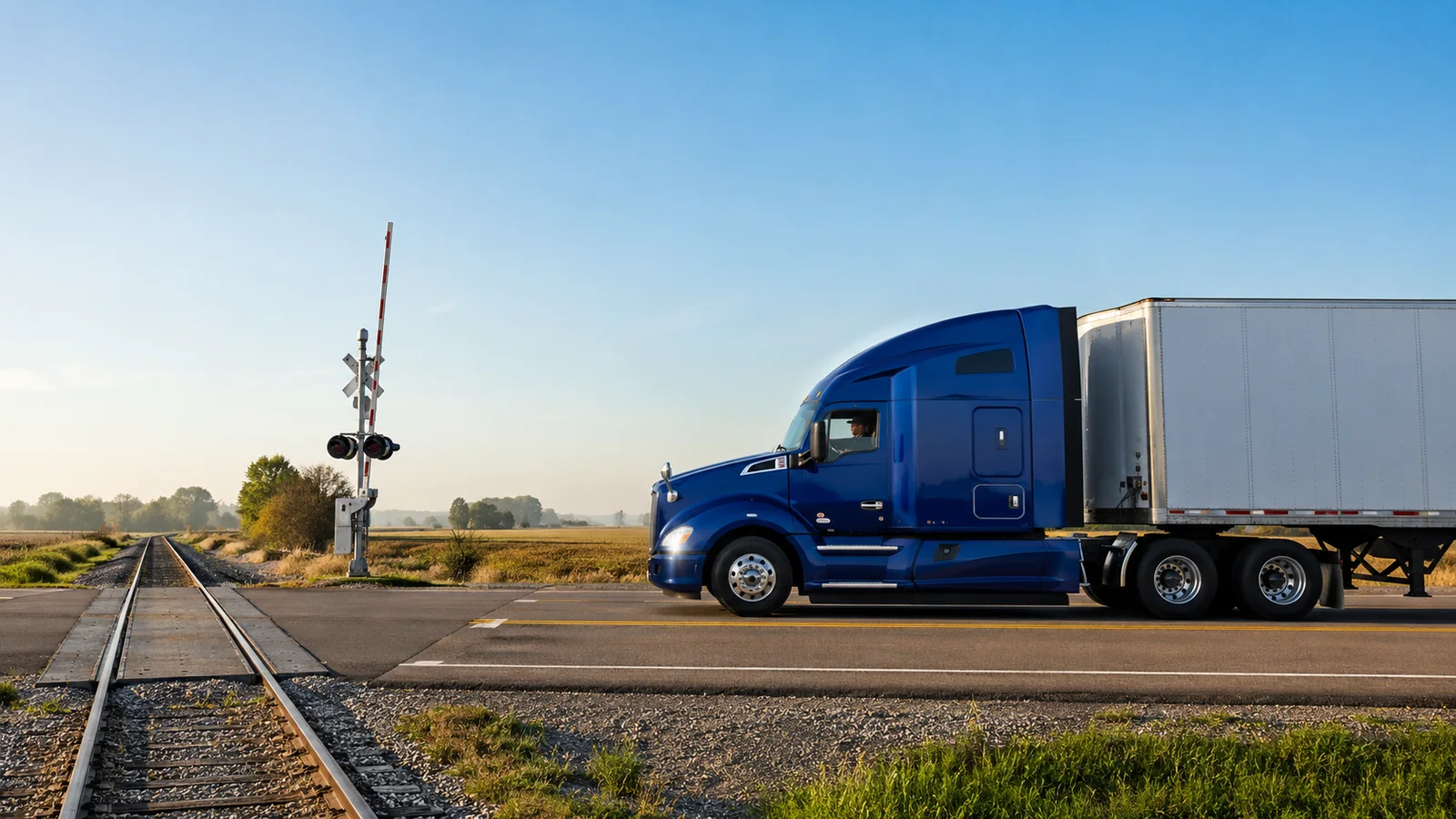
A railroad crossing is one place where a small commercial-driving mistake can become catastrophic. Trains cannot steer away, need a long distance to stop, and always have the right of way. A driver must manage the approach, the vehicle's length and low-clearance points, traffic beyond the rails, and the possibility that warning equipment is absent or inactive.
Federal rules do not require every commercial motor vehicle to make the same stop. Some vehicles must stop at nearly every grade crossing, while other CMVs must slow enough to stop and verify that the tracks are clear. Every CMV driver, however, must obey signals and officials, avoid entering without room to clear the crossing, and account for undercarriage clearance.
Which commercial vehicles must stop
Under 49 CFR §392.10, the driver of a covered CMV must stop within 50 feet of the tracks but no closer than 15 feet to the nearest rail. The driver must listen and look in both directions and determine that no train is approaching before proceeding. When safe, the driver must cross in a gear that allows the vehicle to complete the movement without changing gears.
The stop rule covers every bus transporting passengers. It also covers specified hazardous-material operations, including CMVs required to display the markings or placards listed in the regulation and cargo tank motor vehicles described there, whether loaded or empty. Because the list is technical, a driver should use current shipping papers, placarding requirements, vehicle type, and carrier guidance rather than assuming an empty tank or small quantity eliminates the stop.
Federal exceptions include a police officer or crossing flagman directing traffic to proceed, a functioning highway traffic signal showing green when local law permits proceeding without slowing or stopping, a properly marked abandoned crossing, and an industrial or spur-line crossing marked Exempt. The rule also includes a limited business-district exception for streetcar crossings or tracks used exclusively for industrial switching. A raised gate or inactive light alone is not one of these listed exceptions.
What other CMV drivers must do
Section 392.11 applies to CMVs not listed in the mandatory-stop rule. The driver must approach at a speed that allows the vehicle to stop before the nearest rail and may not drive onto or over the crossing until taking due caution to confirm that the path is clear. This is more than a quick glance at the signal: scan both directions, account for more than one track, and be prepared for a train that is hidden by buildings, vegetation, curves, or another train.
Active devices add warnings; they do not transfer responsibility away from the driver. Never drive around a lowered gate, enter while lights are flashing, or follow another vehicle so closely that its decision controls yours. At a passive crossing without gates or lights, reduce speed early and create the time and sight distance needed to make your own safe decision.
Never enter unless the whole vehicle can clear
49 CFR §392.12 is direct: no CMV driver may enter a highway-rail grade crossing without enough space to drive completely through without stopping. The available space must fit the tractor, trailer, rear overhang, and any combination units beyond the farthest rail. Do not count space occupied by a queue that might not move.
Pause before the tracks when congestion, a traffic light, construction, a turn, or a delivery entrance could trap the vehicle. Keep enough following distance to see the pavement beyond the crossing. If there is doubt, wait on the approach side even if traffic behind becomes impatient. A horn is never a reason to place any part of the vehicle on the rails.
Lowboy, car-carrier, moving-van, tanker, and other low-clearance configurations need special route planning. A steep or humped crossing can hang a landing gear, frame, dolly, liftgate, or trailer belly on the rails. Check the route before departure, obey low-ground-clearance warnings, and use a safe alternate route when the profile is uncertain. Do not attempt to test the clearance by creeping onto the tracks.
Select the gear before crossing
For vehicles required to stop under §392.10, the federal rule expressly prohibits shifting gears while crossing. Select a gear that can carry the entire combination across without a shift, release the brakes smoothly, and continue until every unit is clear. A missed shift, stall, or rollback on the rails can consume the few seconds needed to escape danger.
Drivers of automatic vehicles still need a deliberate plan. Confirm the transmission is in the proper drive range, leave enough room, and avoid a speed or throttle change that could interrupt progress. Training should make the sequence routine: observe, stop or slow as required, verify the path, choose the operating gear, and cross without hesitation or stopping.
Railroad violations can disqualify a CDL
Table 3 in 49 CFR §383.51 applies when a person required to hold a CLP or CDL, or a CLP/CDL holder, is convicted of a Federal, State, or local railroad-highway grade-crossing offense committed while operating a CMV. A first qualifying conviction requires disqualification from operating a CMV for at least 60 days. A second conviction from a separate incident within three years requires at least 120 days; a third or later conviction within three years requires at least one year.
The covered offenses include failing to slow and check when a stop is not always required, failing to stop when the tracks are not clear, failing to make a mandatory stop, entering without enough space to clear, disobeying a traffic-control device or enforcement official, and failing to negotiate a crossing because of insufficient undercarriage clearance.
These are minimum federal disqualification periods, not a complete forecast of consequences. State citations, fines, employer discipline, insurance decisions, and additional safety action can also follow. FMCSA's older safe-clearance page lists historical civil-penalty figures, so drivers should not use those dollar amounts as a current penalty quote. The current regulation and the licensing state control the actual case.
Use a repeatable crossing routine
Start before the trip. Review the route for railroad crossings, low-clearance profiles, restricted roads, and turns immediately beyond the rails. If dispatch creates a route that looks unsafe, stop in a lawful location and ask for an alternative. The driver's duty to operate safely does not disappear because a customer, schedule, or navigation app suggests the route.
On approach, check mirrors and traffic, identify the number of tracks, reduce speed smoothly, and silence avoidable distractions. Make the mandatory stop at the correct distance when the vehicle or load is covered. Look and listen in both directions, then look again before moving. Confirm that the far-side space remains open, select the gear, and cross straight through without shifting or stopping.
Continue until the trailer and any rear equipment are fully beyond the crossing. Then resume normal speed and recheck the mirrors. During supervised CDL practice, ask the instructor to evaluate sight-line management, stopping position, gear choice, trailer clearance, and response to a blocked exit—not merely whether the truck crossed.
If the vehicle becomes stuck on the tracks
If a vehicle stalls or hangs up on a crossing, getting people away from the tracks is the immediate priority. Do not spend critical time trying repeated restarts or inspecting the underside. Move everyone to a safe location at least 15 feet from the tracks, then use the blue-and-white Emergency Notification System sign to call the railroad. Give the dispatcher the crossing identification number and describe the emergency. Call 911 as well when there is immediate danger or anyone needs assistance.
FRA explains that the ENS number connects callers with the railroad responsible for that exact crossing so train movements can be addressed. If a gate or warning signal malfunctions, report it with the same sign information from a safe location. Never remain in the cab because the crossing appears quiet; a train can arrive quickly and may be difficult to hear or judge.
Build the habit during CDL training
Railroad-crossing decisions are part of professional vehicle operation, whether the goal is a tractor-trailer, straight truck, bus, or hazardous-materials work. Class A and Class B ELDT theory establishes a safety foundation, while behind-the-wheel instruction should turn the rules into a consistent routine in representative equipment.
ELDT completion is not a defense to a later violation, and it does not replace state law, carrier policy, route-specific restrictions, or sound judgment. Use the current CDL manual for the licensing state, practice with a qualified instructor, and treat every crossing as a new decision. The safe choice is simple when the exit is blocked, the clearance is uncertain, or the signals are active: do not enter.