CDL O Restriction in 2026: Fifth-Wheel Rules and How to Remove It
Learn why a Class A CDL receives the O restriction, which tractor-trailers it prohibits, and what federal rules require to remove it in 2026.
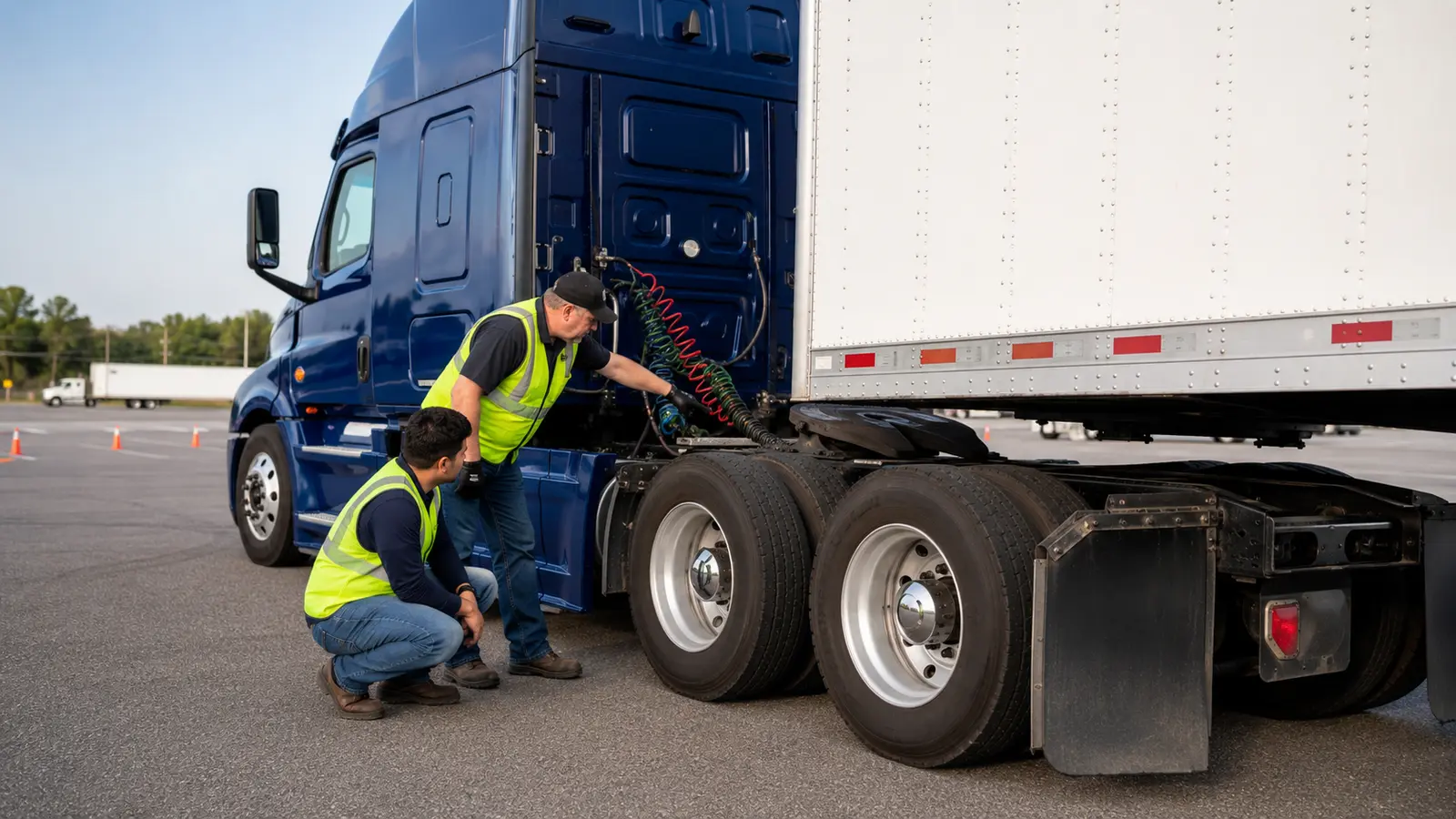
A Class A CDL does not always authorize every Class A combination. If the skills test vehicle connected its power unit and trailer with a pintle hook or another non-fifth-wheel connection, federal rules require the State to place a tractor-trailer restriction on the license. The standard code is O.
The O restriction matters because the conventional semi-tractor and trailer used in most over-the-road, regional, intermodal, and many local freight jobs connect through a fifth wheel. Understanding the test vehicle before the first appointment can prevent an expensive second test.
What the CDL O restriction means
Under 49 CFR §383.95(d), the O restriction applies when an applicant performs the Group A skills test in a combination whose power unit and towed unit use a pintle hook or other non-fifth-wheel connection. The resulting credential restricts the driver from operating a tractor-trailer combination connected by a fifth wheel when that combination requires a Group A CDL.
A fifth wheel is the plate-and-locking-jaw coupling mounted on the tractor. It receives the trailer's kingpin and allows the combination to pivot. A pintle hook captures a lunette ring, a setup common in some construction, utility, municipal, and equipment-hauling combinations. The coupling and handling experience is not identical.
The O code is therefore about the connection used during the skills test—not about the driver's age, medical status, transmission, brakes, or endorsements. Those subjects can produce separate restrictions. Read the entire credential and driving record instead of treating 'Class A' as the only line that matters.
What you may and may not drive
With an O restriction, a driver may not operate a fifth-wheel tractor-trailer that requires a Class A CDL. The prohibited category includes the familiar road tractor pulling a semitrailer when the combination meets the Class A weight definition. Driving one anyway can place the driver and employer out of compliance, even if the driver has experience with a different heavy combination.
The restriction does not erase the Class A credential. It may still allow other Class A combinations that use an authorized non-fifth-wheel connection, plus Class B or Class C vehicles that the driver is otherwise qualified and endorsed to operate. Actual authority still depends on the vehicle's ratings, use, endorsements, other restrictions, medical status, and State law.
Do not decide from the hitch alone. Class A generally covers a combination with a gross combination weight rating or gross combination weight of at least 26,001 pounds when the towed unit's rating or weight exceeds 10,000 pounds. Confirm the vehicle identification, ratings, coupling, cargo, and license before accepting a dispatch.
Why the O restriction can narrow job options
For a driver who plans to haul dry van, refrigerated, flatbed, tanker, intermodal, or other semitrailer freight, an O restriction is a significant barrier. Carriers usually need drivers who can legally couple, inspect, maneuver, and operate their fifth-wheel equipment. A recruiter may decline an otherwise qualified Class A applicant when the fleet has no compatible non-fifth-wheel positions.
The restriction may be less important in a job built around dump trucks with equipment trailers, utility combinations, road-maintenance units, or other specialized rigs. A future equipment change can still introduce a fifth-wheel tractor-trailer, so compare the credential with both today's vehicle and likely assignments.
Be direct on applications. List 'Class A CDL — O restriction' when a form asks about restrictions. Ask which coupling and vehicle class the road evaluation uses. Never conceal the code or operate prohibited equipment to complete an employer test.
Removing O requires all three skills tests
Federal rules make O removal more demanding than removal of certain equipment restrictions. Under 49 CFR §383.135(b)(7), a State may use a modified skills test for the air-brake, full-air-brake, or manual-transmission restrictions addressed in paragraphs (b)(3) through (5). The tractor-trailer restriction is addressed separately.
Section 383.135(b)(8) says an applicant seeking to remove the tractor-trailer restriction must retake all three skills tests in a representative tractor-trailer. Those segments cover the vehicle inspection test, basic vehicle control skills, and on-road driving skills. Passing only a coupling demonstration or short road test is not enough under the federal standard.
The test vehicle must be a representative Class A tractor-trailer with a fifth-wheel connection. It also affects other codes. Testing in an automatic vehicle can retain or create an E restriction; testing without a full-air-brake system can retain or create L or Z. Before reserving equipment, give the provider and State licensing agency a complete list of restrictions you intend to remove.
Does removing the O restriction require ELDT?
A driver who already holds, or previously held, a Class A CDL generally does not repeat federal Entry-Level Driver Training for the same license class. FMCSA's ELDT applicability page says holders of a current or former Class A or Class B CDL do not need ELDT for the type they currently or previously held. That is the usual situation for a Class A driver removing O.
Do not confuse that principle with the restriction-removal exception that cites §383.135(b)(7). That paragraph covers the modified-test restrictions in (b)(3) through (5), while O removal appears in (b)(8) and requires all three test segments. The federal sources therefore support no new Class A ELDT for an existing Class A holder, but they do not reduce the O retest to the shorter modified procedure.
A Class B holder upgrading to Class A is different: the upgrade is an ELDT-covered transaction. A person seeking Class A for the first time is also subject to applicable ELDT. States may impose additional training, permit, waiting-period, documentation, or testing rules, so obtain the O-removal checklist from the State licensing agency before purchasing training or renting a truck.
A practical O-restriction removal plan
Start with the State that issued the CDL. Ask whether you need a commercial learner's permit, which application and medical documents to bring, which knowledge tests remain valid, whether a waiting period applies, and how the State codes an O-removal appointment. Confirm fees and whether a third-party examiner is authorized to conduct the test.
Next, arrange a compliant tractor-trailer and a qualified person to move it to the test site. Verify registration, insurance, inspection status, fifth-wheel connection, weight class, brake system, and transmission. Ask about trailer loading, required safety equipment, and document originals. A suitable truck can still be rejected for missing paperwork or an unsafe defect.
Then practice the complete examination rather than only coupling. Rehearse the State's vehicle inspection sequence, straight-line and offset backing or other required control exercises, safe turns, lane position, railroad crossings, traffic checks, speed management, and stopping. Use the current State CDL manual because test layouts, scoring procedures, appointment rules, and vehicle requirements can vary.
Practice fifth-wheel inspection as a system
Treat coupling as a sequence that controls whether the trailer stays attached. On level, stable ground, inspect the fifth wheel, mounting hardware, skid plate, locking mechanism, release handle, apron, and kingpin for damage, contamination, improper position, or missing parts. Follow the vehicle and training provider's approved procedure rather than relying on a memorized shortcut.
After coupling, visually verify that the trailer apron is properly seated on the fifth wheel and that the locking jaws are closed around the kingpin. Confirm the release handle is secured, connect and inspect air and electrical lines, raise the landing gear correctly, and perform the required tug and brake checks in the proper order. Never place any part of your body in a pinch zone or between vehicles that could move.
Practice uncoupling too. Choose firm, level support, secure the vehicle against movement, lower the landing gear appropriately, disconnect lines without damage, release the locking mechanism, and pull away under control while checking that the trailer remains stable. Exact vehicle procedures and terminology belong in the current manufacturer guidance, State manual, and hands-on instruction.
Avoid the restriction on the first Class A test
If you are still planning your original Class A test, work backward from the equipment you want to operate. For broad tractor-trailer eligibility, train and test in a representative fifth-wheel combination. Also check for a manual transmission and full-air-brake system if avoiding E, L, and Z restrictions matters for your target jobs.
Federal Class A ELDT includes theory plus behind-the-wheel range and public-road instruction from providers listed on the Training Provider Registry. CDL Compass provides the online Class A theory portion; students must separately arrange registered behind-the-wheel training and the State-administered skills test. Confirm that every provider is registered for the training it will deliver.
Inspect the CDL after issuance. Verify the class, endorsements, restrictions, name, and medical status before driving for work. If O appears unexpectedly, contact the licensing agency immediately and preserve the test and vehicle records. The safest and least expensive restriction is the one prevented by choosing the correct training and test vehicle from the start.