CDL M and N Restrictions in 2026: Bus Test Vehicles and How to Remove Them
Learn why a passenger skills-test vehicle can create an M or N restriction, what each code permits, how it affects bus jobs, and what to verify before retesting.
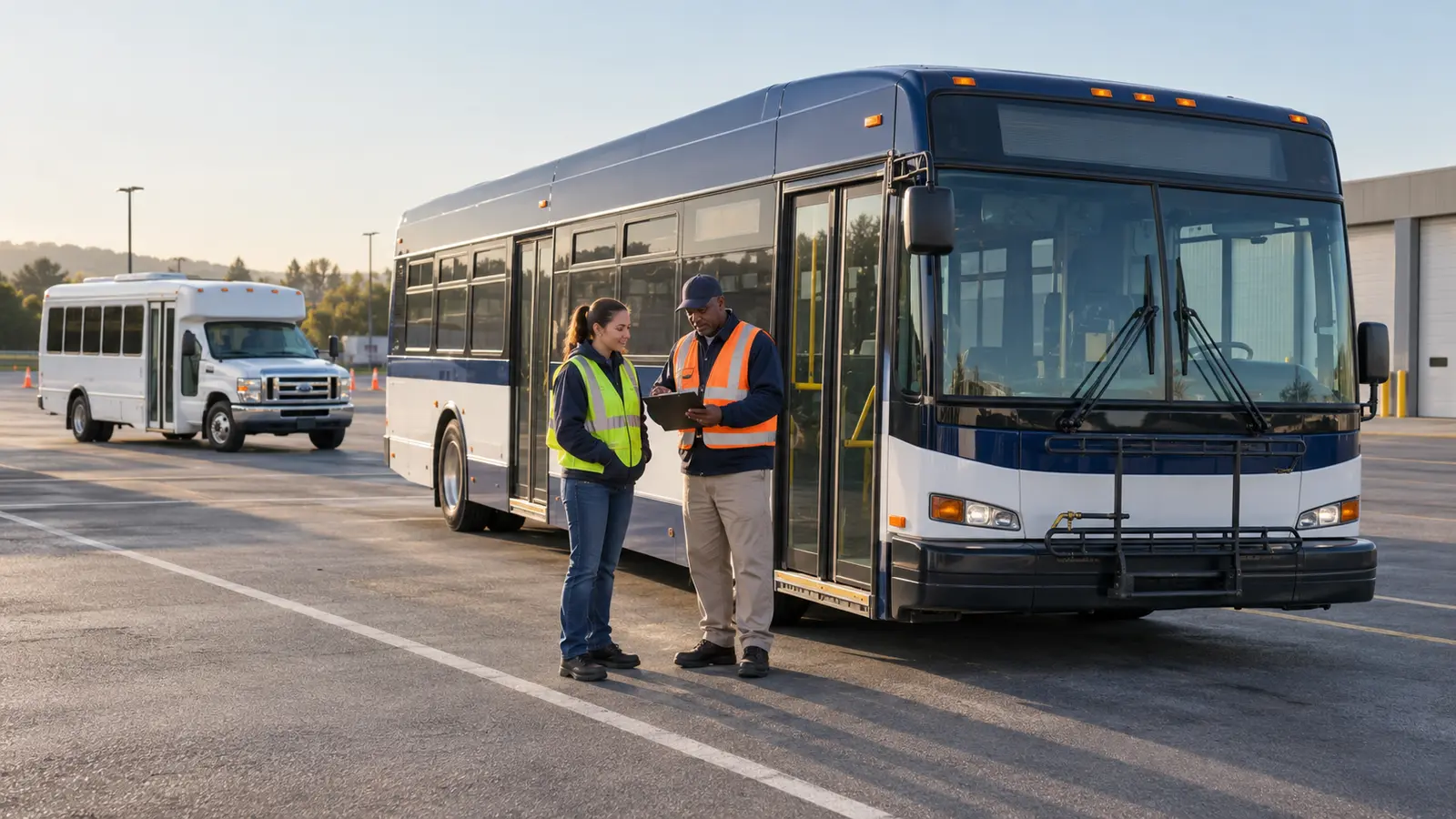
An M or N restriction on a commercial driver's license does not cancel the passenger endorsement or reduce every CDL privilege. It limits the class of passenger vehicle the driver may operate because the passenger skills test was taken in a lower-class vehicle. The test vehicle creates the federal restriction.
This matters for transit, motorcoach, shuttle, paratransit, and school-bus applicants. A convenient small test vehicle may qualify a driver for one job while blocking a future position in a heavier bus. Before scheduling, compare the vehicle's official weight ratings, required CDL class, brake and transmission systems, and expected endorsements.
What the M restriction means
Under 49 CFR §383.95(e), a passenger applicant who performs the skills test in a Group B vehicle must be restricted from operating a passenger vehicle requiring a Group A CDL. FMCSA identifies this as M. A Class A CDL holder with P and M may operate qualifying Class B and C passenger vehicles, but not a Class A passenger vehicle.
M applies only to passenger-vehicle authority. It does not turn a Class A CDL into Class B or prohibit an otherwise authorized Class A freight combination. Compare the restriction with the exact vehicle and assignment instead of assuming it blocks all Class A work.
What the N restriction means
Section 383.95(f) requires a restriction when the passenger skills test is performed in a Group C vehicle. FMCSA labels it N: no Class A or Class B passenger vehicle. A driver with P and N is limited to qualifying Class C passenger vehicles.
Do not confuse the N restriction with the N tank-vehicle endorsement. The same letter can describe a tank endorsement in one CDL field and a passenger limitation in another. Read the labeled endorsement and restriction sections separately before deciding whether a driver is qualified for a bus.
CDL class depends on vehicle ratings and configuration
A full-size single-unit bus with a gross vehicle weight rating or actual gross vehicle weight of 26,001 pounds or more is generally Class B. A smaller vehicle that does not meet Class A or B thresholds can be Class C when it is designed to transport 16 or more people, including the driver. A Class A passenger vehicle is a qualifying heavy combination, not simply the longest single bus on the lot.
Use the manufacturer's certification labels and the licensing agency's classification rules; do not guess from body style, seating, or curb weight. FMCSA classifications use the greater of the applicable rating or actual weight. For a combination, both the 26,001-pound combination threshold and the more-than-10,000-pound towed-unit threshold matter. Ask the examiner to confirm the group before test day.
The P endorsement and M/N restriction do different jobs
The P endorsement shows that the driver passed the required passenger knowledge and skills tests. Federal law requires both for a passenger endorsement. The M or N code then narrows the vehicle groups in which that endorsement may be used. Having a higher base CDL class does not erase a lower-class passenger test result.
For example, a Class A tractor-trailer driver who adds P using a Class B bus can receive M. The driver remains Class A for authorized non-passenger combinations but has demonstrated passenger skills only at the Class B level. A Class B driver who tests for P in a Class C shuttle can receive N and remain able to drive authorized non-passenger Class B vehicles while being limited to Class C passenger work.
How school-bus testing fits in
A school-bus driver generally needs both the S school-bus endorsement and the P passenger endorsement. Federal rules require knowledge and skills tests for each applicable endorsement, and first-time P and S applicants are covered by ELDT. The class of school bus used for the skills test therefore affects the passenger authority shown on the resulting license.
FMCSA's driver guidance explains that a Class A holder who obtains a passenger or school-bus endorsement in a Class B vehicle receives M, while a Class B holder who tests in a Class C vehicle receives N. A school-bus applicant should confirm whether the planned route vehicle is Class B or C and test in a representative vehicle that preserves the needed authority.
Other test-vehicle restrictions can stack
Choosing the correct bus class does not by itself produce an unrestricted CDL. A skills test in an automatic-transmission CMV can create an E restriction against manual-transmission CMVs. Testing without air brakes can create an L restriction; testing with air-over-hydraulic brakes can create a Z restriction against full-air-brake vehicles. These codes can appear alongside M or N.
Review the actual fleet used by the target employer. Many transit and motorcoach positions require a Class B CDL with P, full-air-brake authority, and no restriction that conflicts with the bus. A driver who tests in a small automatic hydraulic-brake shuttle may pass successfully yet still need additional testing before operating a heavier air-brake bus.
How to remove an M or N restriction
Start with the State Driver Licensing Agency that issued the CDL. Ask for its current M- or N-removal checklist, required permit or knowledge tests, acceptable test vehicle, appointment process, fees, and whether all three skills-test segments must be repeated. Federal §383.135 expressly permits modified tests for certain E, L, and Z removals, but it does not provide the same shortcut for M or N. Do not assume a limited road test will be enough.
Expect to demonstrate passenger skills in a vehicle from the higher group you want to operate. To remove N for Class B passenger work, that generally means testing in a qualifying Class B passenger vehicle. Removing M requires access to a qualifying Class A passenger vehicle, which can be uncommon. If the State issues a new CLP, the CLP is class-specific for P and the federal 14-day wait applies before the skills test.
Does restriction removal require ELDT again?
Federal ELDT applies when a person obtains a Class A or B CDL for the first time, upgrades to Class A or B, or obtains P, S, or H for the first time. The federal rule does not list removal of an existing M or N restriction as a separate ELDT event. A driver who already holds P does not automatically repeat first-time P ELDT solely because of the restriction code.
The answer changes if the plan also includes a first-time endorsement or a CDL class upgrade. State law, an employer, or a training provider may impose additional preparation even when federal ELDT is not triggered again. Give the licensing agency the full credential history and intended vehicle class; do not enroll or rent a test bus until the agency confirms the exact path.
Plan the test vehicle around the job
Ask the employer for the CDL class, required endorsements, prohibited restrictions, GVWR or GCWR, passenger design capacity, brake system, and transmission of the assigned vehicle. Then compare those details with the test vehicle's certification labels. Get written confirmation from the school or test provider that the vehicle qualifies for the intended passenger group.
If the goal is a typical full-size transit bus or motorcoach, a representative Class B passenger vehicle is usually the relevant test choice. A Class C shuttle may be easier to source, but it can create N and close off Class B bus work. Class A passenger combinations are unusual, so a Class A freight driver should decide whether avoiding M has real career value before pursuing specialized equipment.
A restriction-prevention checklist
Before testing, verify the licensing State's rules, the P or P-and-S knowledge tests, first-time ELDT records, CLP class and endorsements, permit issue date, medical status, and test appointment. Inspect the test vehicle's class, passenger configuration, brakes, transmission, registration, insurance, and safety condition. Confirm what restriction codes will result from that exact equipment.
After passing, inspect the temporary and permanent CDL immediately. Confirm the class, P and any S endorsement, and each restriction before accepting a route. If Class B training is your starting point, CDL Compass offers online Class B ELDT theory; complete the required passenger or school-bus ELDT separately when seeking those endorsements for the first time, then finish hands-on training and testing with qualified providers in the right vehicle.