CDL Endorsements Explained in 2026: HazMat, Tanker, Passenger, School Bus, and More
Compare the six federal CDL endorsements, their tests, ELDT requirements, permit restrictions, and the credentials that fit different commercial driving jobs.
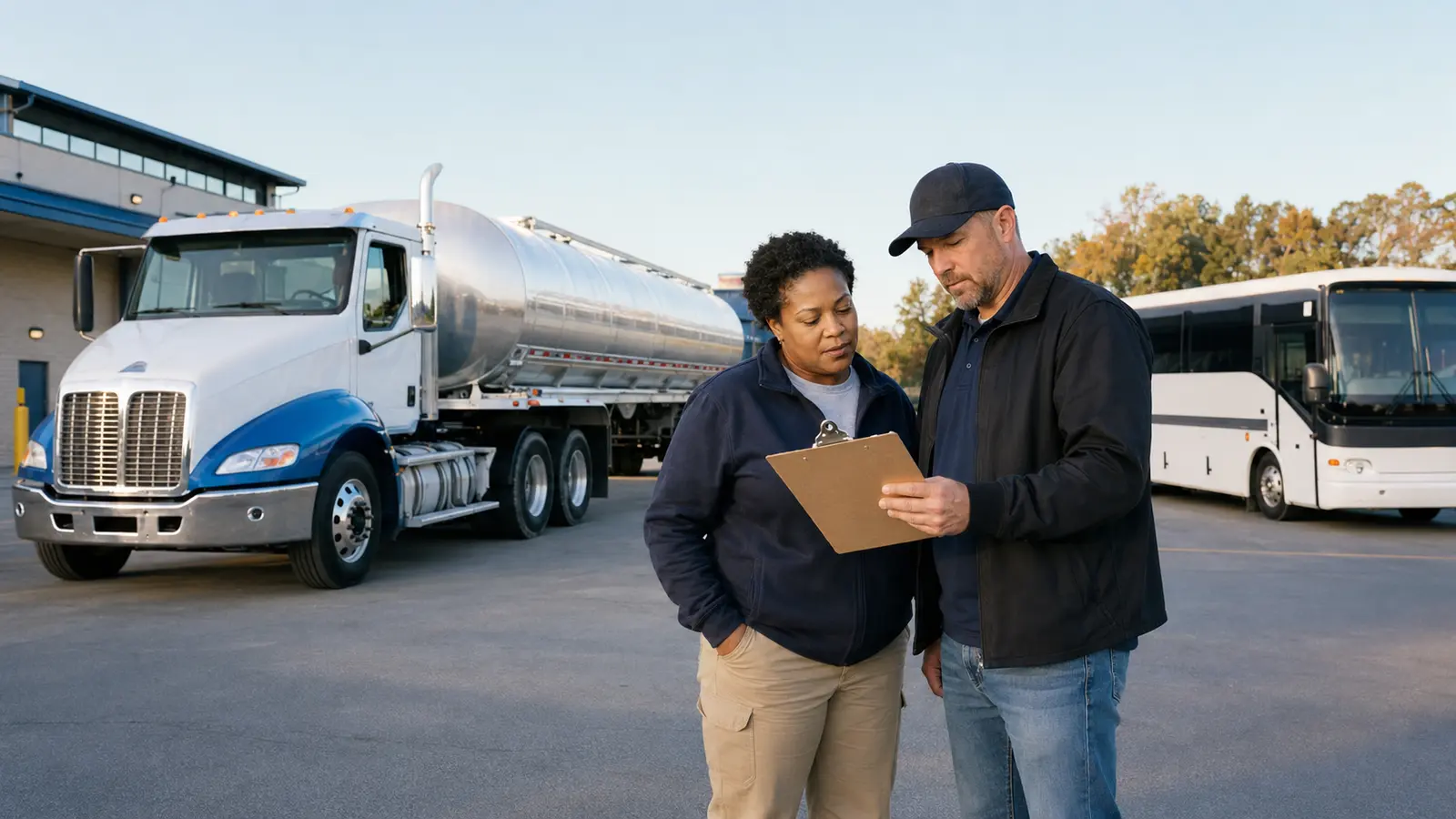
A Class A, Class B, or Class C CDL identifies the vehicle group a driver may operate. An endorsement adds authority for a special vehicle or operation. Choosing the right endorsements can open tanker, passenger, school-bus, HazMat, or multiple-trailer work, but each credential has its own testing and training path.
Federal standards recognize six main endorsement codes: T, P, N, H, X, and S. Only the first-time H, P, and S endorsements trigger federal Entry-Level Driver Training. States issue the actual CDL and may impose additional steps, fees, or restrictions, so use this guide to plan the federal baseline and then confirm the current instructions with your State Driver Licensing Agency.
Endorsements are different from CDL classes
The CDL class is based primarily on vehicle weight, configuration, and—in some Class C situations—passenger or hazardous-material use. An endorsement adds a special operating privilege. A Class A driver may still need N for a tank, H for placarded hazardous materials, or P for a qualifying passenger vehicle.
An endorsement does not expand the underlying vehicle class. Earning P in a Class B bus does not authorize a Class A passenger combination. The passenger or school-bus test vehicle can also create an M or N restriction. Match the license class, endorsement, and test vehicle to the job.
T endorsement: double and triple trailers
The T endorsement authorizes double or triple trailers. FMCSA lists a knowledge test, not a separate federal endorsement skills test. Topics include coupling, inspections, rollover prevention, space management, and handling multiple articulation points.
Federal ELDT does not apply solely because a driver adds T, though it may apply to the underlying first Class A CDL. Triple trailers are not permitted everywhere, and an endorsement does not override route or equipment rules.
N endorsement: tank vehicles
The N endorsement is for tank vehicles and requires a knowledge test. Drivers must understand liquid surge, high centers of gravity, stopping distance, smooth control, inspection, and baffled or unbaffled tanks. It can apply even when cargo is not hazardous.
Adding N alone does not trigger federal ELDT. On a commercial learner’s permit, N is one of only three allowed endorsements. The holder may operate only an empty tank and may not operate one that carried hazardous material unless it has been purged of residue.
H endorsement: hazardous materials
The H endorsement authorizes transportation of hazardous materials that require placards under federal rules. A first-time H applicant must complete HazMat ELDT theory with a provider listed in FMCSA’s Training Provider Registry before the state may administer the H knowledge test. HazMat ELDT does not include a federal behind-the-wheel component.
The endorsement process also includes a Transportation Security Administration security threat assessment, fingerprinting, state application steps, and recurring renewal requirements. The sequence and timing vary by state, so coordinate the ELDT record, TSA enrollment, and knowledge test rather than treating them as one appointment.
HazMat theory covers topics such as classification, shipping papers, placards, loading and unloading, segregation, emergency response, route planning, parking, and security. A driver must still follow employer procedures and the rules for the material being transported after the endorsement is issued.
X endorsement: tanker and HazMat combined
The X endorsement combines N tank-vehicle authority with H hazardous-material authority. It is useful for jobs hauling placarded liquid or gaseous hazardous materials in tanks. FMCSA identifies X as a knowledge-test endorsement, but a first-time applicant must satisfy the HazMat ELDT requirement because X includes H authority.
An X applicant should prepare for both tanker and hazardous-material knowledge. The TSA threat assessment and state HazMat procedures still apply. X is not a shortcut around either credential: it represents both operating responsibilities on the CDL.
P endorsement: passenger vehicles
The P endorsement is required for qualifying passenger commercial vehicles. Unlike T, N, H, and X, it requires both knowledge and skills tests. A first-time P applicant must complete the applicable P theory and behind-the-wheel ELDT with registered providers before the state administers the P skills test.
Training addresses passenger safety, vehicle inspection, loading and unloading, emergency exits, evacuation, railroad crossings, prohibited practices, and vehicle operation. The skills test must be taken in an appropriate passenger vehicle. Testing in a lower vehicle group can produce a restriction even when the driver holds a higher CDL class.
A P endorsement on a CLP carries a strict limitation: the permit holder may not carry ordinary passengers. Only authorized auditors, inspectors, examiners, other trainees, and the properly licensed supervising CDL holder may be aboard under the federal CLP rule.
S endorsement: school buses
The S endorsement covers school-bus operation and requires knowledge and skills tests. A first-time applicant must complete S endorsement theory and behind-the-wheel ELDT before the S skills test. Because drivers actually transporting schoolchildren in a school bus generally need both P and S, applicants commonly must satisfy the applicable requirements for both endorsements.
School-bus training adds student loading and unloading, danger zones, mirror use, stop-arm procedures, emergency evacuation, railroad crossings, and student-management safety. States may add background checks, driving-history standards, medical or physical qualifications, training hours, and school-district requirements.
FMCSA guidance distinguishes student transportation from other uses of a school bus. Drivers delivering an empty bus, mechanics moving an empty bus, or drivers carrying people to a non-school-sponsored event may need P without S. Confirm the actual operation instead of relying only on the vehicle’s paint or body style.
Which endorsements require ELDT?
Federal ELDT applies to H, P, and S when the driver is obtaining that endorsement for the first time. H requires theory training before the knowledge test. P and S require both theory and behind-the-wheel training before their respective skills tests. Training must come from a provider listed in the Training Provider Registry, and the state verifies completion electronically.
T, N, and the tanker portion of X do not independently trigger ELDT. However, first-time H authority within X does. A driver obtaining the underlying Class A or Class B CDL for the first time—or upgrading from Class B to Class A—may also have separate ELDT obligations. Complete each required curriculum and confirm that the Registry record appears before the covered test.
Air brakes are not a CDL endorsement
Many applicants casually call air brakes an endorsement, but the federal CDL system treats air-brake limitations as restrictions. A driver who does not pass the air-brake knowledge and skills requirements, or tests in equipment without a full air-brake system, may receive an L or Z restriction. Testing in an automatic vehicle can create an E restriction, and other equipment choices can create additional limits.
Review the intended job equipment before selecting a test vehicle. Removing a restriction later may require another state test and access to properly equipped equipment, even when federal ELDT is not required for the restriction removal.
How to choose endorsements for your career
Start with local job descriptions. Dry-van and refrigerated work may require only Class A; fuel and chemical hauling commonly need X. Food-grade bulk may need N without H. Transit and motorcoach work typically needs P, school transportation usually needs P plus S, and LTL fleets may value T, H, or X.
More endorsements create flexibility, but each carries responsibility, renewal work, and sometimes extra screening. Choose credentials you can maintain and use safely, then ask employers about experience requirements and company training.
A practical endorsement plan
First, identify the vehicle, cargo, passenger capacity, and operation. Second, confirm the required CDL class and endorsement codes with the state. Third, check whether first-time H, P, or S ELDT applies and select registered providers. Fourth, study the current state CDL manual and complete every required theory, behind-the-wheel, knowledge, skills, medical, and security step.
Before testing, verify the ELDT completion in the Training Provider Registry and confirm the appointment, identification, permit, test vehicle, and fees. After issuance, inspect the physical CDL for the correct endorsements and restrictions before accepting a dispatch.
CDL Compass offers online ELDT theory courses for Class A, Class B, and HazMat. The HazMat course can satisfy the federal theory-training step for a first H endorsement when completed through the registered provider. Passenger and school-bus applicants must use providers registered for those specific curricula, including the required behind-the-wheel training.