CDL E Restriction in 2026: Automatic Transmission Limits and How to Remove It
Learn what the CDL E restriction means, how it affects manual-transmission jobs, and which training and testing steps can remove it in 2026.
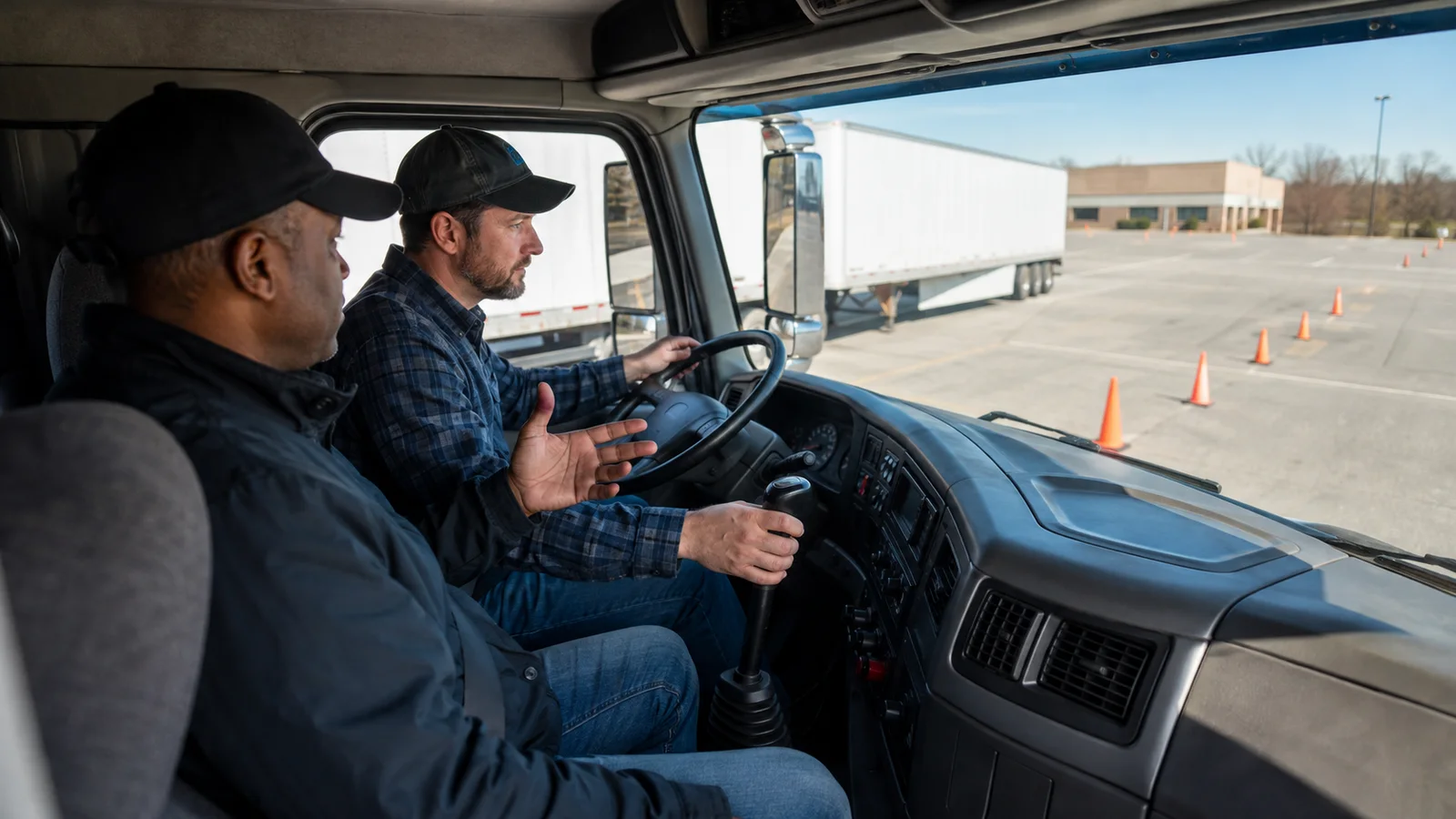
Automatic transmissions are common in newer commercial fleets, but a CDL marked with restriction E still limits the vehicles you may legally operate. The restriction can affect access to older tractors, specialized equipment, construction fleets, moving trucks, and employers that expect drivers to handle both manual and automatic units.
As of August 9, 2026, FMCSA defines E as the no-manual-transmission-equipped-CMV restriction. It is added when a driver takes the skills test in an automatic. Removal generally requires a state licensing action and testing in a qualifying manual CMV, while the home state sets the permit, test, document, and fee requirements.
What the CDL E restriction actually prohibits
Restriction E does not change the CDL class printed on the license. A Class A driver with E may still operate qualifying Class A vehicles that use automatic transmissions and that fit every other endorsement and restriction on the CDL. The driver may not operate a manual-transmission CMV, even when the driver knows how to shift or the employer is willing to provide informal practice.
FMCSA explains that restrictions are added when the skills-test vehicle lacks equipment found on other CMVs. For E, the deciding feature is an automatic transmission. The restriction applies to commercial vehicles, not to a manual-transmission personal car operated under a noncommercial license.
Read the entire CDL. E can appear alongside L or Z air-brake restrictions, O no-tractor-trailer, K intrastate-only, or passenger-vehicle limitations. Removing E does not remove another code.
Should a new driver test in a manual truck?
The best test vehicle depends on the work you plan to pursue. Testing in an automatic reduces the tasks a beginner coordinates during preparation. It can be practical when the target carrier operates an all-automatic fleet and confirms that E will not affect eligibility.
A manual test preserves flexibility for small carriers, vocational fleets, heavy-haul operations, construction work, older fleets, and jobs where substitute equipment varies. A restriction-free license does not guarantee employment, but it removes one equipment-related barrier.
Ask employers whether their fleet includes manuals, whether new drivers face a shifting evaluation, and whether E affects pay, routes, or eligibility. Compare extra training and vehicle cost with broader access. Choose a manual test only when you can operate the equipment smoothly and safely in traffic.
Removing E does not require another ELDT course
FMCSA’s Training Provider Registry FAQ directly addresses this question: a driver removing the E, L, or Z restriction under 49 CFR §383.135(b)(7) is not subject to the federal Entry-Level Driver Training regulations for that restriction removal. An existing CDL holder does not need to repeat Class A or Class B ELDT theory merely to remove E.
The exception does not eliminate practical preparation. A state can require a CLP or authorization, a waiting period, and skills-test segments. A school may require an evaluation before providing its manual truck. Those are licensing and safe-equipment-use requirements, not a new federal ELDT certification.
The answer changes when the transaction is more than restriction removal. A Class B-to-A upgrade and a first Class A or Class B CDL generally require the applicable ELDT. Give the state and school your current class and every requested change.
The state decides which test segments you must repeat
There is no nationwide shortcut such as ‘take only the road test.’ Pennsylvania currently lists vehicle inspection and on-road testing for manual-transmission removal, without a knowledge or basic-control test. Other states may use a different modified test or require the complete skills test.
Ask your home-state agency which permit is required, whether a knowledge test or waiting period applies, which test segments are included, whether third-party testing is allowed, and what documents and fees to bring. Confirm again when scheduling because procedures change.
Since November 18, 2024, FMCSA requires states to query the Drug and Alcohol Clearinghouse for licensing actions that expand CMV authority. FMCSA treats an expanding restriction removal as an upgrade for this purpose. A prohibited driver cannot complete the transaction until Clearinghouse status allows it.
Choose a test truck that protects the rest of your CDL
The truck must have a true manual transmission and represent the class and type of commercial vehicle you intend to operate. Ask the school or tester to identify the transmission, CDL class, gross-vehicle ratings, brake system, coupling system, registration, inspection status, and insurance before you reserve it. The examiner, not a marketing description, determines whether the vehicle qualifies.
For a Class A driver, pay special attention to the trailer connection. Testing in a Class A combination without a fifth wheel can create or preserve an O restriction. A vehicle without full air brakes can create L or Z limitations. The goal is not merely to remove one letter; it is to finish with the operating privileges required for the intended job.
Practice in the same vehicle whenever possible. Shift pattern, clutch engagement, gear spacing, mirror position, brake feel, and transmission behavior vary. A driver who is comfortable in one truck can still struggle if the test vehicle has unfamiliar controls or a different shifting technique.
Train for control, not just a memorized shift pattern
Begin with stationary orientation: neutral position, clutch travel, service and parking brakes, range selector if equipped, gear pattern, gauges, and safe start and shutdown. Then practice smooth starts and stops in a controlled area before adding upshifts, downshifts, turns, grades, traffic, and railroad-crossing procedures.
The examiner is evaluating safe vehicle control. Repeated grinding, missed gears, coasting, rolling backward, stalling in a hazardous location, blocking traffic, or losing attention while searching for a gear can lead to failure even if the driver eventually recovers. Keep both steering and traffic awareness ahead of speed. If a shift is missed, follow the instructor’s recovery method rather than forcing the transmission.
Some heavy-truck transmissions and employers use specific shifting procedures. Learn the method required for the test vehicle and follow the state manual and instructor’s directions. Do not assume that advice from a passenger car, a different tractor, or an online video transfers perfectly to the truck in front of you.
A practical E-restriction removal checklist
First, inspect the current CDL and motor-vehicle record. Write down every restriction and endorsement, confirm medical certification status, and resolve any suspension, downgrade, or Clearinghouse prohibition before paying for a test. Second, contact the home-state licensing agency for the current restriction-removal process and obtain the correct permit or authorization.
Third, schedule hands-on instruction with a provider that has a qualifying manual CMV in the correct class. Ask what is included: evaluation, practice hours, vehicle use for the exam, insurance, examiner fee, cancellation policy, and retest cost. Fourth, practice inspection language and on-road operation until performance is consistent, not merely good during one lesson.
Finally, pass the required state test segments and verify the new credential before operating a manual CMV. Check that E was removed and that no unintended restriction was added. Keep the temporary credential or receipt as directed by the state while waiting for the permanent CDL.
Plan ELDT and transmission training in the right order
If you already hold the needed CDL class, E removal is a hands-on licensing project rather than another ELDT course. If you are starting your CDL or upgrading from Class B to Class A, complete the appropriate federal theory and behind-the-wheel pathway, then select a skills-test vehicle that matches the privileges you want.
CDL Compass offers registered online Class A and Class B ELDT theory courses for drivers who are obtaining those credentials for the first time or completing a covered upgrade. Theory prepares you for the federal curriculum, but shifting proficiency and the CDL skills test require in-person practice with a qualified provider and a representative vehicle.
The durable strategy is simple: decide which jobs and equipment you want, verify the state process, train in the correct truck, and test only when manual control is safe and repeatable. That approach can prevent an unwanted E restriction at the beginning—or remove it without paying for training you do not legally need.