CDL Doubles and Triples Endorsement in 2026: T Test, ELDT, and Safety
Learn when the CDL T endorsement is required, what the knowledge test covers, whether ELDT applies, and how drivers safely inspect and handle doubles and triples.
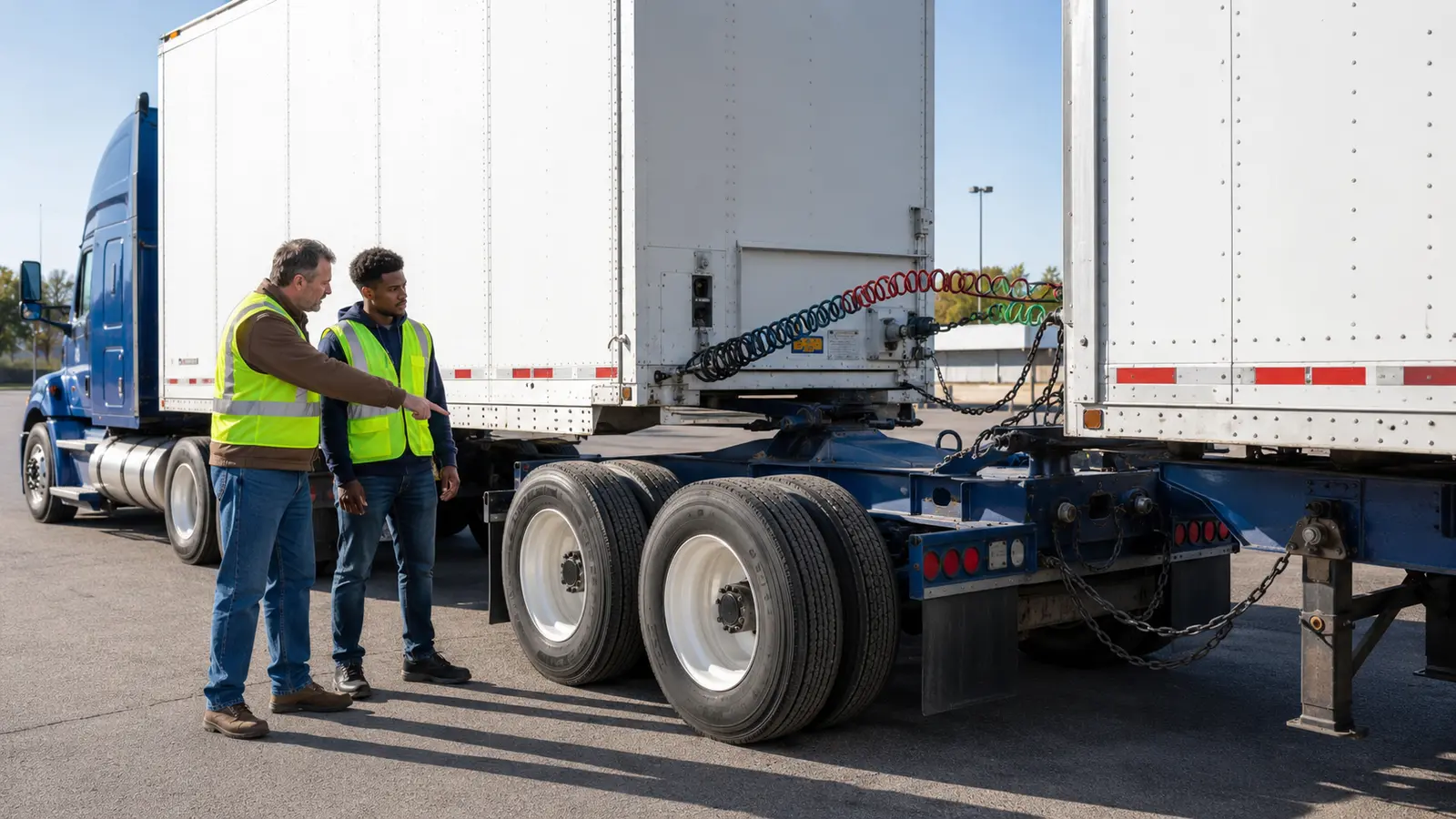
Pulling two or three trailers requires more than a Class A CDL. Federal rules require a State-issued double/triple trailers endorsement—normally shown as T—before a driver operates those commercial vehicle combinations. The endorsement confirms that the driver passed a specialized knowledge test covering hookup, trailer placement, stability, inspections, and operating risks.
The credential is only the legal starting point. Doubles and triples have more coupling points, air lines, valves, and moving joints than a single semitrailer. They also amplify steering inputs toward the rear of the combination. A driver must combine test knowledge with supervised, equipment-specific practice before accepting a dispatch.
What the T endorsement authorizes
Under 49 CFR §383.93, a driver must obtain the doubles/triples endorsement to operate double- or triple-trailer commercial motor vehicles. The federal requirement is a knowledge test, not a separate endorsement skills test. Unlike P, S, and N, T is not allowed on a commercial learner's permit.
A T endorsement does not expand the underlying CDL class. A typical tractor pulling doubles is a Group A combination, so the driver must already hold the appropriate Class A CDL and satisfy any other restrictions or endorsements created by the vehicle, cargo, and operation. The endorsement also does not make triples legal everywhere. State laws, approved routes, vehicle dimensions, weight limits, weather controls, and carrier policies still govern each trip.
Does adding T require Entry-Level Driver Training?
No federal ELDT curriculum is required solely to add a doubles/triples endorsement. Section 380.609 requires ELDT for a first Class A or Class B CDL, a Class B-to-Class A upgrade, and the first P, S, or H endorsement. T is not on that endorsement-training list.
That distinction matters for planning. A current Class A driver can generally study the State manual and take the T knowledge test without buying a separate federal ELDT course. A person seeking Class A for the first time must still complete applicable Class A theory and behind-the-wheel training through providers listed on the Training Provider Registry before the State skills test. The later T test does not replace any part of Class A ELDT.
What the doubles and triples knowledge test covers
Section 383.115 identifies five knowledge areas: assembling and hooking up the units; placing the heaviest trailer correctly; handling and stability characteristics; traffic problems created by the longer combination; and other operating practices. The official State CDL manual turns those categories into the procedures and inspection points a test applicant must study.
Expect questions about converter dollies, pintle hooks, safety chains, shut-off valves, air and electrical lines, landing gear, coupling checks, brake checks, and uncoupling order. Operating questions may address off-tracking, steering response, sway, rollover, following distance, lane changes, grades, adverse weather, parking, and the extra time needed to pass or cross traffic.
Why the rear trailer demands special attention
Doubles and triples can produce a crack-the-whip effect: a steering movement at the tractor becomes larger farther back in the combination. The last trailer is the most likely unit to roll over. Curves, ramps, quick lane changes, and abrupt corrections that feel manageable in a single-trailer combination may be too aggressive for the rear trailer.
Look far ahead and make every control input gradual. Enter curves and ramps at a conservative speed, allow more following distance, build larger gaps before crossing or entering traffic, and verify side clearance before changing lanes. Slippery roads, wind, mountain grades, and other adverse conditions add risk because the combination has more length and more axles that are not driving the vehicle.
Plan parking before entering a lot. A doubles combination is difficult to back and may be impossible to recover from a poor setup. Favor a route through the property that allows the unit to pull straight through, and stop before committing when clearance, surface condition, or exit geometry is uncertain.
Put the heavier trailer in the correct position
For safer road handling, the official CDL manual directs drivers to place the more heavily loaded semitrailer first, directly behind the tractor, and the lighter trailer at the rear. This reduces the tendency of the rear unit to swing and roll. Load information should be verified rather than guessed from trailer appearance.
Trailer order is only one part of stability. Confirm that axle and gross weights are legal, cargo is properly distributed and secured, and every unit is compatible with the route and coupling equipment. If documents, seals, weights, or trailer identity do not match the dispatch plan, stop and resolve the discrepancy before assembly.
Inspect every connection in the combination
Treat each coupling point as a complete system. Inspect fifth wheels, kingpins, mounting hardware, locking jaws, release arms, pintle hooks, pintle eyes, dolly supports, and safety chains for correct engagement, damage, and missing parts. Confirm that landing gear is fully raised and secured before travel. A sound tractor-to-first-trailer connection does not compensate for a defective dolly or rear coupling.
Check air and electrical lines for correct routing, secure glad hands, adequate slack, leaks, abrasion, and clearance from moving parts. On a common doubles setup, the shut-off valves at the rear of the front trailer must be open so air reaches the next unit, while the service and emergency valves at the rear of the last trailer must be closed. The converter dolly air-tank drain valve must also be closed. Equipment-specific instructions control when a configuration differs.
Verify air reaches the rear trailer and perform the required combination brake checks. Converter dollies manufactured on or after March 1, 1998 must have antilock brakes and normally display a yellow ABS lamp on the left side. An ABS warning does not eliminate foundation braking, but it signals a defect that must be handled under inspection and carrier procedures.
Coupling and uncoupling require a disciplined order
Secure the rear trailer before positioning the converter dolly, using spring brakes or wheel chocks as appropriate. Align the dolly with the rear trailer's kingpin, verify trailer height, couple at low speed, perform a tug test, and visually confirm that there is no gap and the fifth-wheel jaws are closed around the kingpin shank. Connect safety chains, air hoses, and light cords, raise supports completely, and verify air at the final unit.
For uncoupling, park straight on firm, level ground, apply the brakes, secure the rear trailer, lower its landing gear, close the required air shut-offs, and disconnect and stow lines. Pull the dolly out from under the rear trailer before releasing the dolly from the first trailer. The manual specifically warns against unlocking the pintle hook while the dolly remains under the rear trailer because the tow bar can rise violently and injure someone.
These are general study principles, not a substitute for hands-on instruction. Dolly designs, controls, trailer brakes, and coupling hardware vary. Follow the current State manual, manufacturer instructions, employer procedure, and a qualified instructor; keep people clear of pinch points and never work between units that can move.
A practical plan for earning and using T
First, verify that the jobs and routes you are targeting actually use doubles or triples. Ask the State licensing agency for its T endorsement process and download the current State CDL manual. Study the doubles/triples, combination vehicles, air brakes, and inspection sections together, then use practice questions to identify weak areas rather than memorizing answer patterns.
After passing the knowledge test, inspect the reissued CDL and confirm the T endorsement and all existing restrictions. Before the first assignment, request supervised training on the carrier's exact dollies, trailers, valve layout, coupling sequence, and inspection documentation. Practice assembly, brake checks, turns, space management, parking decisions, and emergency communication under controlled conditions.
If you still need the underlying Class A CDL, CDL Compass offers the online Class A ELDT theory course. You will also need registered behind-the-wheel range and public-road training plus the State-administered skills test. Build the full Class A foundation first, then add T when doubles or triples fit your intended work.