Can You Complete ELDT Online? Theory vs. Behind-the-Wheel Training Explained
Learn which ELDT requirements can be completed online, which training must happen in a real commercial vehicle, and how to coordinate theory and behind-the-wheel providers.
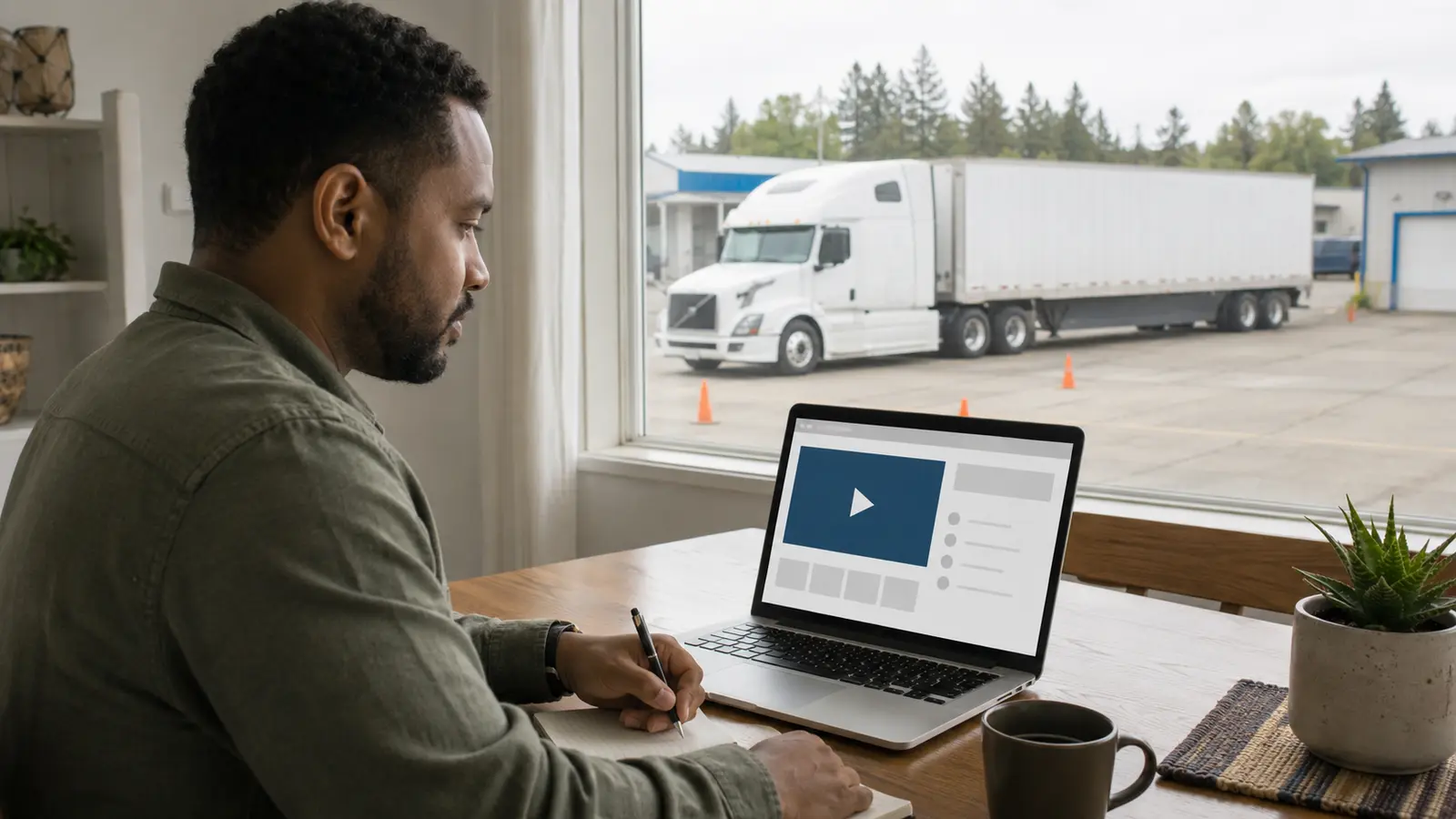
Yes, you can complete the theory portion of Entry-Level Driver Training online when the course is provided by a training provider listed on the Federal Motor Carrier Safety Administration's Training Provider Registry. But a first-time Class A or Class B applicant cannot complete the entire federal ELDT process from a laptop. The required behind-the-wheel portions must be taught in person in a representative commercial motor vehicle.
That distinction matters when comparing course prices and planning a CDL timeline. An online Class A or Class B theory course builds the required knowledge foundation, while range and public-road instruction develop the vehicle-control skills needed before the CDL skills test. Understanding what each part accomplishes helps you avoid buying the wrong course or arriving at the licensing agency with an incomplete training record.
What online ELDT theory can cover
FMCSA permits theory instruction to be delivered online. A registered provider offering online training must ensure that the content is prepared or delivered by a qualified theory instructor. The curriculum must cover the federal topics applicable to the credential, and the student must achieve an overall score of at least 80 percent on the written or electronic theory assessment.
For Class A and Class B applicants, theory topics include vehicle systems, inspections, basic operation, safe operating procedures, speed and space management, hazard perception, Hours of Service, fatigue, railroad crossings, maintenance, cargo responsibilities, distracted driving, and post-crash procedures. A well-designed online course lets you review difficult topics, study around work or family commitments, and complete the knowledge portion before beginning intensive vehicle practice.
Federal ELDT rules do not impose one universal number of theory hours. Completion is based on covering the required curriculum and passing the provider's assessment. A fast completion time does not make a course better; the useful measure is whether you can explain the material and apply it during training, inspections, trip planning, and the skills test.
What cannot be completed online
Class A and Class B ELDT also require behind-the-wheel training on a range and on a public road. This instruction cannot be replaced by videos, virtual reality, a driving simulator, or an online meeting. FMCSA specifically states that simulators may support theory training but cannot substitute for mandatory behind-the-wheel instruction or be used to demonstrate proficiency in the BTW curriculum.
The training must use a vehicle representative of the CDL class being sought. On the range, the instructor evaluates tasks such as vehicle inspection, basic controls, backing, coupling and uncoupling when applicable, and other required maneuvers. On public roads, the trainee must demonstrate safe operation in traffic, including turns, lane positioning, communication, speed and space management, railroad crossings, hazard response, and appropriate control of the vehicle.
There is no federal minimum number of BTW hours. Instead, a qualified instructor must determine that the trainee is proficient in every required element. A state or training program may impose additional hours or requirements, so applicants should verify the rules where the training is provided and where the CDL will be issued.
Which credentials require theory and behind-the-wheel training?
First-time Class A and Class B applicants need both theory and BTW range and public-road training. A Class B holder upgrading to Class A also needs the applicable Class A upgrade curriculum, including theory and BTW. First-time passenger and school-bus endorsement applicants need the required endorsement theory and BTW instruction before the applicable skills test.
The Hazardous Materials endorsement is different. A first-time H endorsement applicant completes HazMat theory ELDT, but there is no separate federal HazMat behind-the-wheel curriculum. The applicant must complete theory before the state HazMat knowledge test and must also satisfy the Transportation Security Administration security threat assessment and any state requirements. This makes a registered online HazMat theory course a potentially complete ELDT training component for that endorsement, although it is not the entire endorsement process.
Can theory and BTW come from different schools?
Yes. FMCSA allows the theory and behind-the-wheel portions to be delivered by separate providers. Both providers must be listed on the Training Provider Registry and each submits its own driver-specific completion information. However, the range and public-road portions of BTW training must be provided by the same registered provider.
This arrangement can be practical. You might complete theory online with a national provider, then choose a local truck-driving school for range and road training. Before enrolling, confirm that the hands-on school accepts students who completed theory elsewhere, has the correct Class A or Class B equipment, can work with your schedule, and will report BTW completion promptly. Ask for the full price and clarify what is included: instruction, vehicle use, test scheduling, additional practice, and retest fees can be separate items.
When should you complete each part?
Federal rules do not require theory, range, and public-road training to occur in one fixed order. ELDT theory also does not have to be completed before obtaining a commercial learner's permit. In practice, however, most applicants benefit from learning the inspection, operating, and safety concepts before or alongside hands-on training.
Public-road practice requires a valid CLP and proper supervision. Before scheduling the CDL skills test, the licensing agency must be able to verify the applicable ELDT completion records. Build time into the plan for theory study, the CLP knowledge tests, the federal minimum CLP holding period, range practice, public-road instruction, and provider reporting. Your state may add longer waiting periods, appointment rules, or training-hour requirements.
Do not schedule the skills test based only on the date you expect to finish an online course. Class A and Class B applicants must also complete BTW training and reach proficiency. Coordinate the online provider, local school, and testing appointment so that all records are submitted before the state checks the Registry.
A checklist before buying an online ELDT course
First, confirm that ELDT applies to your licensing history and goal. It generally covers first-time Class A or Class B applicants, Class B drivers upgrading to Class A, and first-time applicants for passenger, school-bus, or HazMat endorsements. ELDT is not retroactive, and specific exceptions can apply.
Second, search the provider on FMCSA's Training Provider Registry and verify that it offers the exact curriculum you need. A generic CDL study course, permit practice test, or video library is not automatically an ELDT program. Confirm how the provider verifies identity, delivers assessments, provides support, reports completion, and corrects an error in a driver's legal name, date of birth, license number, or issuing state.
Third, use the same personal information shown on your driver license or CLP. Even small discrepancies can delay the state's verification. Save the receipt and completion confirmation, but remember that the official training record is the provider's electronic submission to FMCSA—not a printable certificate by itself.
Finally, plan the remaining steps before you click enroll. Identify the local BTW provider, expected vehicle, possible license restrictions, state testing process, medical and self-certification requirements, and total cost. Online theory is most valuable when it fits into a complete, realistic CDL plan.
Choose the course that matches your goal
If you are pursuing a first Class A CDL, select Class A theory and arrange registered Class A range and public-road training. For a first Class B CDL, complete the Class B curriculum and train in a representative heavy straight vehicle. If you are adding HazMat for the first time, select the HazMat theory course and confirm your state's testing and TSA steps.
Online ELDT can make the knowledge portion more accessible, but it should never be confused with learning to control a commercial vehicle. Treat theory as preparation for good decisions and BTW as supervised practice that turns those decisions into repeatable habits. When both are completed through registered providers and correctly reported, your state can verify the federal training requirement before the applicable CDL skills or endorsement knowledge test.